 DIXIE GENS
Clark Hollin Tucker · Family archive
The Eight Patriots
Eight ancestral lines of Clark’s family reach back to men associated with the American Revolution. Their surviving records tell different stories: militia duty, company command, public office, and the resources that sustained a war.
Seven lines come through Clark’s father, Olis Creed Tucker Jr. Caleb Moore’s line comes through his mother, Jinna Kaye Higgs Tucker. Each man is an admitted direct ancestor; the individual proof grades remain visible. Bowman's pension supplies explicit A parentage and an A/B family identity correlation. His Cowpens account comes from later family testimony.
Reading the family paths. Start with Clark at 00. Every following person is the parent of the person before. Eight parent-child steps make a sixth-great-grandfather; nine make a seventh-great-grandfather. Select a name to open that person’s existing archive profile.
The family record’s proof labels are retained: Family means accepted recent family information; A/B combines explicit records with correlated evidence; B is a conclusion built from records read together. Qualified and probable connections stay qualified. The Patriot badge is separate from those relationship assessments.
01 / North Carolina militia service
Joseph McCommon / McCammon
American PatriotClark’s sixth-great-grandfather
Through Clark’s father and his grandmother Ola Inez Jacobs
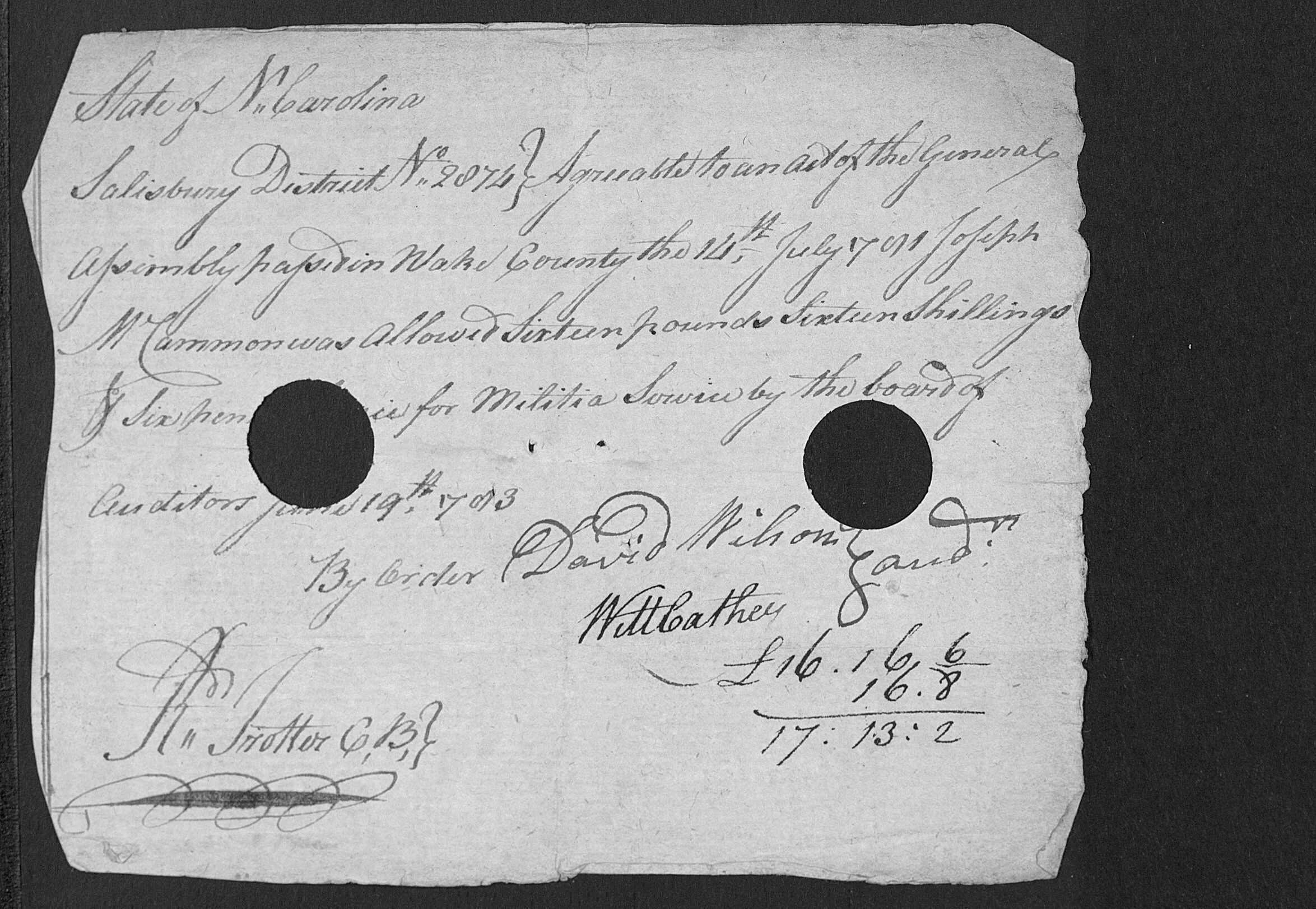
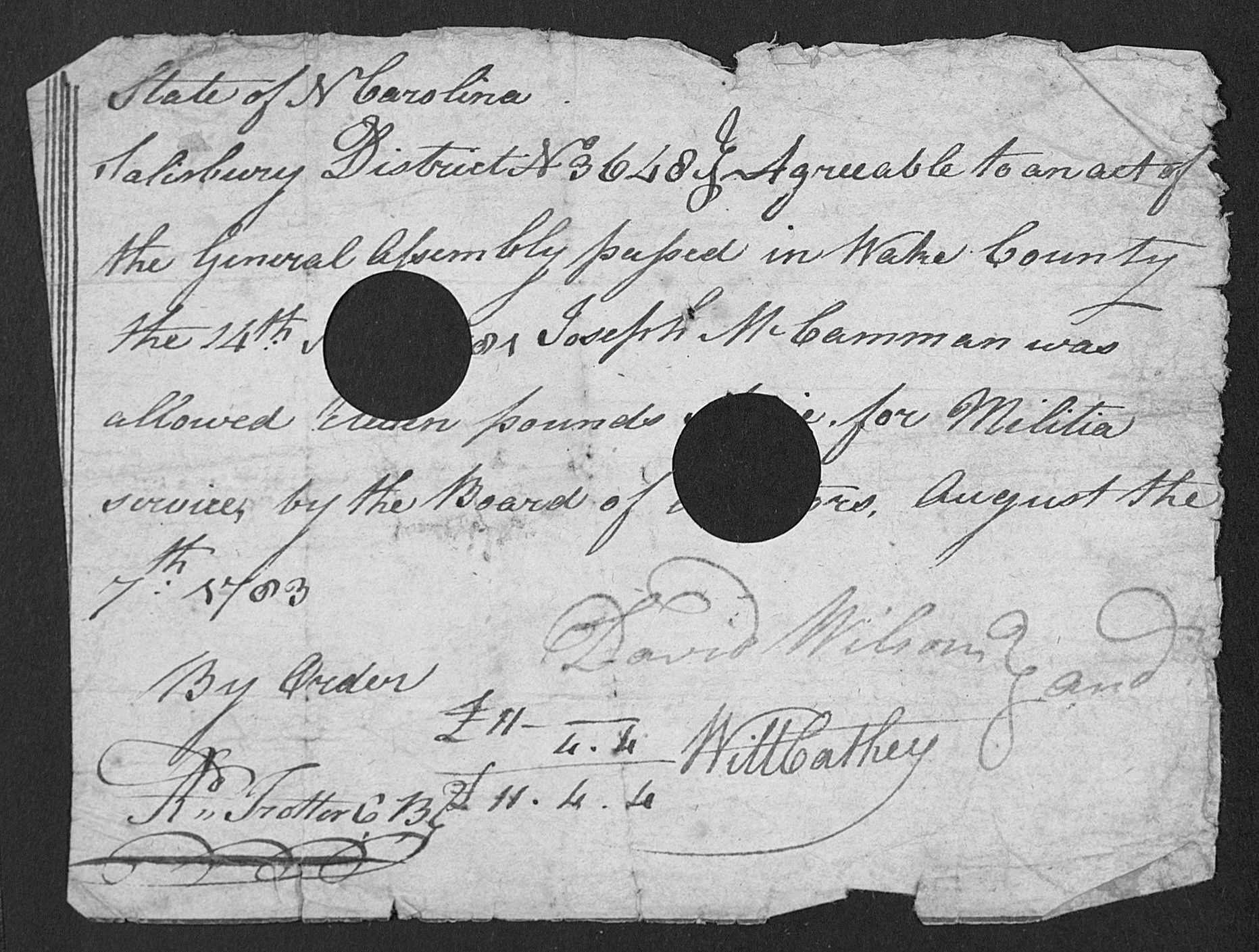
Joseph’s war survives in two pieces of paper that promised payment. Both Salisbury District certificates explicitly say the money was allowed for militia service. That is solid evidence for the kind of contribution he made, even though the documents do not tell us his company, rank, or the length of his duty. [J1–J2]
The certificates were audited in 1783, after the fighting that created the debt. One is dated 7 August. The other has a damaged month: the handwriting is uncertain, while a later account abstract reads 19 July. Both refer to an act passed on 14 July 1781. That date belongs to the law authorizing payment; it is not Joseph’s enlistment date.
Militia service meant helping with a state’s military needs. These vouchers preserve Joseph’s part in that system, but they cannot place him at Kings Mountain, Cowpens, or any other battle. Two certificates also do not prove two separate tours. The useful next record would name the company or describe the work behind the allowance.
After the war, family records make his life easier to follow. A 1791 marriage bond links Joseph with Dorcas Holmes. His father Charles McCommon’s 1799 will names Joseph, and an 1828 division of Joseph’s land helps connect the next generation. His surname appears as McCommon, McCammon, and M’Cammon; the family relationships matter more than a single spelling. [J3]
The surviving records
From Clark to Joseph McCommon
8 parent-child steps · no generations omitted
- Clark Hollin TuckerClark · the starting point
- Olis Creed Tucker Jr.Clark’s fatherParent of Clark Hollin TuckerFamily · accepted recent family information
- Ola Inez JacobsClark’s grandmotherParent of Olis Creed Tucker Jr.Family · accepted recent family information
- Eunice Pearl McCammon (McCommon)Clark’s great-grandmotherParent of Ola Inez JacobsA/B · explicit records and correlated evidence
- Robert Franklin McCommonClark’s 2×-great-grandfatherParent of Eunice Pearl McCammon (McCommon)A · explicit evidence for the stated link
- John Newton McCommonClark’s 3×-great-grandfatherParent of Robert Franklin McCommonA/B · explicit records and correlated evidence
- George Newton "Newt" McCommon Jr.Clark’s 4×-great-grandfatherParent of John Newton McCommonA · explicit evidence for the stated link
- George W. McCommon Sr.Clark’s 5×-great-grandfatherParent of George Newton "Newt" McCommon Jr.A/B · strong correlated paternal proof; qualifications retained
- Joseph McCommon/McCammonClark’s 6×-great-grandfatherParent of George W. McCommon Sr.A/B · explicit records and correlated evidence
The step from George Newton “Newt” McCommon Jr. to George W. McCommon Sr. is qualified A/B, strong correlated paternal proof, following the 14 October 2026 B077 review of the household, estate, widow, and guardian evidence. The 1850 birthplace conflict remains, and no explicit Newt-son clause is claimed. Rebecca’s separate B078 maternity assessment remains B. Robert Franklin belongs between Eunice Pearl and John Newton; his death certificate names John Newton as his father.
02 / Pennsylvania militia officer
Captain Samuel Young
American PatriotClark’s seventh-great-grandfather
Through Clark’s father, grandfather Olis Creed Tucker Sr., and the Hollingshead family
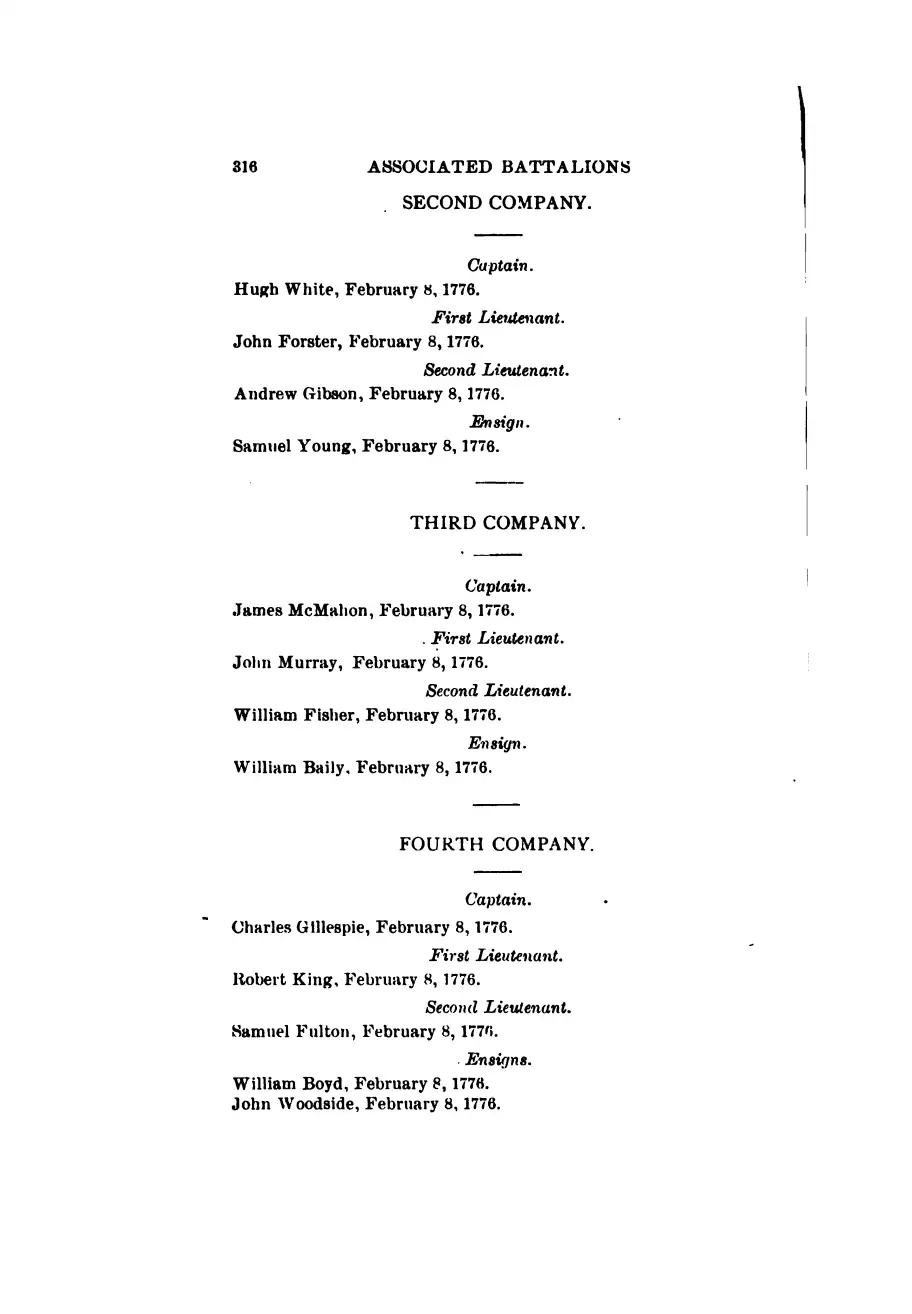
Samuel’s title of captain is supported by official militia returns. On 8 February 1776, he appears as an ensign in Hugh White’s Second Company, First Battalion of the Northumberland Associators. An ensign was a junior officer. A return dated 1 May 1778 names him captain of the Fifth Company in Colonel John Kelly’s First Battalion, with fifty-one officers and men. [Y1]
These entries show him moving from a junior officer’s place to command of a company. They do not give the date of his promotion or prove continuous active duty between the two returns. A company return lists an organization; it does not necessarily show every man assembled at a fort on that day.
There is a promising glimpse of the work such a company performed. In an 1835 pension declaration, a different, younger Samuel Young recalled serving under Captain Samuel Young at Lee’s Fort for three months beginning in May 1778. He described guard duty and no fighting. The date, place, and captain’s name fit, but he named Colonel Dougherty rather than Kelly. This is probable company context, not a proved personal posting or battle for Clark’s ancestor. The younger man’s later campaigns belong to the younger man. [Y2]
Civil records help follow the captain’s family after the war. Samuel and Martha sold a 309-acre Pennsylvania tract in 1780. Martha’s 1786 dower release concerns that same land and places Samuel in Rutherford County, North Carolina. Those shared details connect the household across the state line. They do not establish Martha as the mother of his son James. [Y3]
The surviving records
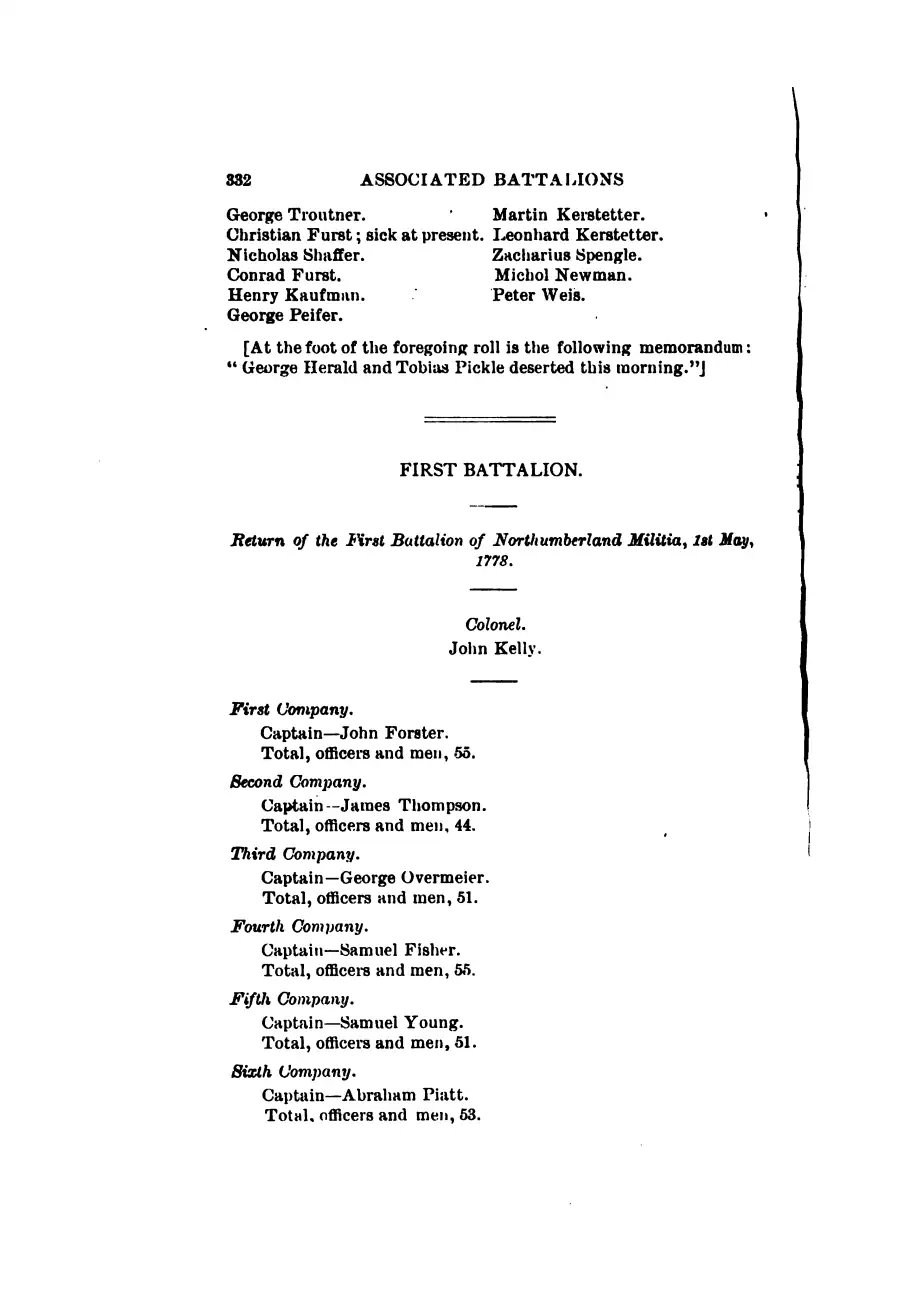
From Clark to Samuel Young
9 parent-child steps · no generations omitted
- Clark Hollin TuckerClark · the starting point
- Olis Creed Tucker Jr.Clark’s fatherParent of Clark Hollin TuckerFamily · accepted recent family information
- Olis Creed Tucker Sr.Clark’s grandfatherParent of Olis Creed Tucker Jr.Family · accepted recent family information
- Grace HollingsheadClark’s great-grandmotherParent of Olis Creed Tucker Sr.A/B · explicit records and correlated evidence
- Samuel HollingsheadClark’s 2×-great-grandfatherParent of Grace HollingsheadA/B · explicit records and correlated evidence
- James Whitten HollingsheadClark’s 3×-great-grandfatherParent of Samuel HollingsheadA/B · explicit records and correlated evidence
- Louisa Young HollingsheadClark’s 4×-great-grandmotherParent of James Whitten HollingsheadA/B · explicit records and correlated evidence
- James Young Jr.Clark’s 5×-great-grandfatherParent of Louisa Young HollingsheadB · correlated proof; qualifications retained
- James Young Sr.Clark’s 6×-great-grandfatherParent of James Young Jr.B · correlated proof; qualifications retained
- Captain Samuel YoungClark’s 7×-great-grandfatherParent of James Young Sr.A/B · explicit records and correlated evidence
Two steps remain B, correlated proof: Louisa Young Hollingshead to James Young Jr., and James Young Jr. to James Young Sr. Louisa’s connection draws on household, aunt, marriage, migration, and land evidence. The 1814 Grog Creek deed contains a corrected or interlined kinship word that remains qualified. Israel Hollingshead was Louisa’s spouse, not an extra generation in this path.
03 / Civil service in North Carolina’s revolutionary government
Thomas Rice
American PatriotClark’s sixth-great-grandfather
Through Clark’s father and the Jacobs, Scott, and Rice families
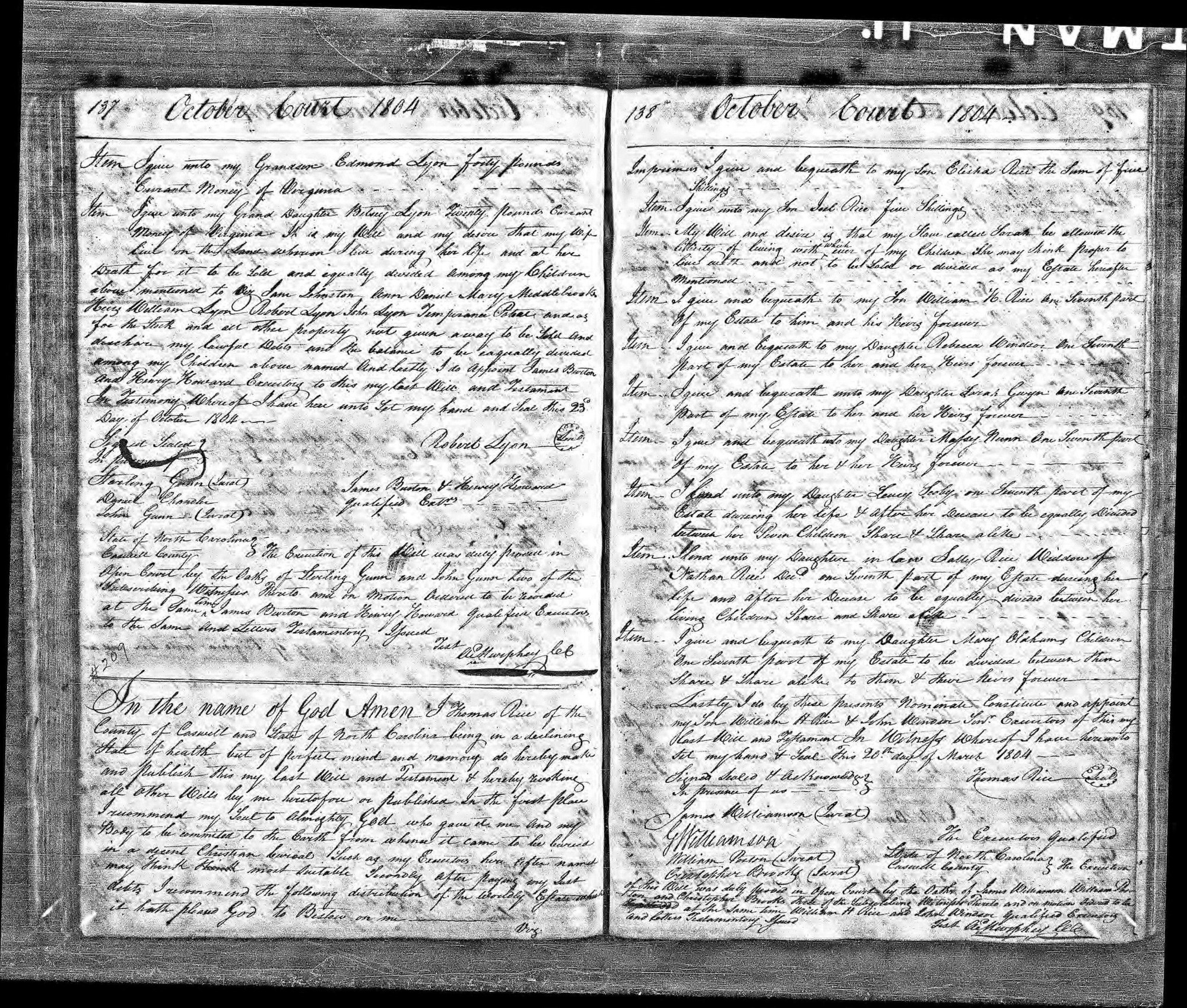
DAR recognizes Thomas Rice’s civil service as a justice of the peace in Orange County, North Carolina, under ancestor record A095156. Clark’s family reaches Thomas through his son Joel Rice. Thomas’s will names Joel directly, giving this branch a clear parent-and-child statement, and the family record places Thomas’s death by 1804. [R1–R2]
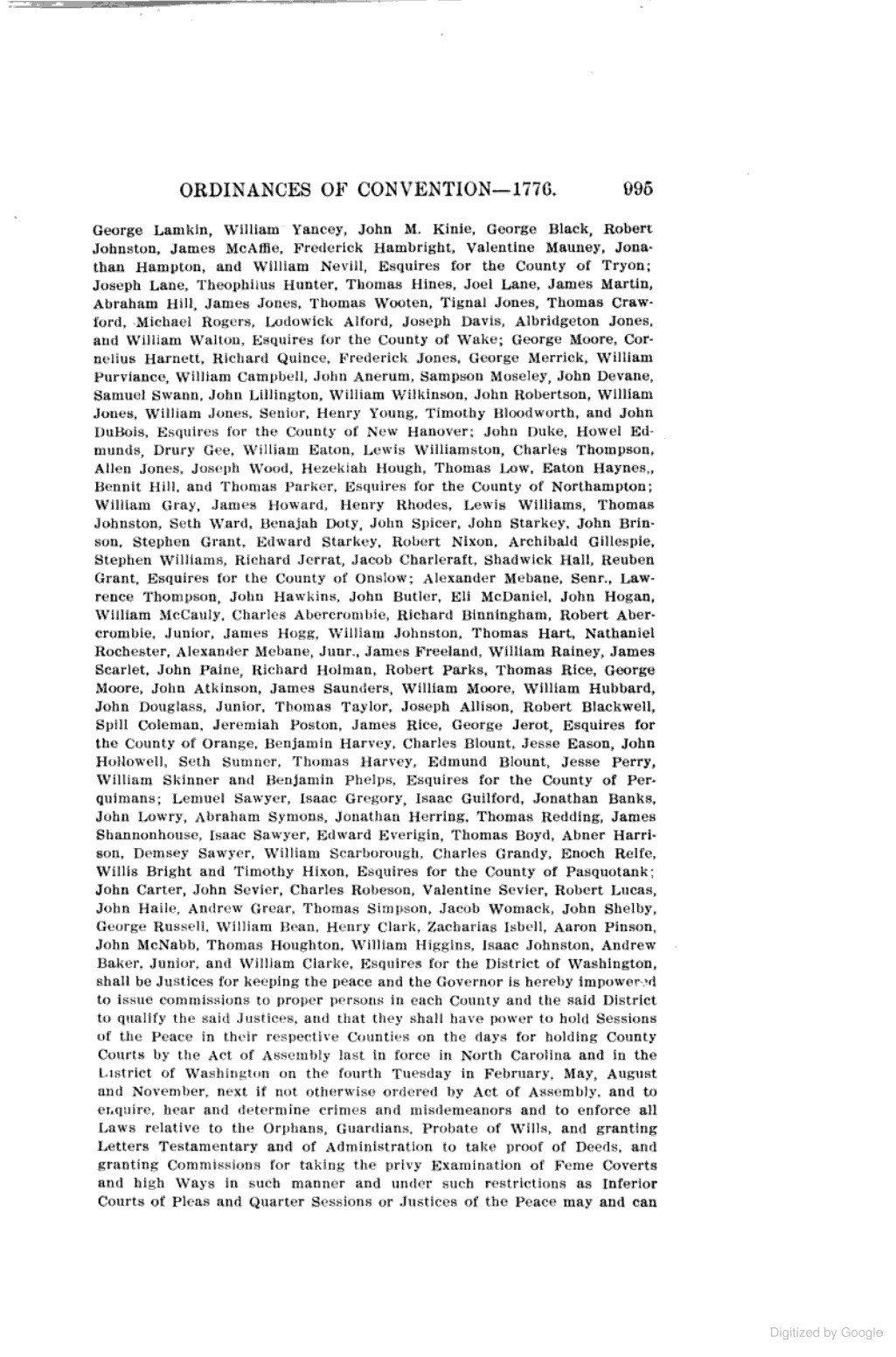
Independence required functioning local government as well as armies. Justices handled the county’s legal business: deeds, estates, guardianships, roads, and matters of public peace. An ordinance passed on 22 December 1776 names Thomas Rice among Orange County’s justices. The opening Caswell County court minutes of 10 June 1777 also name a Thomas Rice among the justices who appeared and took the required oaths. These records show the work of establishing local government during the Revolution. [R2–R3]
His place in this story is public service. Keeping courts and county administration operating helped the new government function while the war continued. The surviving will carries the story into the next generation: Joel is named as Thomas’s son, and Joel’s own will names Agathy Scott, continuing the path toward Clark. [R1, R4]
The surviving records
From Clark to Thomas Rice
8 parent-child steps · no generations omitted
- Clark Hollin TuckerClark · the starting point
- Olis Creed Tucker Jr.Clark’s fatherParent of Clark Hollin TuckerFamily · accepted recent family information
- Ola Inez JacobsClark’s grandmotherParent of Olis Creed Tucker Jr.Family · accepted recent family information
- William Wesley JacobsClark’s great-grandfatherParent of Ola Inez JacobsA/B · explicit records and correlated evidence
- Tulliola “Tulla” ScottClark’s 2×-great-grandmotherParent of William Wesley JacobsA/B · explicit records and correlated evidence
- Alexander Erskine ScottClark’s 3×-great-grandfatherParent of Tulliola “Tulla” ScottA/B · explicit records and correlated evidence
- Agatha P. Rice (Scott)Clark’s 4×-great-grandmotherParent of Alexander Erskine ScottA/B · explicit records and correlated evidence
- Joel Rice of Madison County, AlabamaClark’s 5×-great-grandfatherParent of Agatha P. Rice (Scott)A/B · explicit records and correlated evidence
- Thomas RiceClark’s 6×-great-grandfatherParent of Joel Rice of Madison County, AlabamaA/B · explicit records and correlated evidence
Every historical step in this path retains the family record’s A/B assessment. Joel’s will names Agathy Scott; Thomas’s will names his son Joel.
04 / North Carolina patriotic service in the public accounts
Caleb Moore
American PatriotClark’s sixth-great-grandfather
Through Clark’s mother, Jinna Kaye Higgs Tucker, and the Zorn, Long, Smart, and Moore families
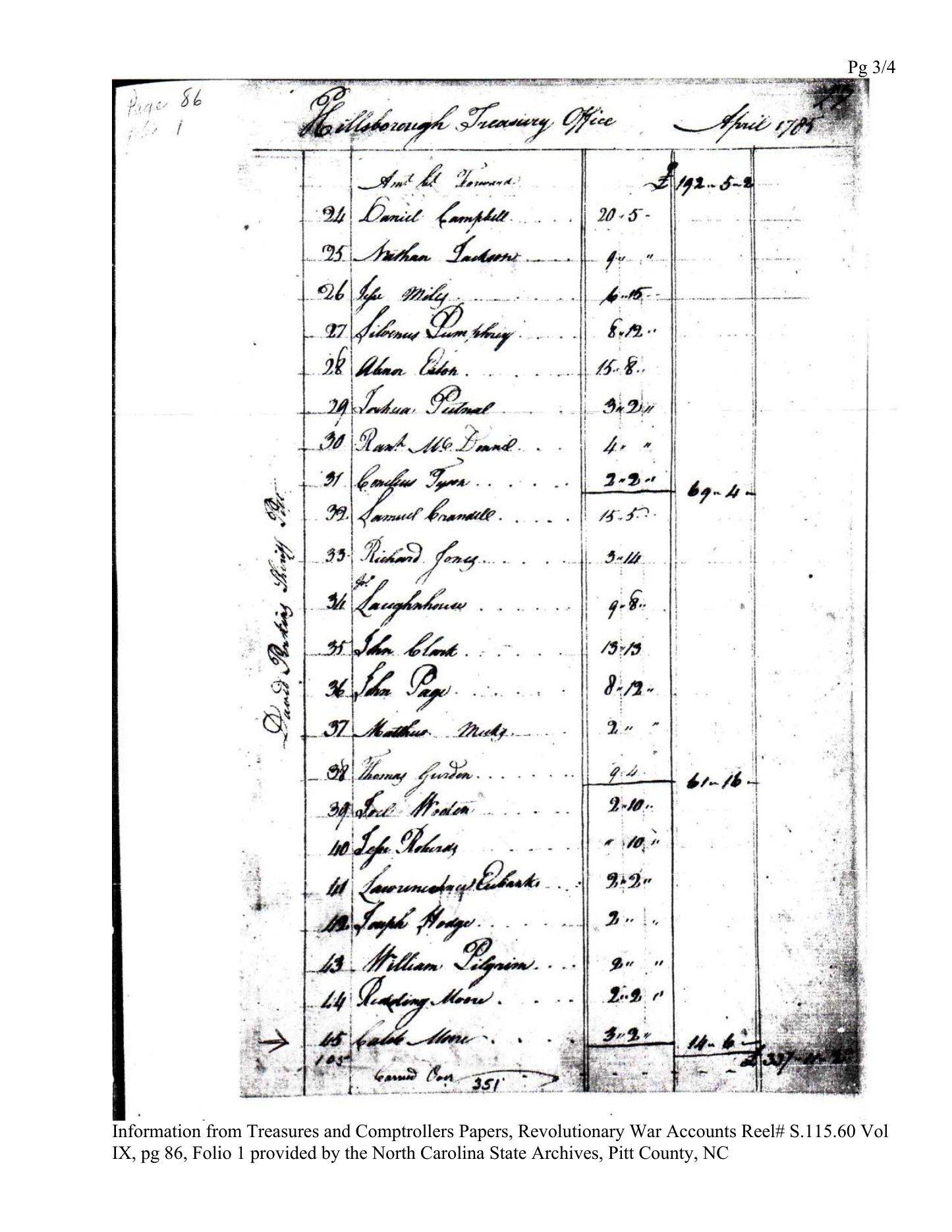
Caleb’s Revolutionary record is a name in the treasury’s books. The April 1785 Hillsborough Treasury Office account lists Caleb Moore at entry 45, in a group associated with David Porter, sheriff of Pitt County. The amount is read as £3 2s. 0d. The entry records a financial obligation; it does not identify the goods or work that first created it. [C1]
The war required resources as well as soldiers. States recognized debts through certificates and later processed them through public accounts. That helps explain why a postwar ledger can preserve Revolutionary support. It does not show that Caleb personally stood in Hillsborough in 1785 or identify a particular army, delivery, or campaign.
DAR ancestor A079289 recognizes Caleb’s North Carolina patriotic service as payment for services rendered. A later family sketch calls him a private, but an individual muster or pay record establishing a military rank has not been recovered. His contribution is described here as patriotic service, without assigning a rank, battle, or a specific commodity. [C2]
After the war, land and estate records link Caleb’s North Carolina family with Georgia. A 1798 Pitt County deed concerns land on Bayard Branch. Later instruments connect his widow and heirs to North Carolina property, and a Wayne County, Georgia, instrument names William Moore among Caleb’s heirs. That William is Clark’s direct-line ancestor. This is a separate Moore branch from the one through Paris Palestine Moore. [C3]
The surviving records
From Clark to Caleb Moore
8 parent-child steps · no generations omitted
- Clark Hollin TuckerClark · the starting point
- Jinna Kaye Higgs TuckerClark’s motherParent of Clark Hollin TuckerFamily · accepted recent family information
- Hulda Dean ZornClark’s grandmotherParent of Jinna Kaye Higgs TuckerFamily · accepted recent family information
- Robert Troy ZornClark’s great-grandfatherParent of Hulda Dean ZornA/B · explicit records and correlated evidence
- Sarah U. / Sula LongClark’s 2×-great-grandmotherParent of Robert Troy ZornA/B · explicit records and correlated evidence
- Loanza SmartClark’s 3×-great-grandmotherParent of Sarah U. / Sula LongA/B · explicit records and correlated evidence
- Laurania / Lourania / Lorana Moore SmartClark’s 4×-great-grandmotherParent of Loanza SmartB · correlated proof; qualifications retained
- William Moore of Tattnall CountyClark’s 5×-great-grandfatherParent of Laurania / Lourania / Lorana Moore SmartB · correlated proof; qualifications retained
- Caleb MooreClark’s 6×-great-grandfatherParent of William Moore of Tattnall CountyB · correlated proof; qualifications retained
Three connections remain B, correlated proof: Loanza Smart to Laurania Moore Smart; Laurania to William Moore; and William to Caleb Moore. The first uses the Smart family’s identity evidence, the second estate, census, and probate records, and the third named-heir records and identity continuity. None is silently upgraded by the Patriot badge.
05 / North Carolina wartime supply and public claims
Elder Richard Bass
American PatriotClark’s seventh-great-grandfather
Through Clark’s father and the Jacobs and Bass families
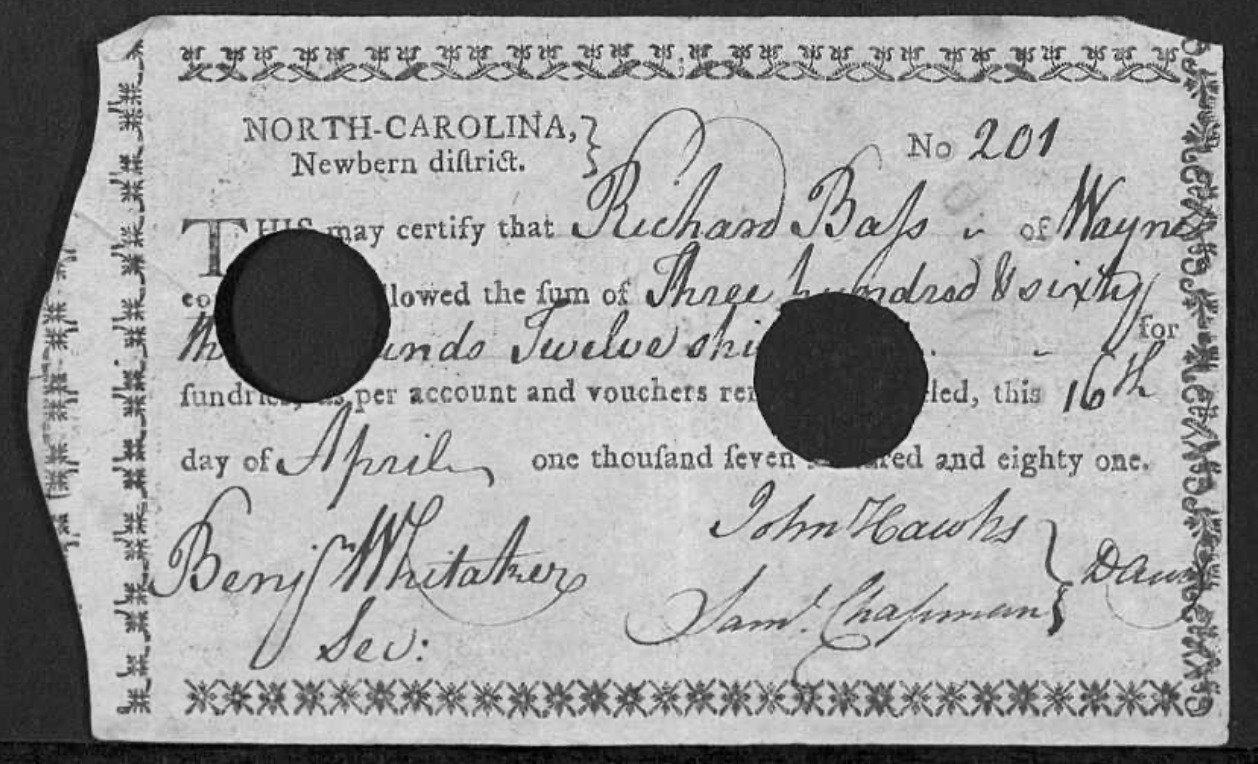
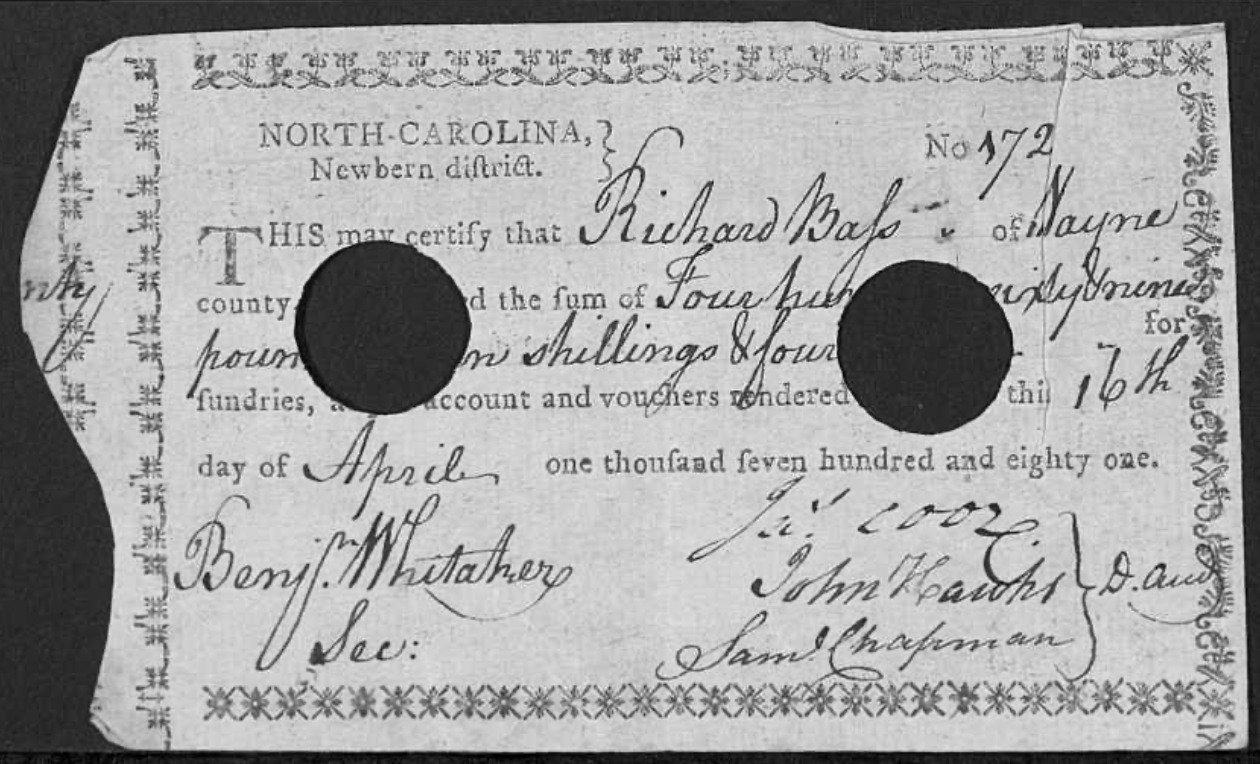
Bass’s vouchers document patriotic support in North Carolina’s wartime public accounts. Two Wayne County claims, audited in New Bern District on 16 April 1781, allow payment for “sundries” supported by an account and vouchers. Those claims preserve his part in the material support behind the war. The word “sundries” covers assorted items; the certificates do not itemize them. [B1]
The cancellation holes obscure parts of the amounts. They remain visible in the reproductions because missing digits should not be replaced by guesses. The audit date tells us when the claims were recognized, not exactly when the underlying support was provided. New Bern was the accounting district; its name does not place Richard at a military camp.
The family’s retained military attribution also points to a roster entry for Private Richard Bass under Captain Thomas Donoho, dated 18 May 1781 for a three-year term. The entry records the stated term of service; it does not show that the full term was completed. Alongside the vouchers, it is part of the family’s account of Richard’s Revolutionary service. The evidence notes explain the personal-identification question attached to this same-name entry. [B2]
The family path includes three generations that must be kept distinct: Elder Richard, his son Edward, and Edward’s son Richard, who died about 1807. Earlier deeds and later probate records connect them. “Elder” distinguishes the generations here; it does not establish ordination or a church office. His 1792 estate record also lists enslaved people as property, a part of the family’s history preserved alongside the Patriot story. [B3]
The surviving records
From Clark to Richard Bass
9 parent-child steps · no generations omitted
- Clark Hollin TuckerClark · the starting point
- Olis Creed Tucker Jr.Clark’s fatherParent of Clark Hollin TuckerFamily · accepted recent family information
- Ola Inez JacobsClark’s grandmotherParent of Olis Creed Tucker Jr.Family · accepted recent family information
- William Wesley JacobsClark’s great-grandfatherParent of Ola Inez JacobsA/B · explicit records and correlated evidence
- Albert Walter JacobsClark’s 2×-great-grandfatherParent of William Wesley JacobsA/B · explicit records and correlated evidence
- Henry Madison JacobsClark’s 3×-great-grandfatherParent of Albert Walter JacobsA/B · explicit records and correlated evidence
- Sarah Bass (Jacobs)Clark’s 4×-great-grandmotherParent of Henry Madison JacobsA/B · explicit records and correlated evidence
- Richard Bass (died about 1807)Clark’s 5×-great-grandfatherParent of Sarah Bass (Jacobs)A/B · explicit records and correlated evidence
- Edward Bass (died about 1802)Clark’s 6×-great-grandfatherParent of Richard Bass (died about 1807)A/B · explicit records and correlated evidence
- Elder Richard BassClark’s 7×-great-grandfatherParent of Edward Bass (died about 1802)A/B · explicit records and correlated evidence
The historical steps retain A/B assessments. The younger Richard Bass, who died about 1807, is Elder Richard’s grandson. Sarah Bass carries the line into the Jacobs family. Her 11 August 1824 marriage bond belongs to Hardeman County, Tennessee; the bond date is not a separately proved ceremony date.
Reading the records together
This exhibit draws on The Five Patriots: An Archival Reconstruction, illustrated research edition dated 4 October 2026, alongside the family’s retained genealogy and its public family graph. “Research edition” page numbers refer to that 59-page study; “retained genealogy” and “retained family evidence” refer to the 348-page Patriot Source Review of 4 October 2026. Their pagination is different.
The images are reproductions of historical documents and official published transcriptions. They are not portraits. Open a full-size record to inspect the writing or print. Some repository viewers require an account or subscription; the reproduced records shown here remain directly readable.
The exact family paths and their existing proof labels are preserved. A service record, a family relationship, and a same-name identification are different questions. No named battle is established for the five earlier profiles. William Bowman’s Cowpens attendance is reported in later family testimony, rather than independently established by a contemporary battle or muster record. This exhibit does not represent DAR or SAR approval of Clark’s assembled descent. The original five-profile study retains its dated title; William was added to the current register on14 October2026.
06 / Continental and militia testimony
William Bowman
American Patriot #6Clark's sixth-great-grandfather · Grade A parentage
Reported 18-month Virginia Continental term from summer 1778; later militia service. Son Eli reports Cowpens under Morgan; regiment and company unspecified.
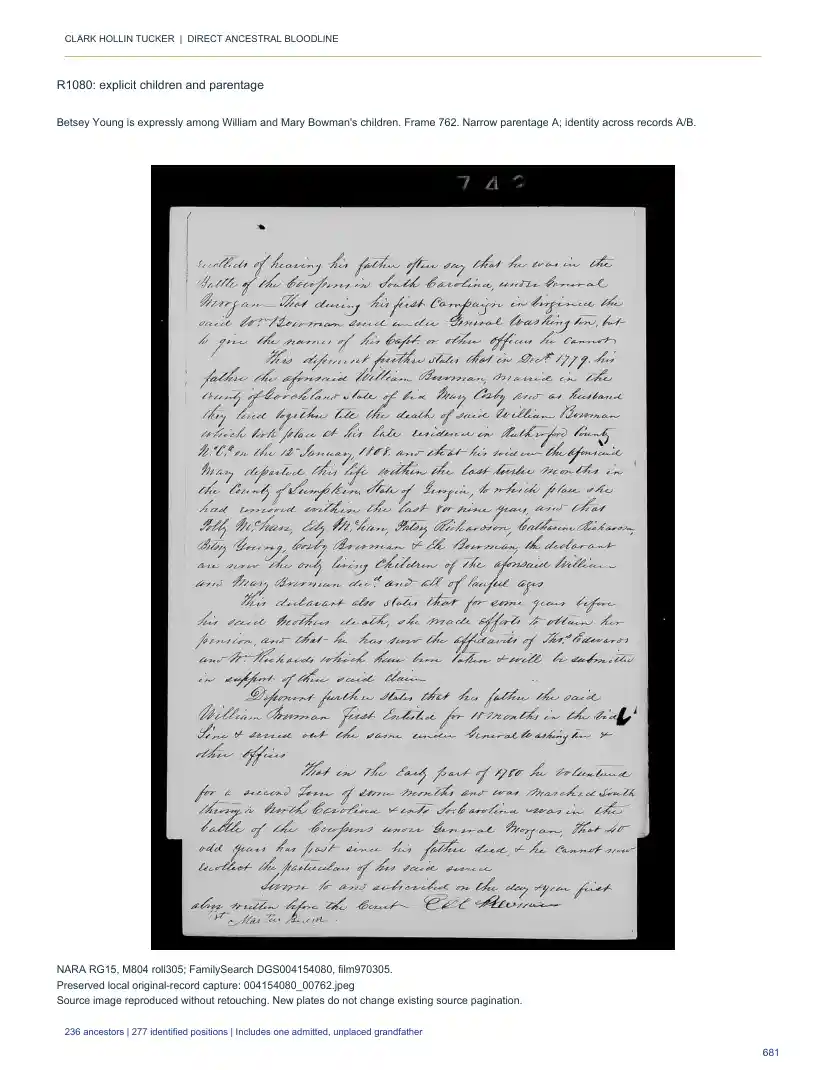
Original pension manuscript images 761-763 (master pp. 670-672), Eli Bowman's declaration of 31 May 1853, R1080, M804 roll 305, RG 15. Eli reports his father's Cowpens recollections under General Morgan; the exact regiment and company remain unspecified. The 1851 widow declaration is also available in the separately identified published transcription.
Mary describes the later term as militia. Eli reports what his father said about Cowpens under Morgan; he cannot name the captain or other officers. The exact unit and a wartime person-specific battle record remain unestablished.
Read the full published transcription · Read the ancestry proof and qualifications
From Clark to William Bowman
8 parent-child steps. Eli Bowman's sworn declaration explicitly names William and Mary as parents of Betsey Young. Matching Betsey with Elizabeth Bowman Young and correlating the family across records remains A/B. Elizabeth-to-Louisa remains B.
- William Bowman6x-great-grandfatherA · explicit parentage; identity correlation explained in the source notes
Verified pension citation
William/Mary Bowman, Revolutionary War pension application file R1080; declaration of Eli Bowman, 31 May 1853, Rutherford County, North Carolina; Revolutionary War Pension and Bounty-Land Warrant Application Files, National Archives microfilm publication M804, roll 305; Record Group 15, Records of the Veterans Administration; National Archives and Records Administration, Washington, D.C.; FamilySearch film 970305, DGS 004154080, images 761-763.
Original image 761 · Original image 762 · Original image 763 · All original exhibits and research limits
John Yates Sr.: the frontier tours
John Yates’s pension declaration gives his Revolutionary service a personal, unusually detailed record. In late May or early June 1776, he volunteered under Francis Hargrove and Lieutenant Lewis DeMoss. The company assembled at Holman’s Ford on the Yadkin, ranged between the river and the Blue Ridge, and built and guarded a frontier fort. Yates did not name that fort; his comrade Moses Waters’s pension account identifies their station as Lewis’ Fort. The identification is a correlation between the two accounts, not a name supplied by Yates himself.
Late that summer, Hargrove’s company joined General Griffith Rutherford at Pleasant Gardens and marched into Cherokee country. Yates described the destruction of the abandoned Cowee and Middle Towns, including corn, livestock and other property. He expressly placed himself among the troops sent onward to the Valley Towns. There the force captured Cherokee men, women, and children and destroyed the towns before turning back; the prisoners were handed over to South Carolina troops encountered on the return. Yates did not know what later happened to them. His testimony records a destructive campaign against Cherokee communities, not a conventional pitched battle that can be assumed for every man in the column.
He also remembered the physical cost: exposure and eating green corn and beef without salt. The expedition returned after six months of service, divided into three months before joining Rutherford and three afterward. In the following spring, Yates volunteered again under Benjamin Cleveland. The company served at Carter’s Fort on the Watauga and then at the Long Island of the Holston during treaty negotiations before returning by way of Carter’s Fort. He remembered reaching home shortly before harvest after another three months. The declaration does not support an exact June discharge date or a claim that he received a written discharge; he explicitly said he never received one.
In 1780 Yates volunteered in David Viars’s company and marched with Benjamin Cleveland’s forces in the Kings Mountain campaign. When the men with horses rode ahead to attack Ferguson, Yates had no horse and could not obtain one. His statement is unambiguous: he did not reach the battlefield before the engagement had been fought. He met the victorious troops returning with prisoners and helped guard them to Wilkes Court House, where fresh troops relieved the escort. Cleveland discharged him nearly without clothing and with his feet badly injured for want of shoes. This tour lasted two and a half months, bringing his pensioned service to 11½ months. Campaign service and prisoner escort deserve their own accurate description; they are not evidence that he fought in the 7 October battle.
The pension jacket also bears military-history notations naming Lyman Copeland Draper in 1881 and 1884. They document later historical interest in Yates’s service. They do not, by themselves, establish the precise present location of both outgoing abstracts or prove the dossier’s proposed connection to particular Draper manuscript volumes.
John and Jemima Yates: the original pension file
All 32 manuscript images are preserved in their original order. NARA Record Group 15; M804, roll 2657; W20142. Fold3 file 28520945, retrieved 3 November 2026.
Download the untouched pension packet · 32 scans plus source information
The download preserves the provider’s native images, 1600 pixels on their longest edge. These are suitable for close study and modest prints; no artificial detail has been added. The full declaration extends across several pages.
01. Pension file cover: John and Jemima Yates, W20142
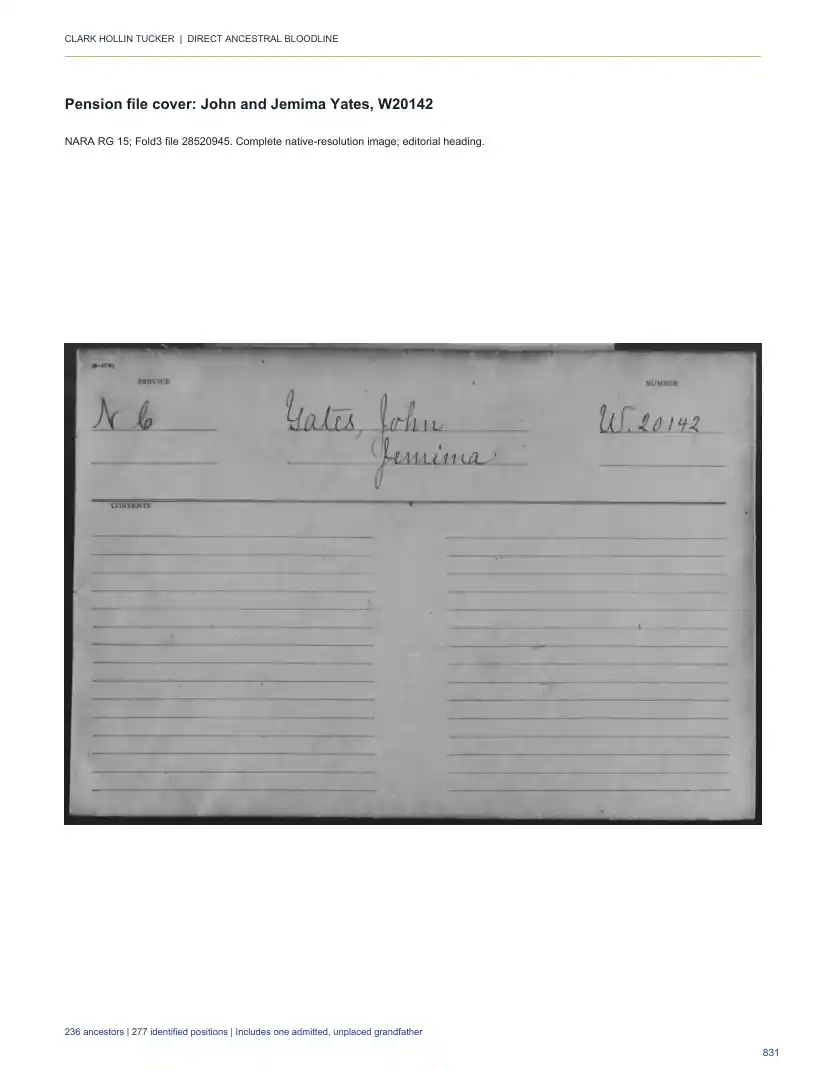
Packet image 1 of 32 · Master page 831
02. Widow pension enrollment
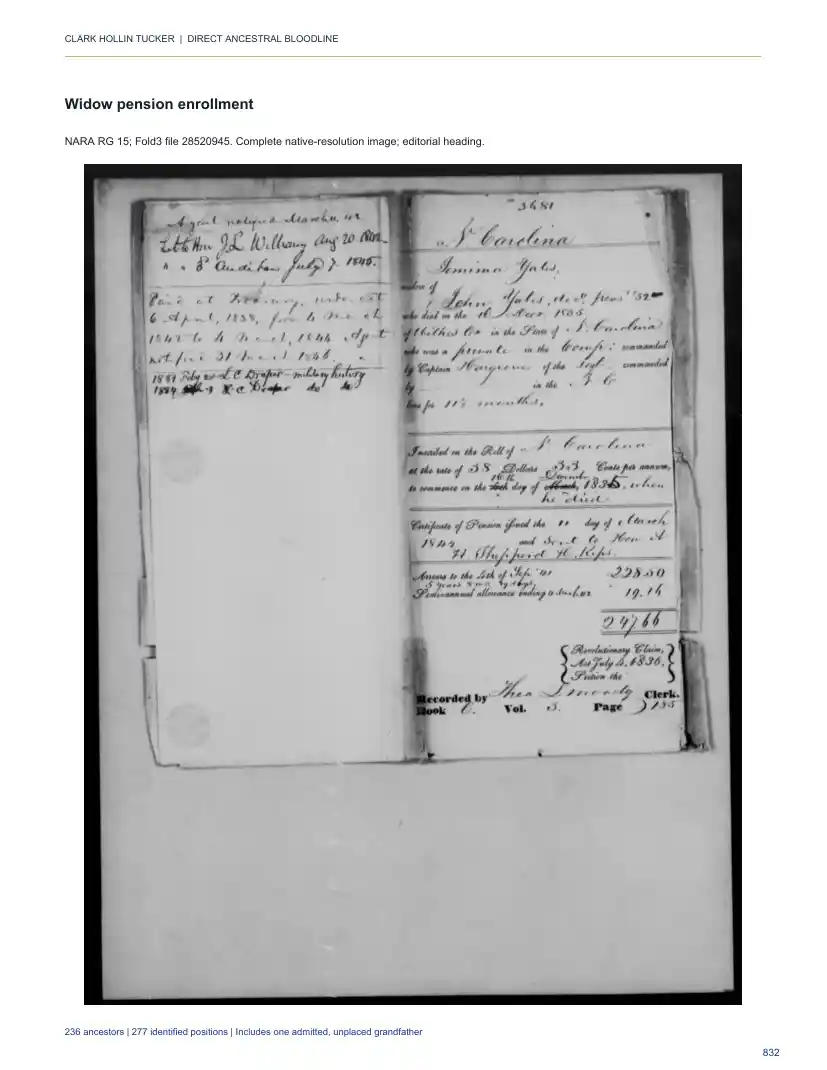
Packet image 2 of 32 · Master page 832
03. John Yates pension enrollment
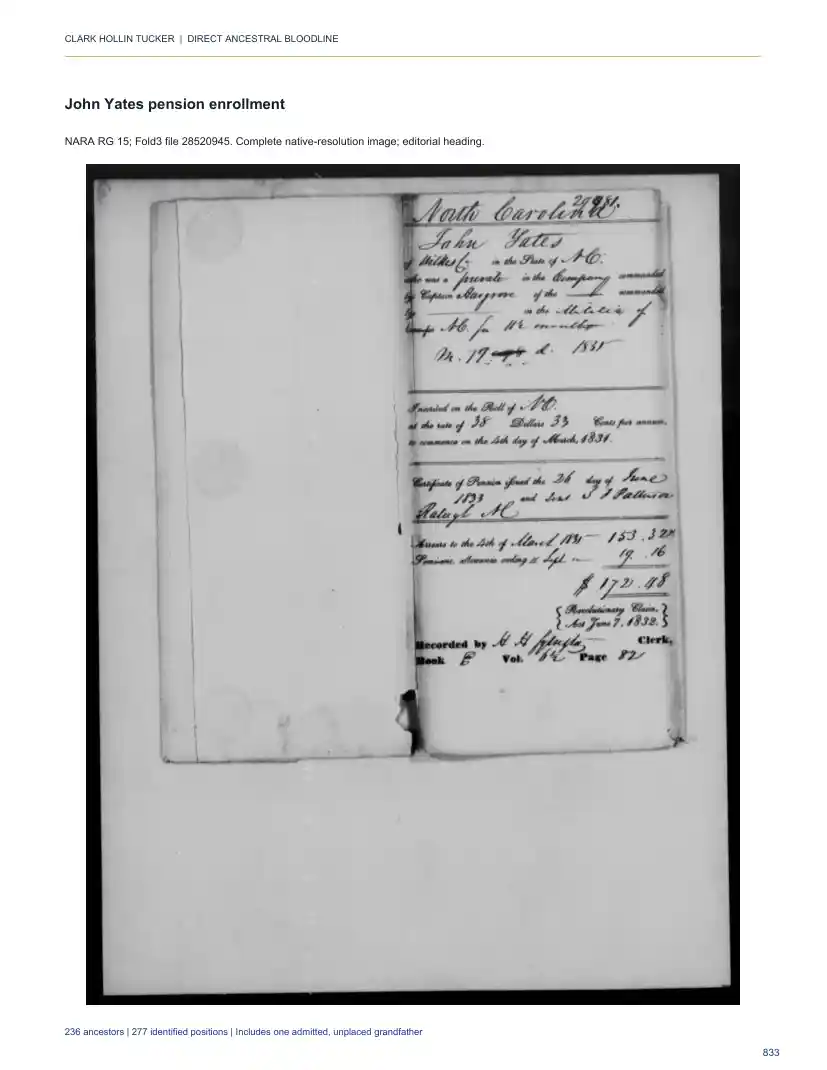
Packet image 3 of 32 · Master page 833
04. Declaration wrapper
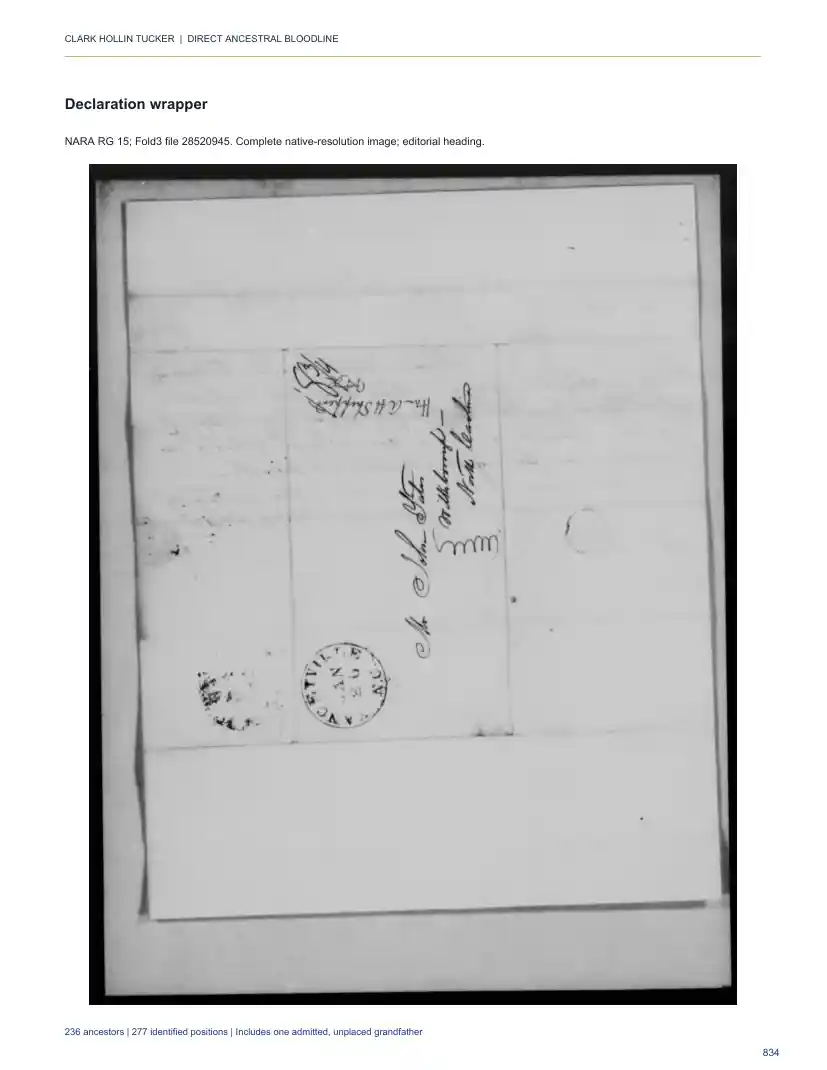
Packet image 4 of 32 · Master page 834
05. Marriage bond: John Yeats and Jemima Raper, 8 March 1779
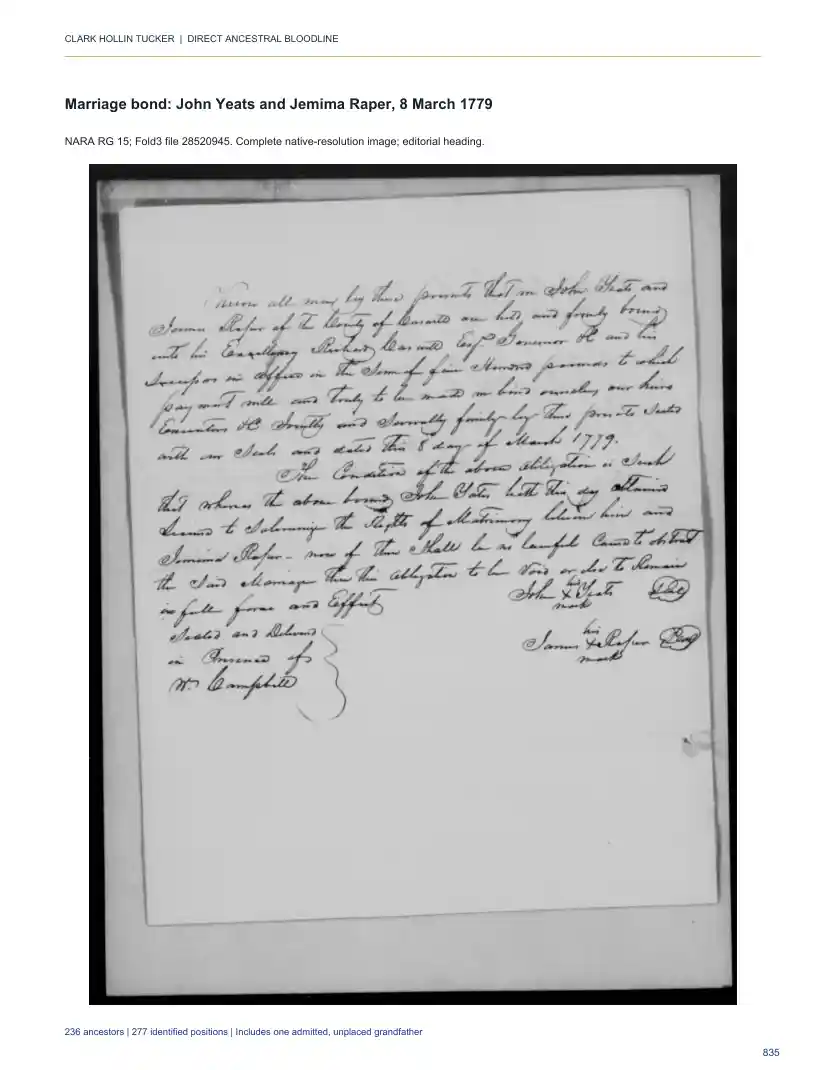
Packet image 5 of 32 · Master page 835
06. Clerk certification of marriage-bond copy, 24 January 1842
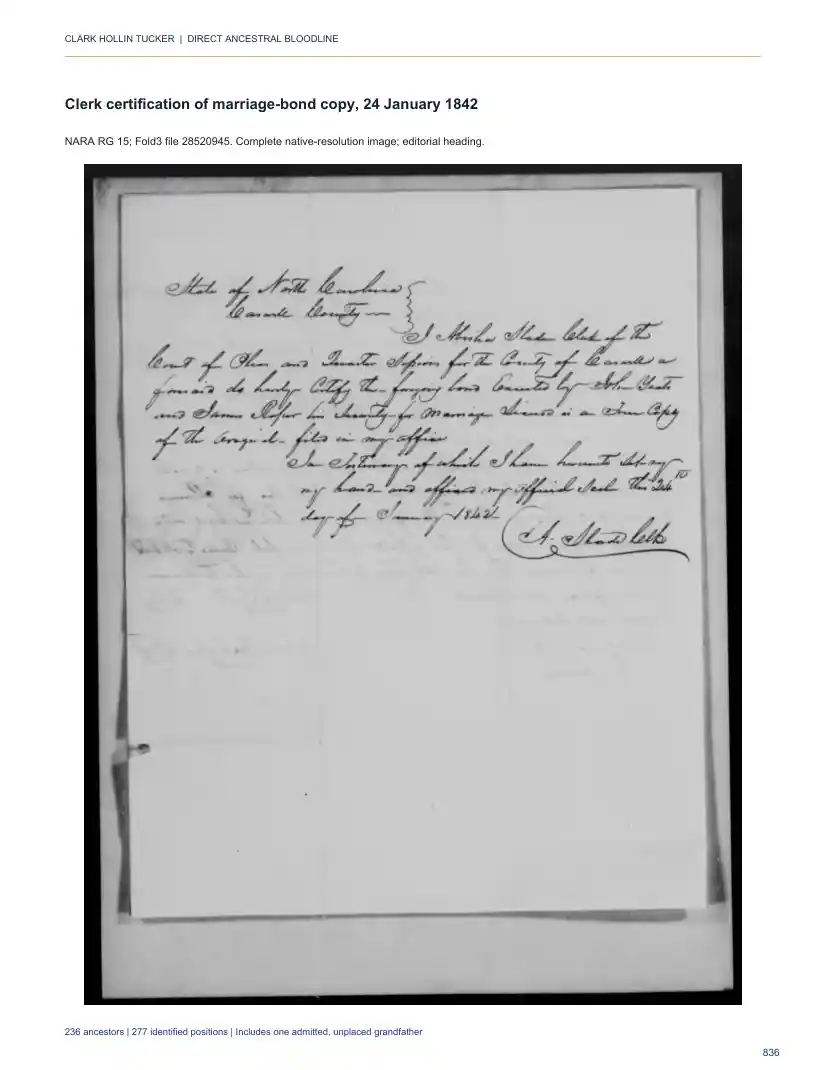
Packet image 6 of 32 · Master page 836
07. Marriage-record correspondence, January 1842
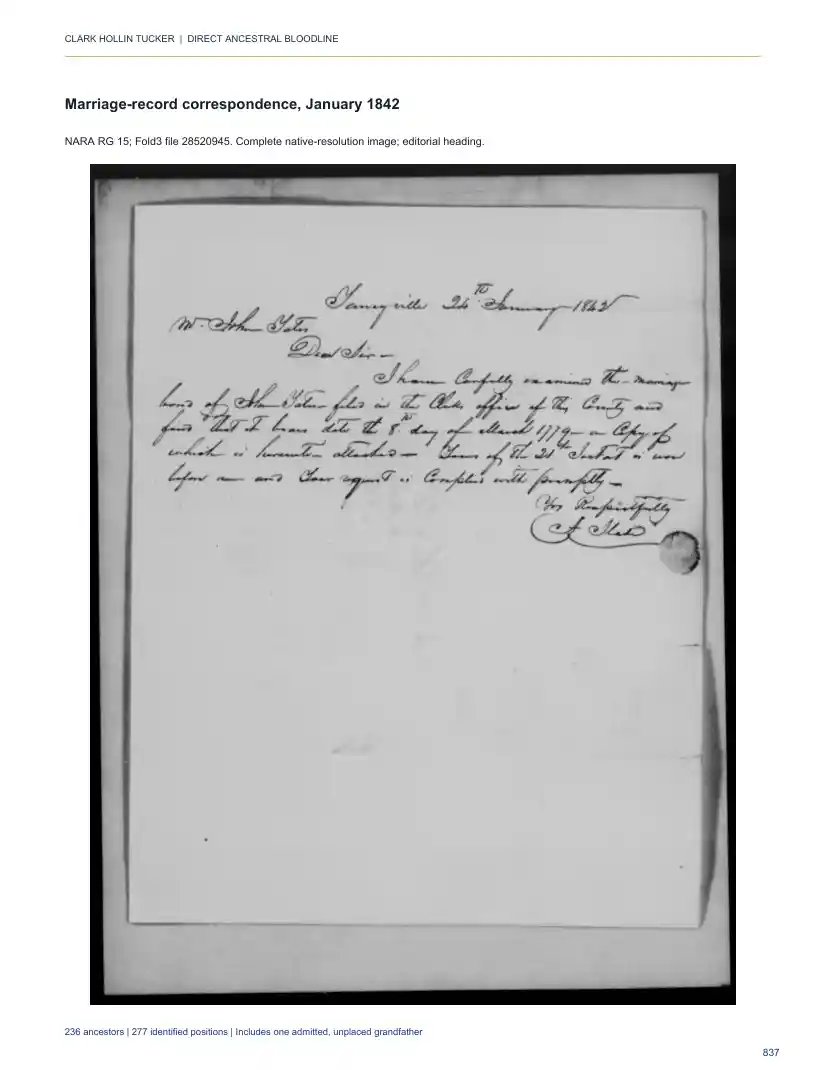
Packet image 7 of 32 · Master page 837
08. John Yates declaration, 4 November 1834: opening
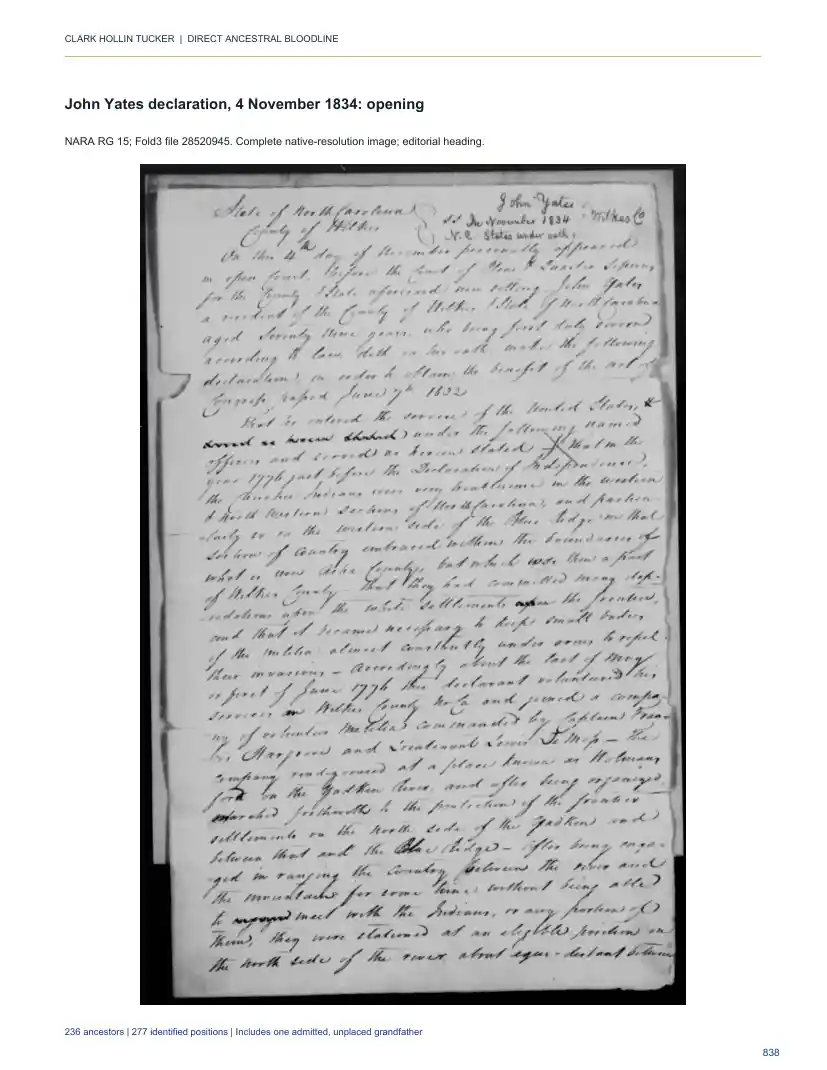
Packet image 8 of 32 · Master page 838
09. Declaration continued: first tour
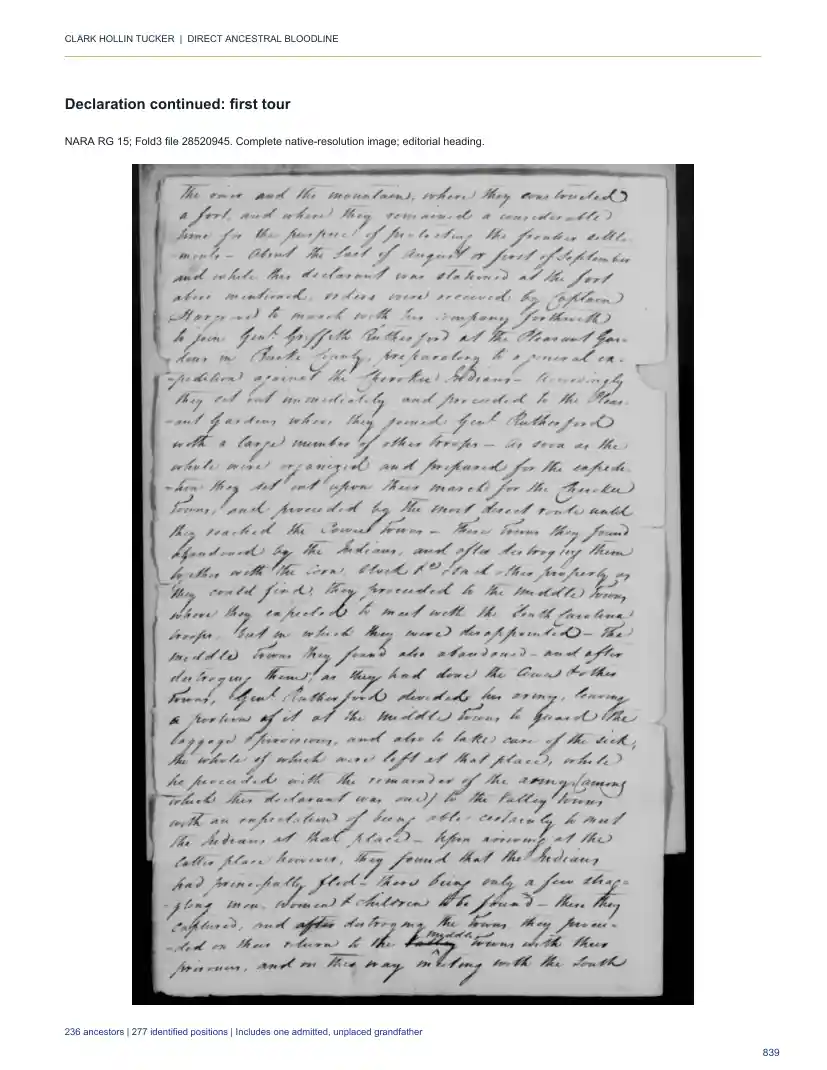
Packet image 9 of 32 · Master page 839
10. Declaration continued: Cleveland tour
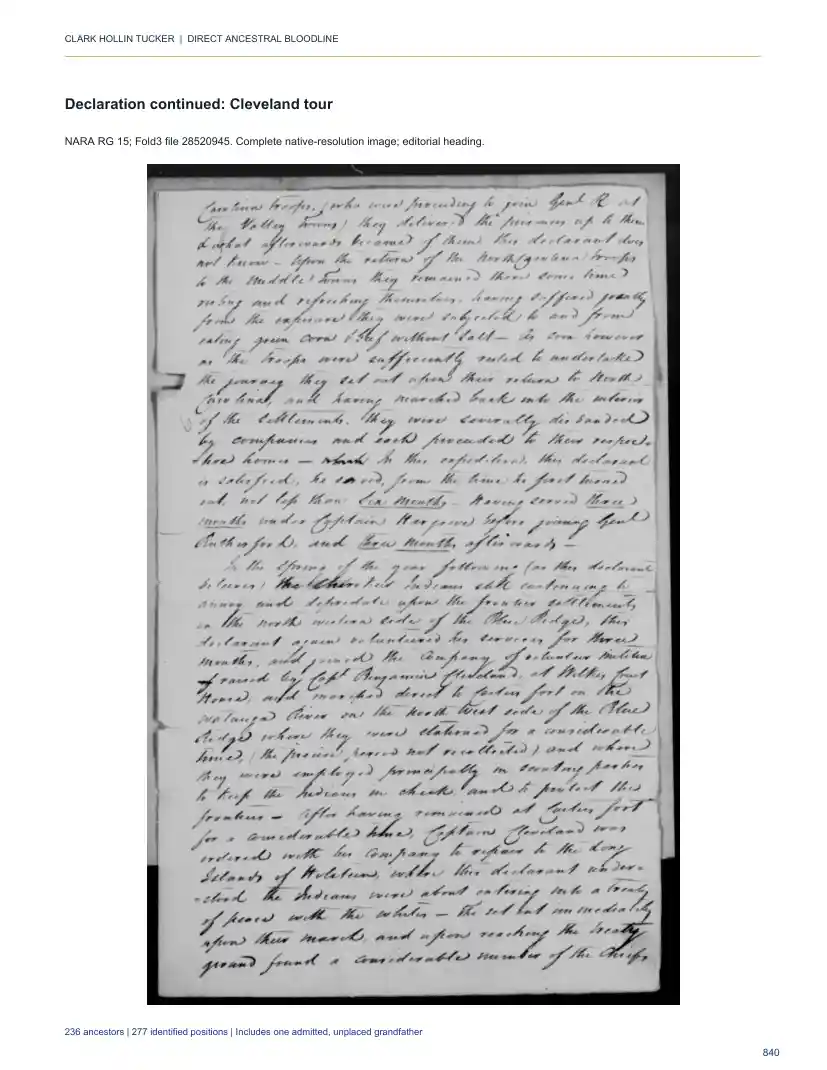
Packet image 10 of 32 · Master page 840
11. Declaration continued: 1780 campaign and missed battle
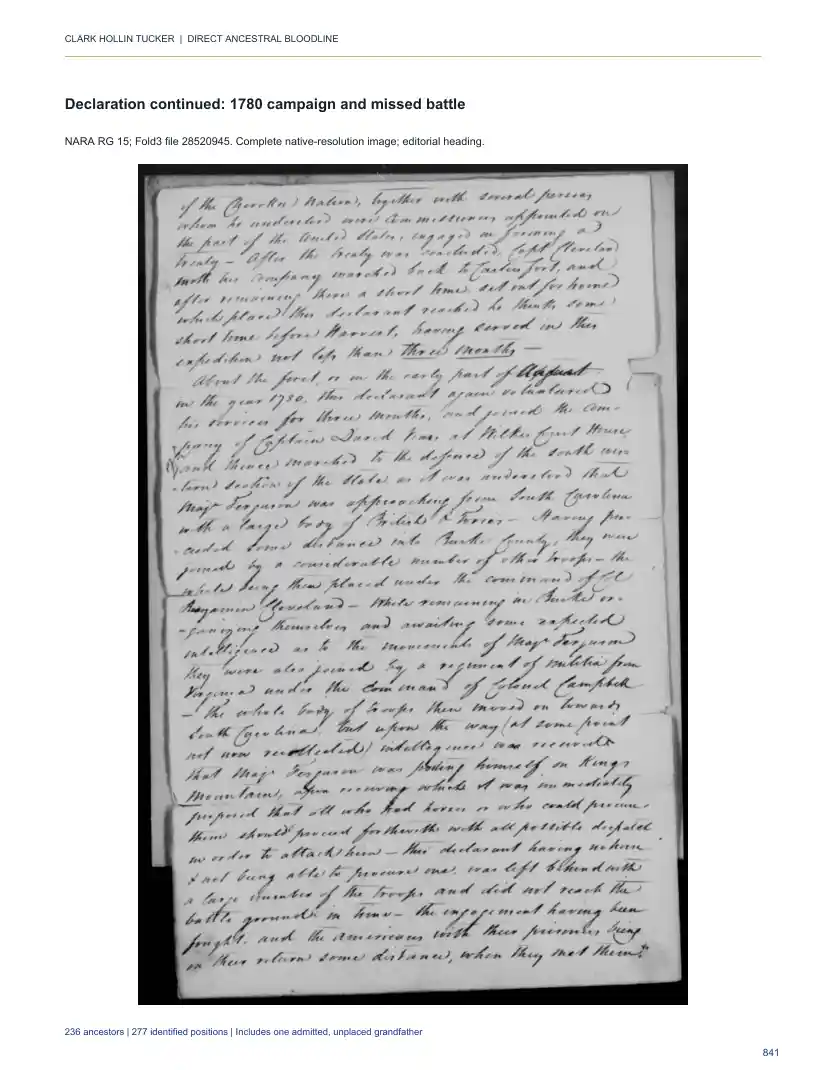
Packet image 11 of 32 · Master page 841
12. Declaration continued: prisoner escort and age testimony
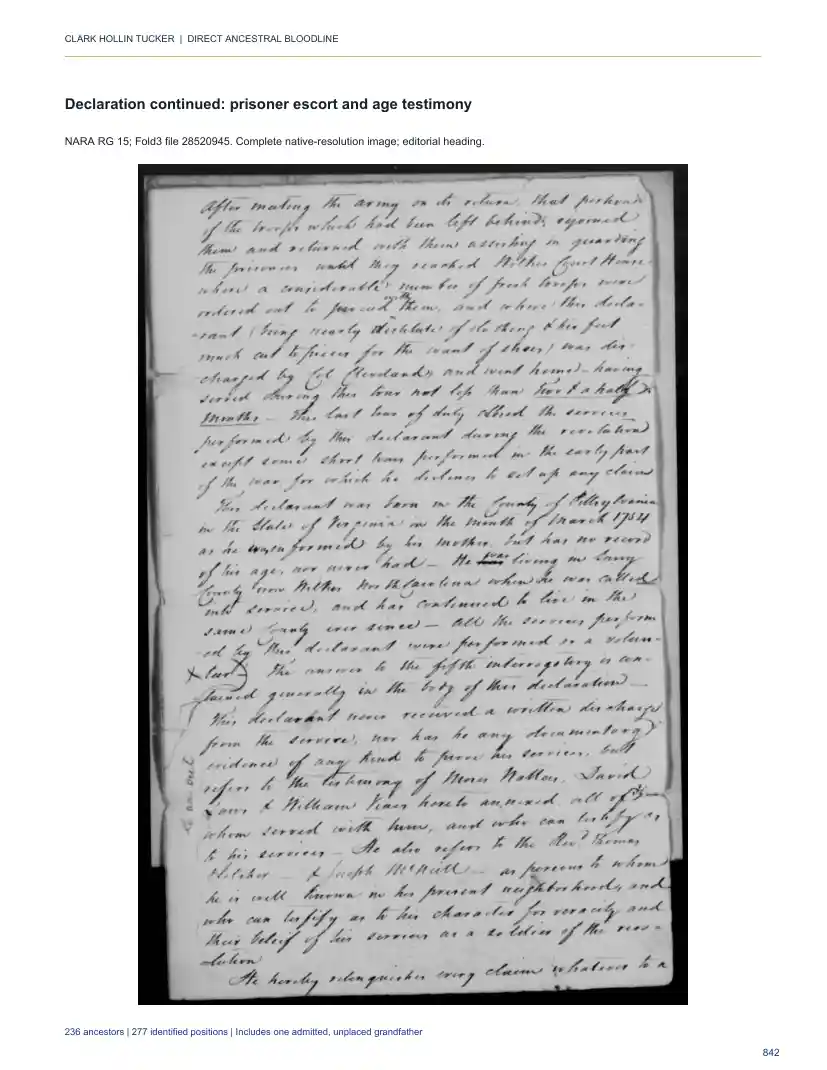
Packet image 12 of 32 · Master page 842
13. John Yates mark; Moses Waters and David Laws testimony
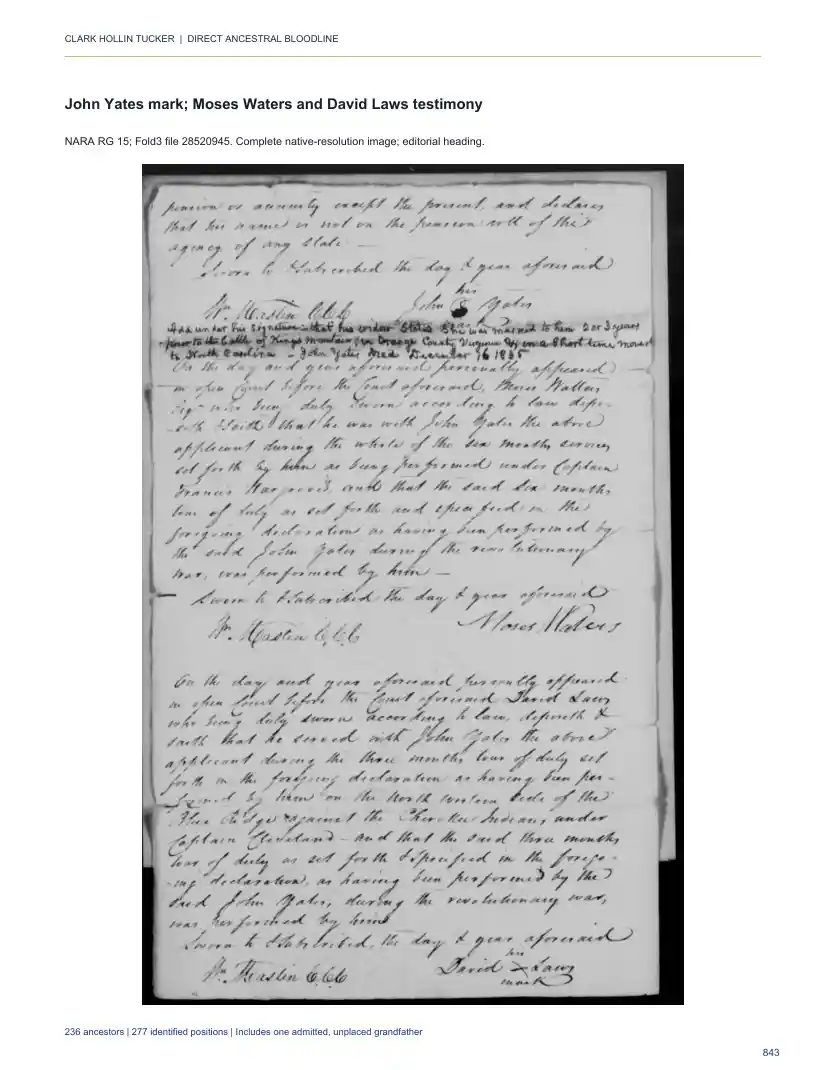
Packet image 13 of 32 · Master page 843
14. William Viars testimony; character and court statements
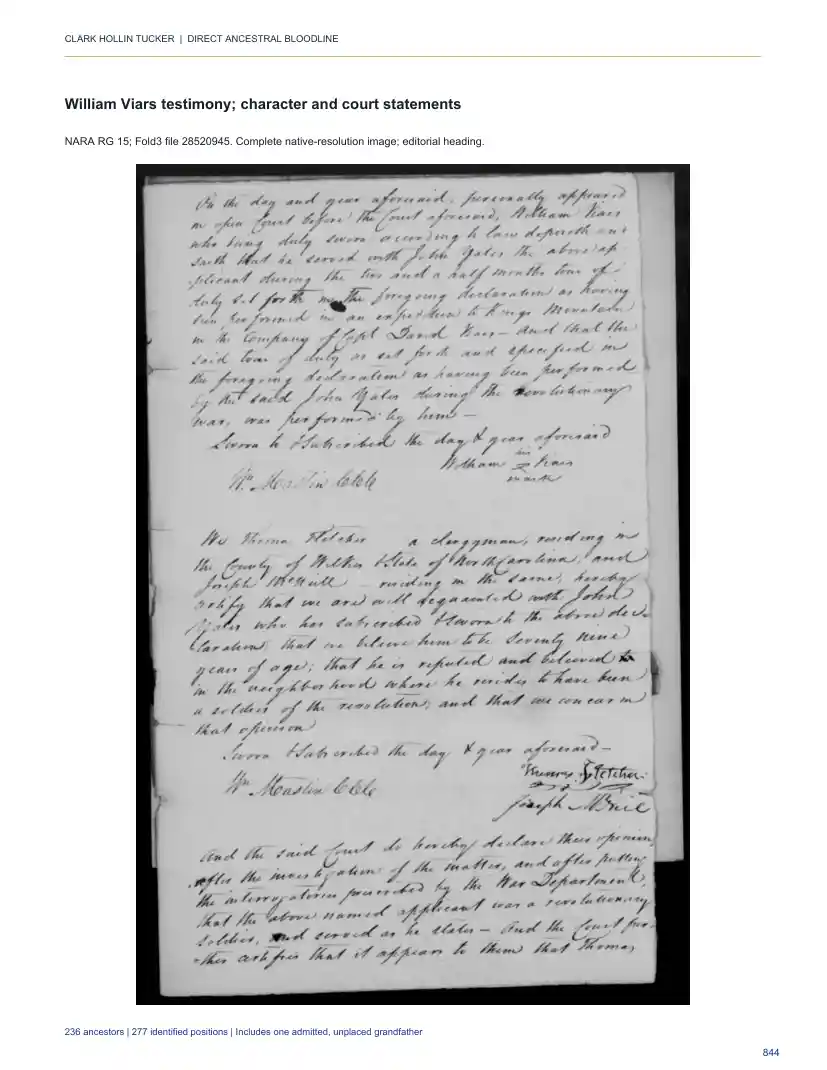
Packet image 14 of 32 · Master page 844
15. Court certification of the declaration
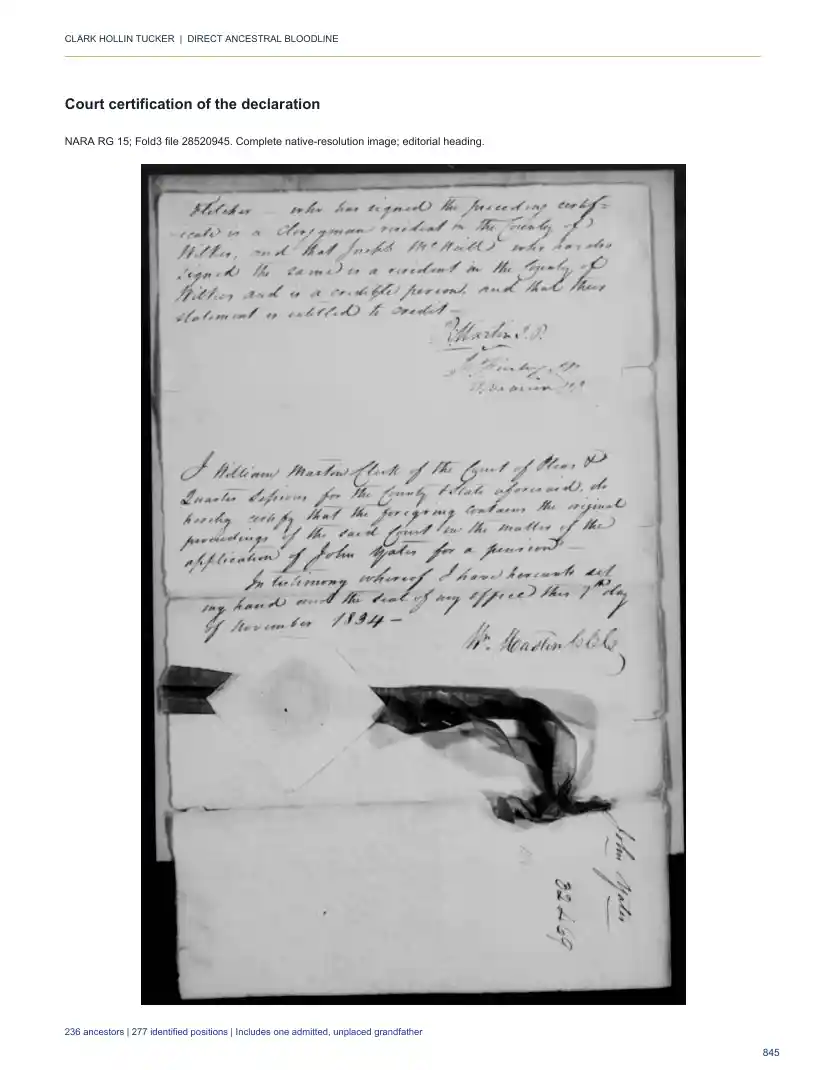
Packet image 15 of 32 · Master page 845
16. Widow application wrapper
Packet image 16 of 32 · Master page 846
17. Jemima Yates declaration, 18 May 1841
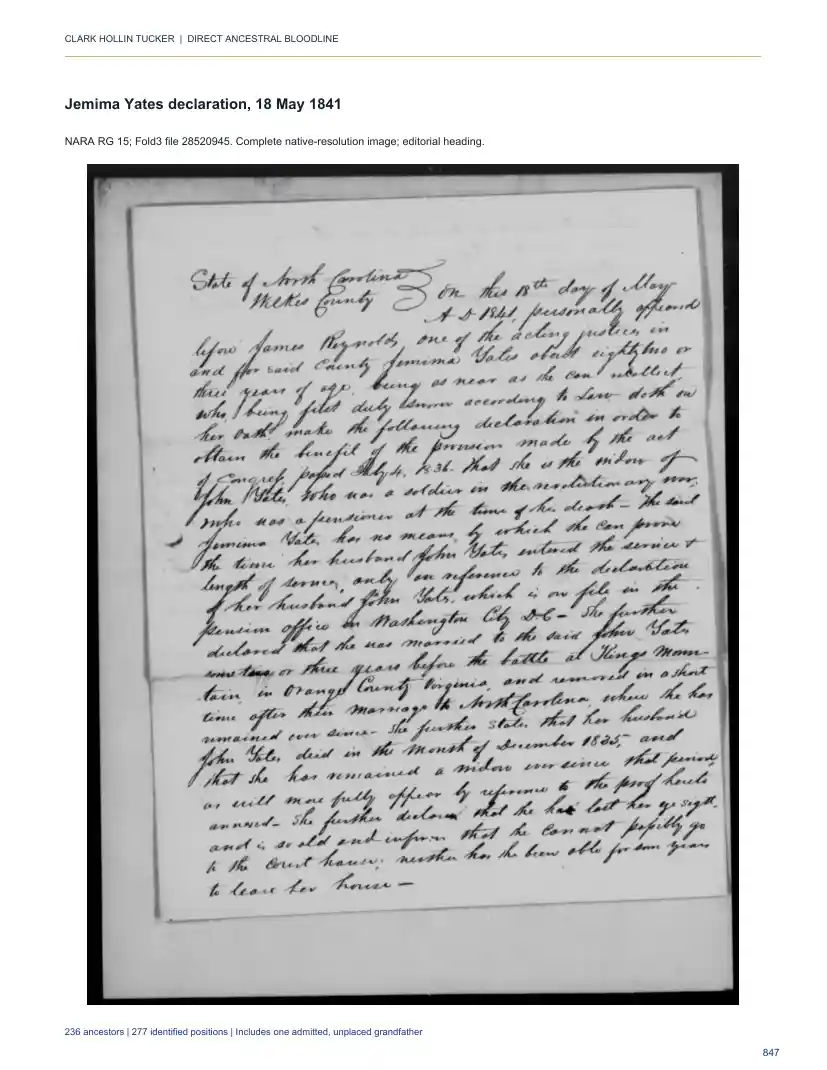
Packet image 17 of 32 · Master page 847
18. Jemima Yates mark and certification
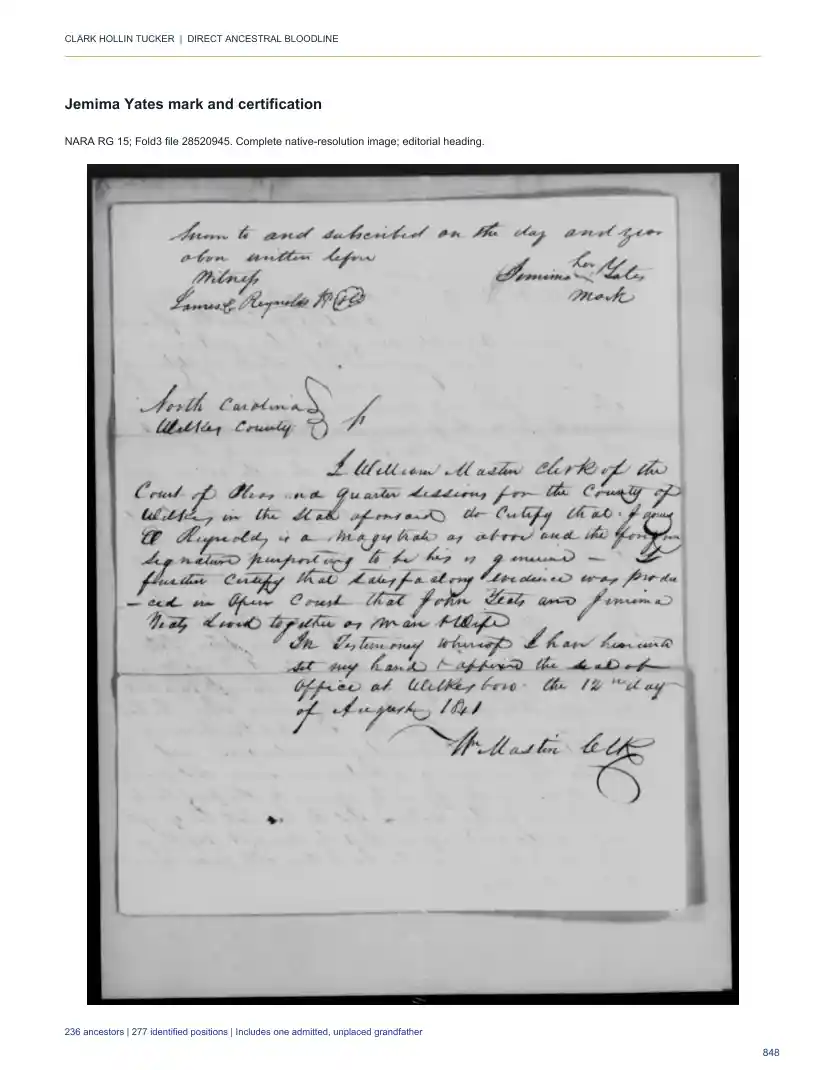
Packet image 18 of 32 · Master page 848
19. Widow application certification
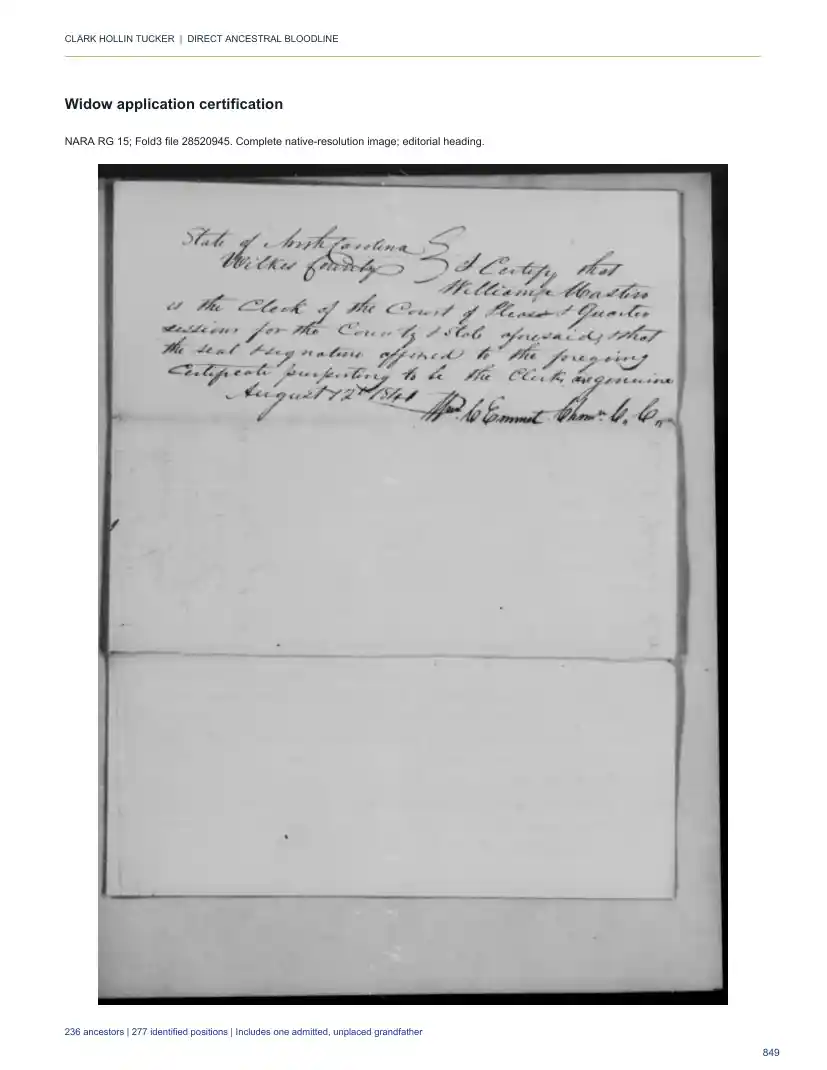
Packet image 19 of 32 · Master page 849
20. Treasury correspondence, 10 July 1845
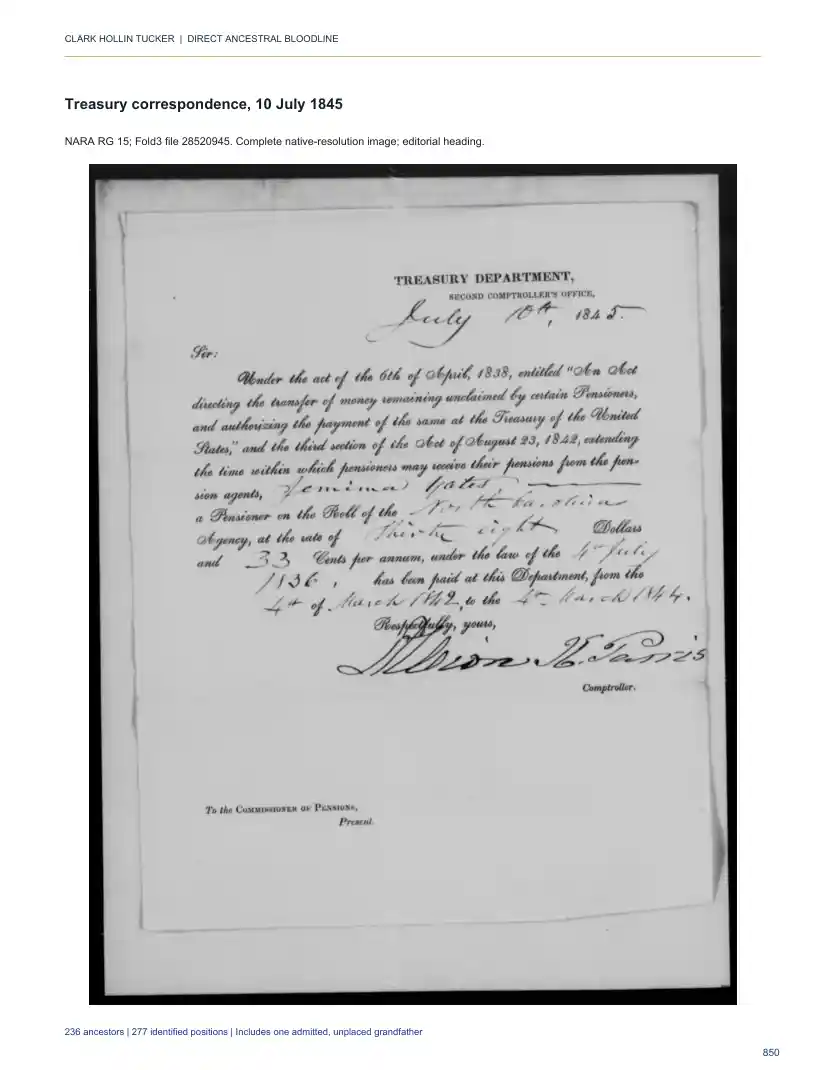
Packet image 20 of 32 · Master page 850
21. James Reynolds statement, 20 May 1841
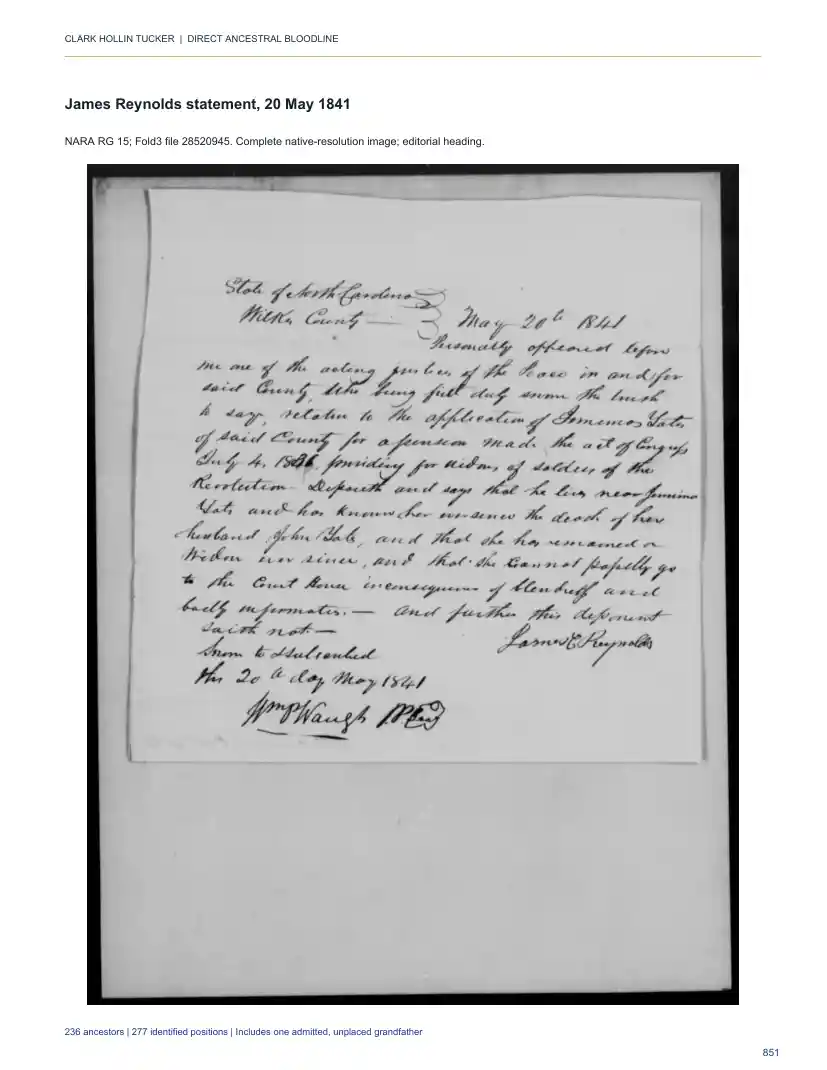
Packet image 21 of 32 · Master page 851
22. Certification accompanying widow evidence
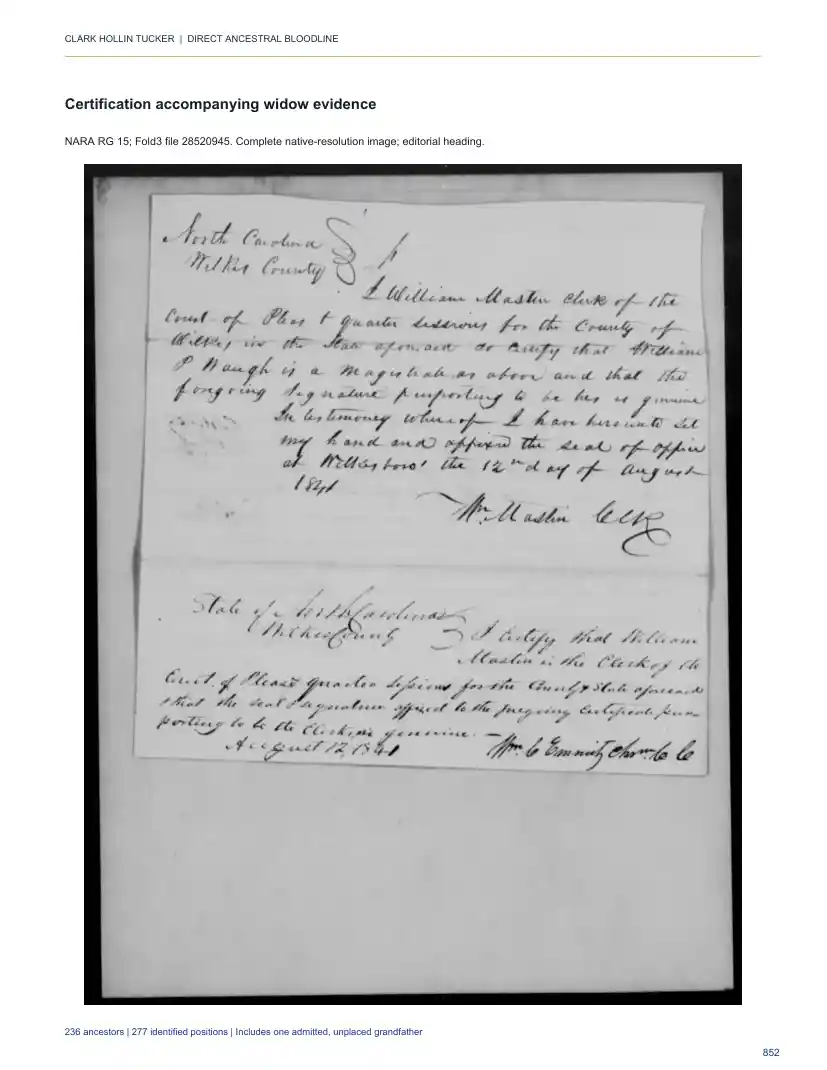
Packet image 22 of 32 · Master page 852
23. Raleigh correspondence, 9 March 1842
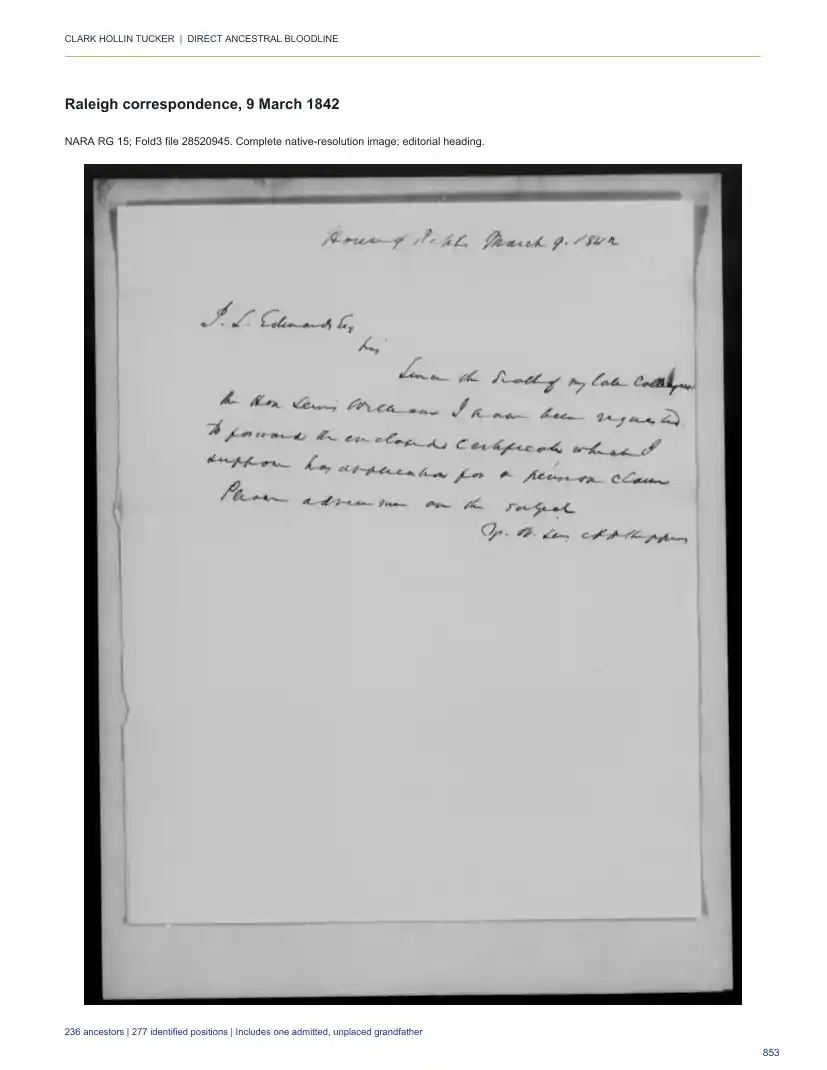
Packet image 23 of 32 · Master page 853
24. Thomas Church marriage and cohabitation testimony
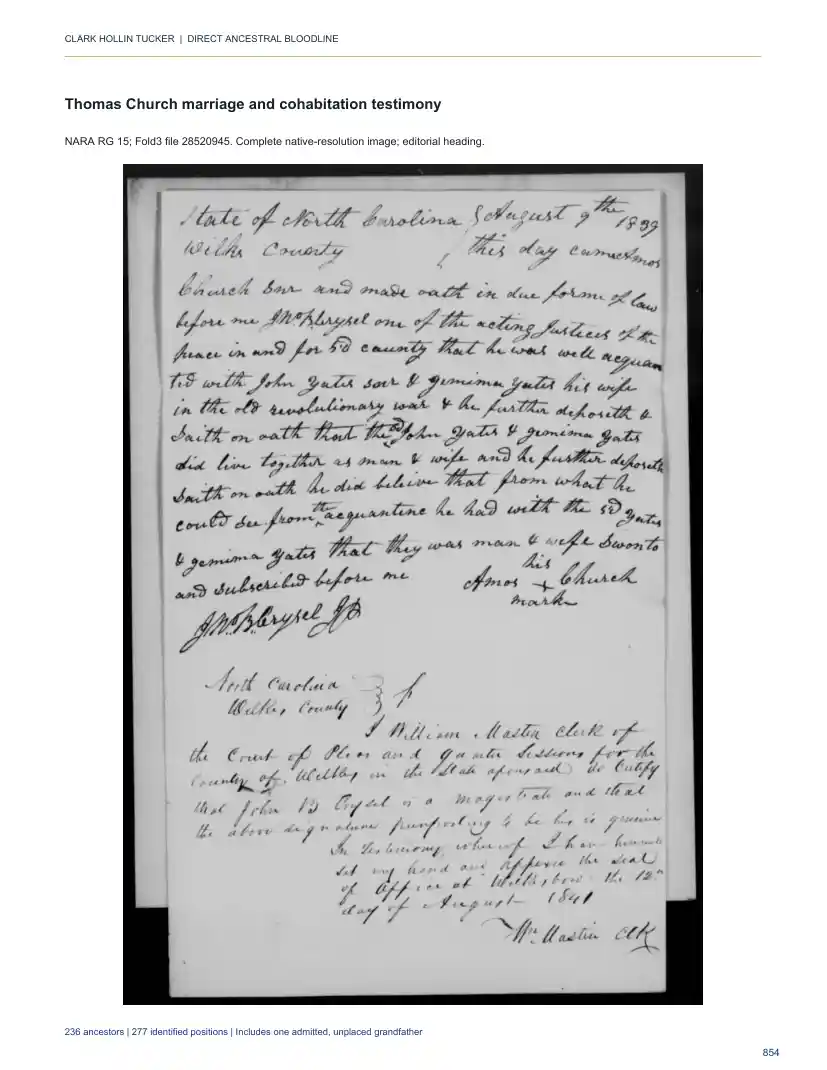
Packet image 24 of 32 · Master page 854
25. Certification of witness evidence
Packet image 25 of 32 · Master page 855
26. Widow file wrapper
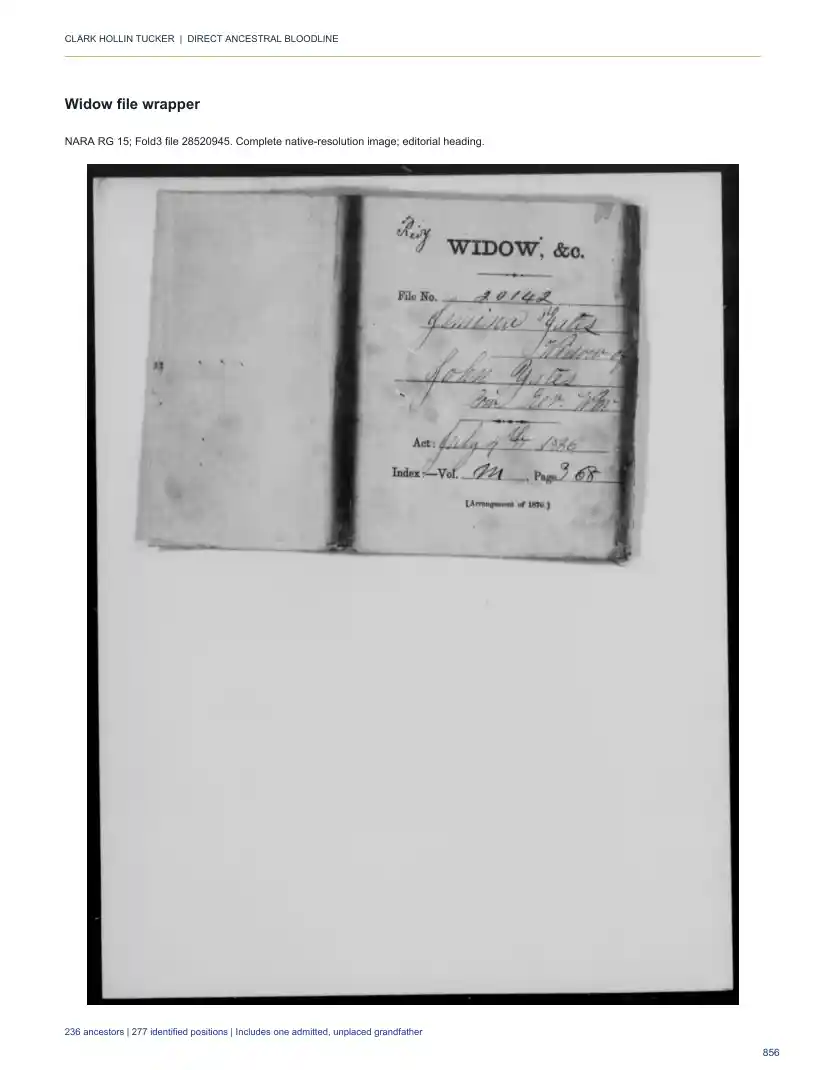
Packet image 26 of 32 · Master page 856
27. File wrapper and administrative notation
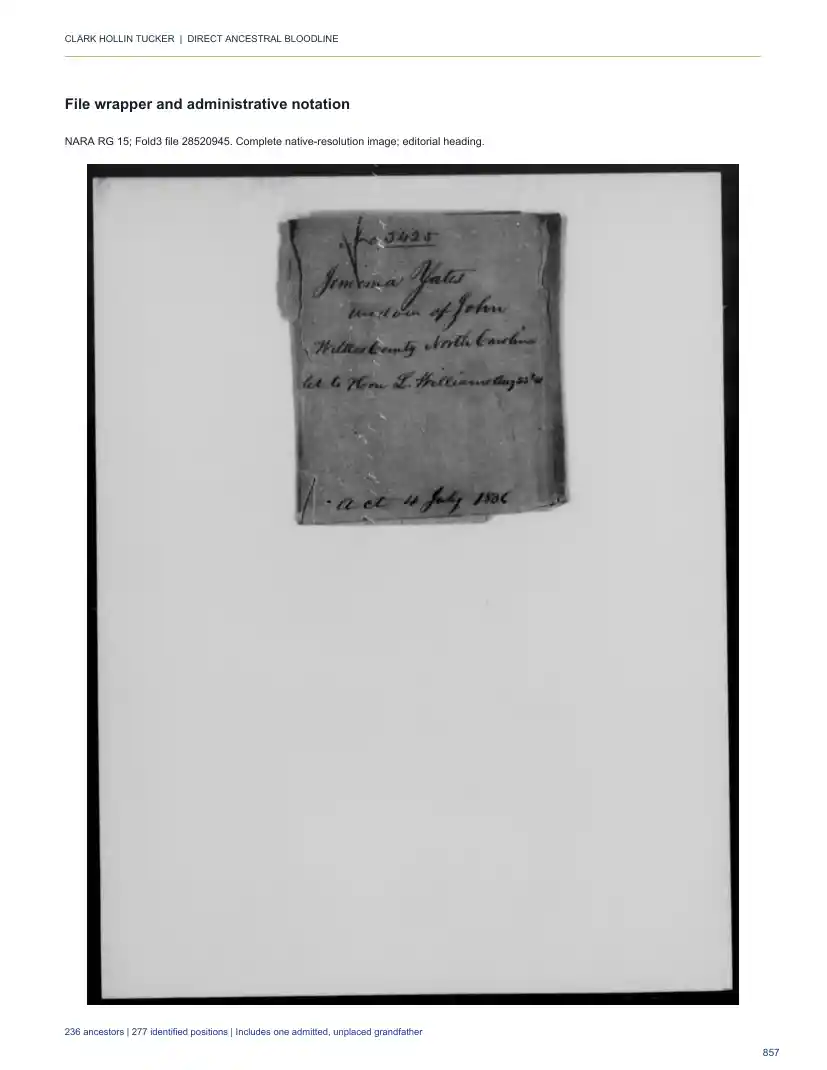
Packet image 27 of 32 · Master page 857
28. Administrative death-date note: 16 December 1835
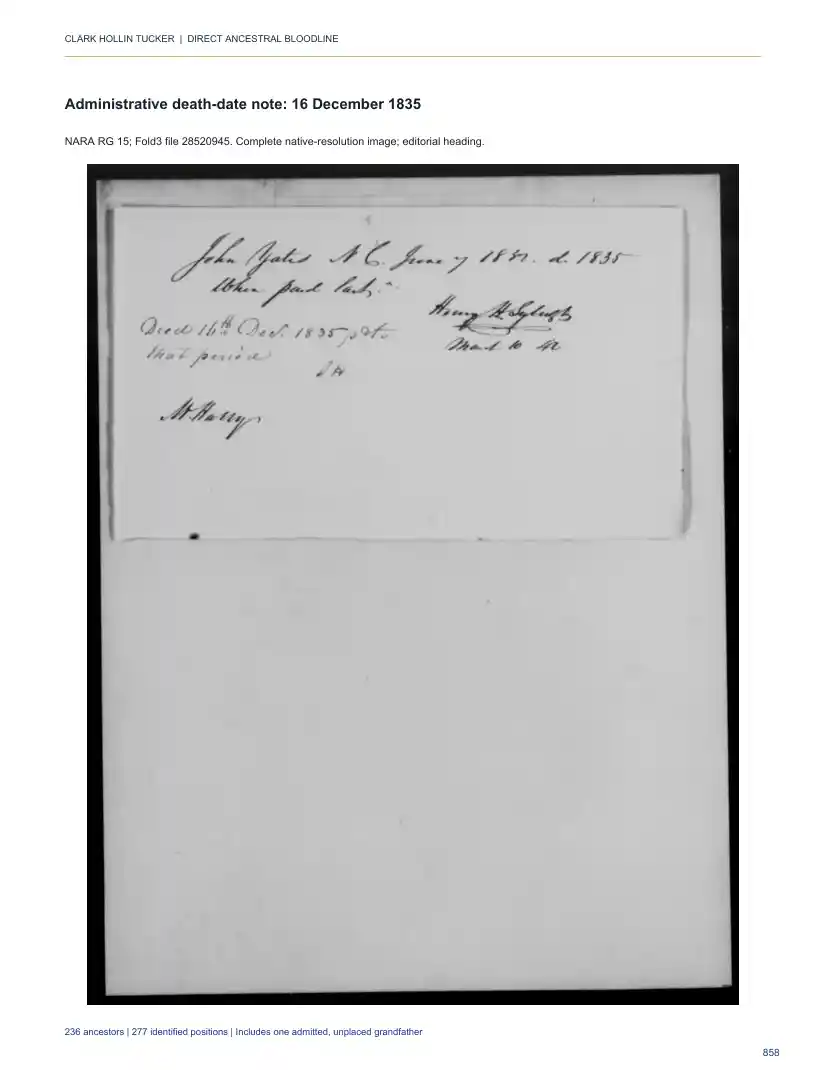
Packet image 28 of 32 · Master page 858
29. Widow application administrative summary
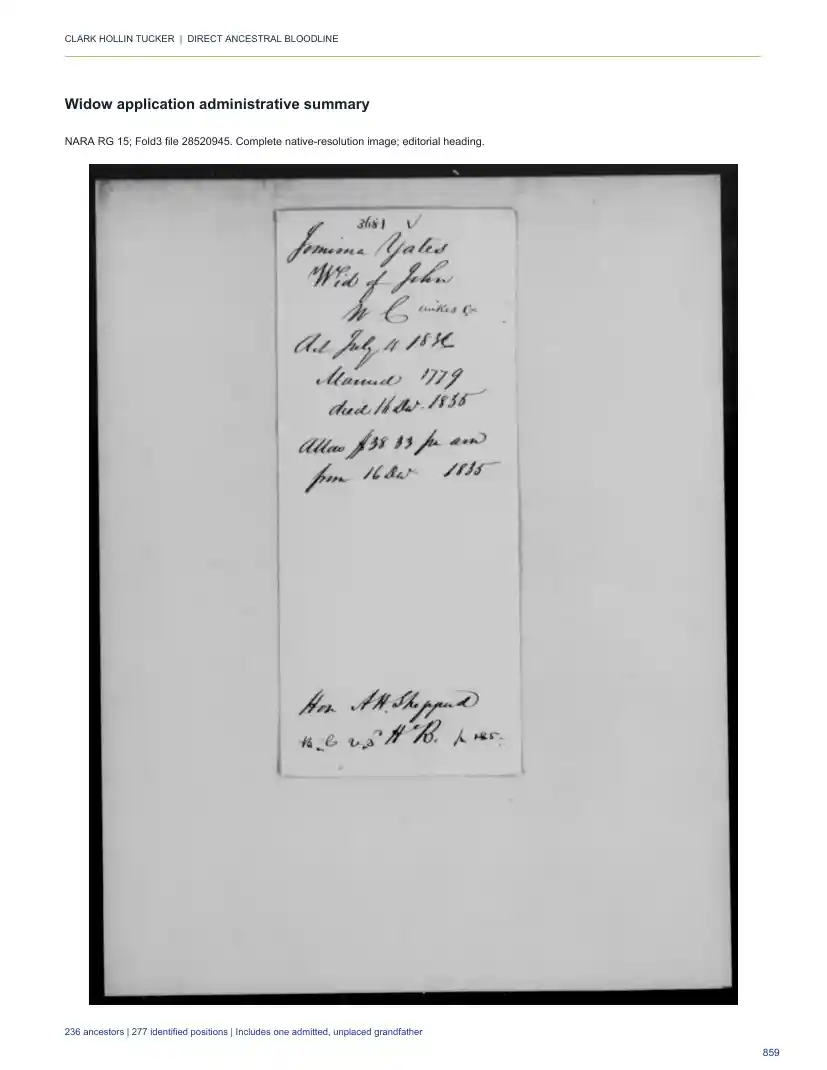
Packet image 29 of 32 · Master page 859
30. Application correspondence, January 1835
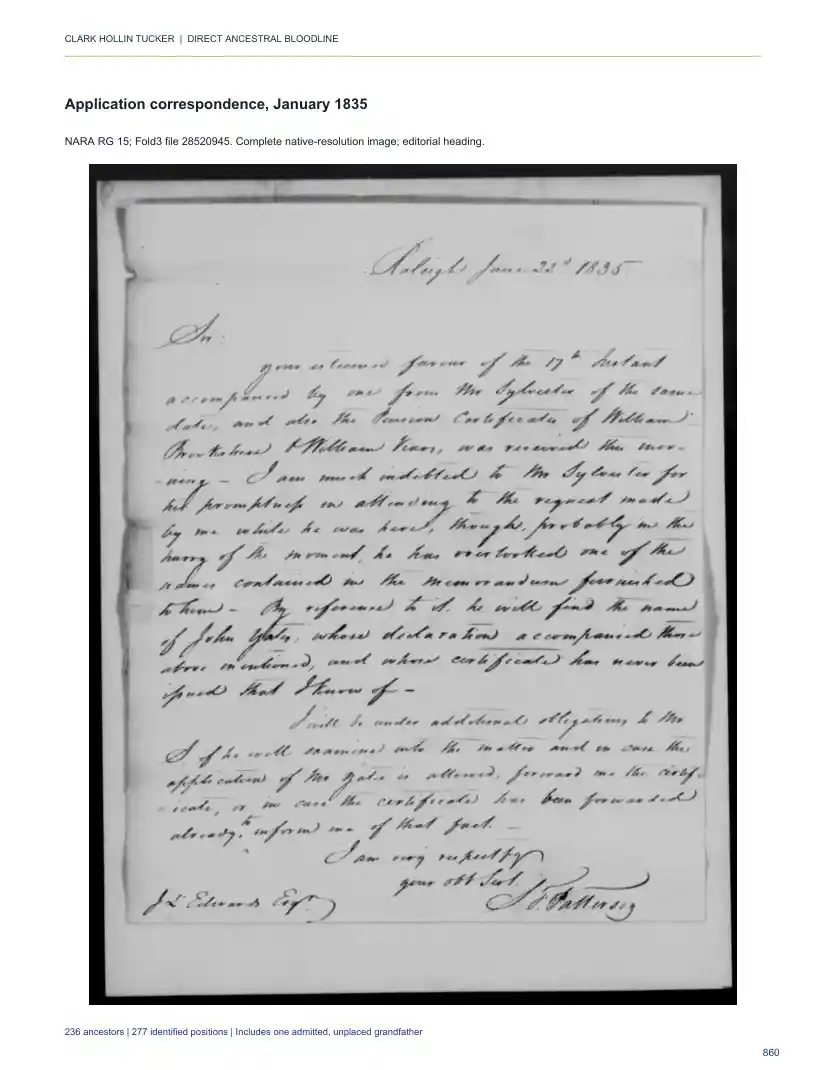
Packet image 30 of 32 · Master page 860
31. Samuel Castle sworn marriage testimony, 6 August 1839
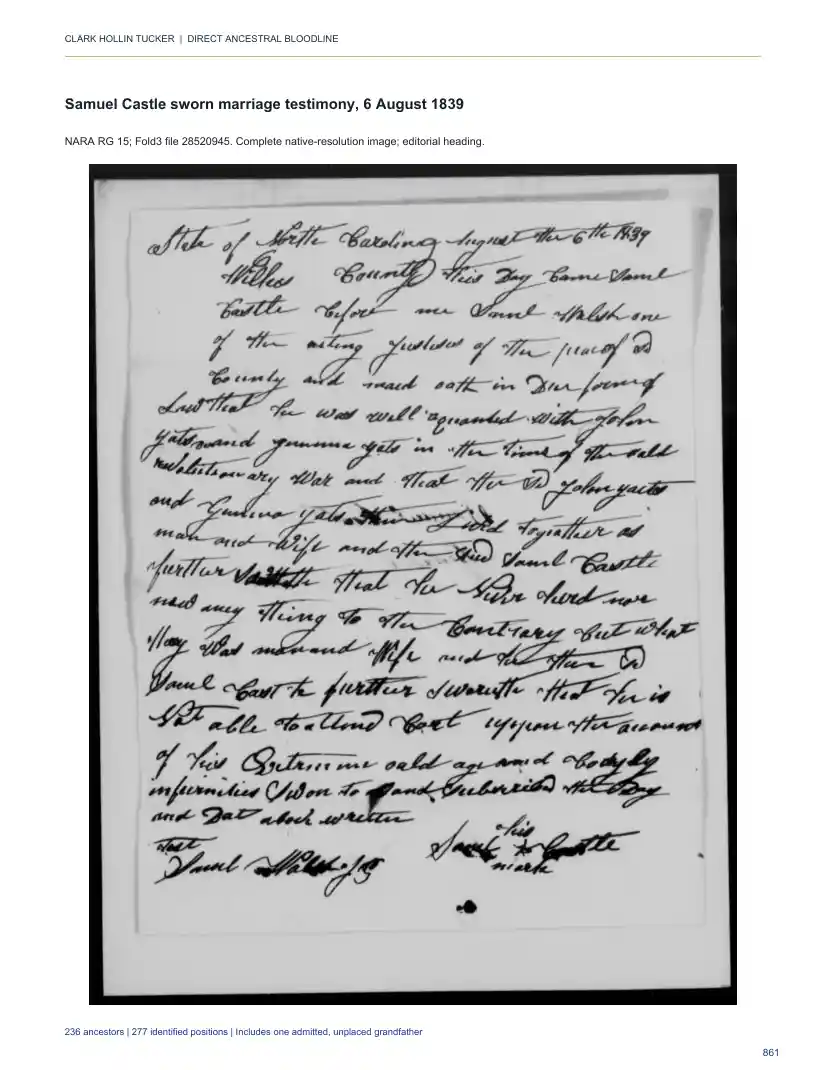
Packet image 31 of 32 · Master page 861
32. Castle statement certification and reverse
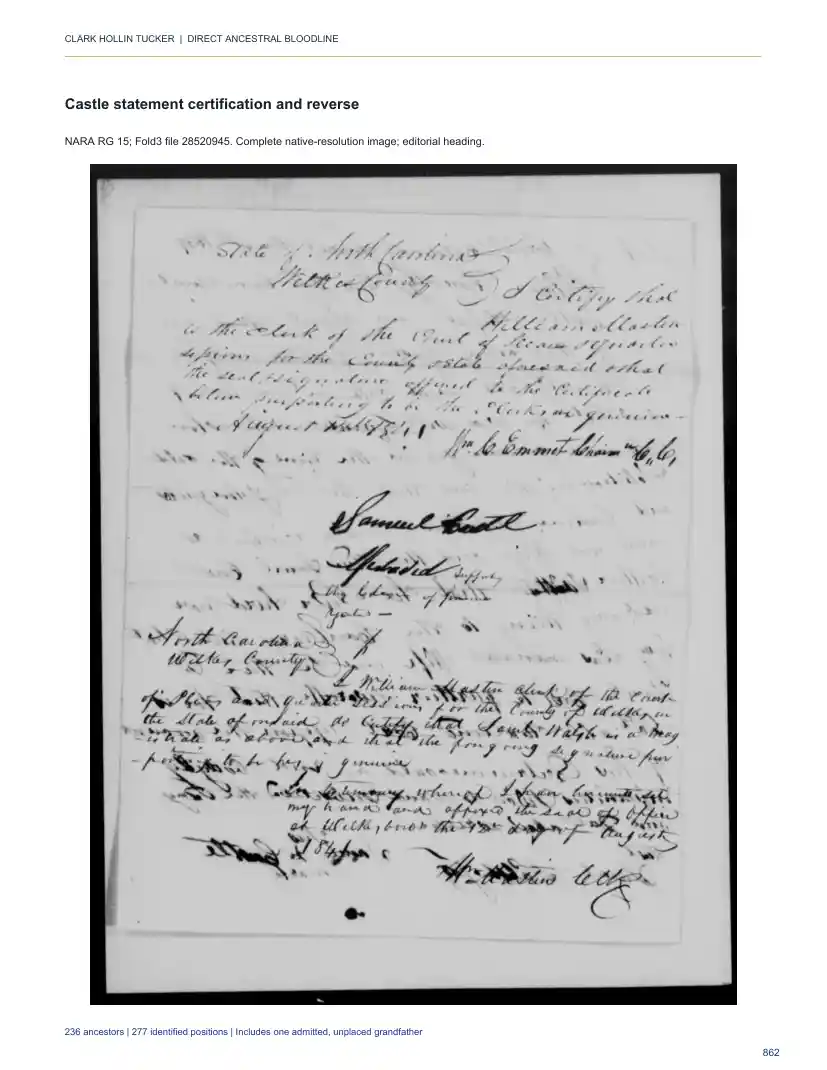
Packet image 32 of 32 · Master page 862
David Roper — project Patriot #8
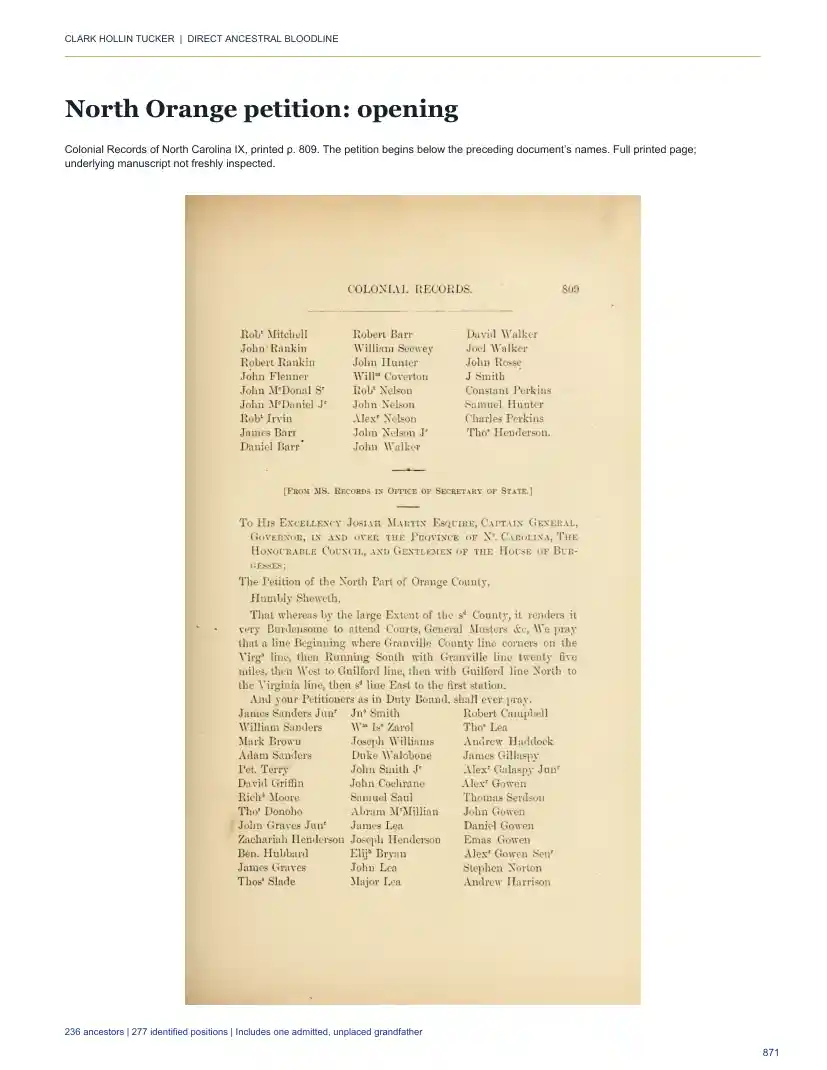
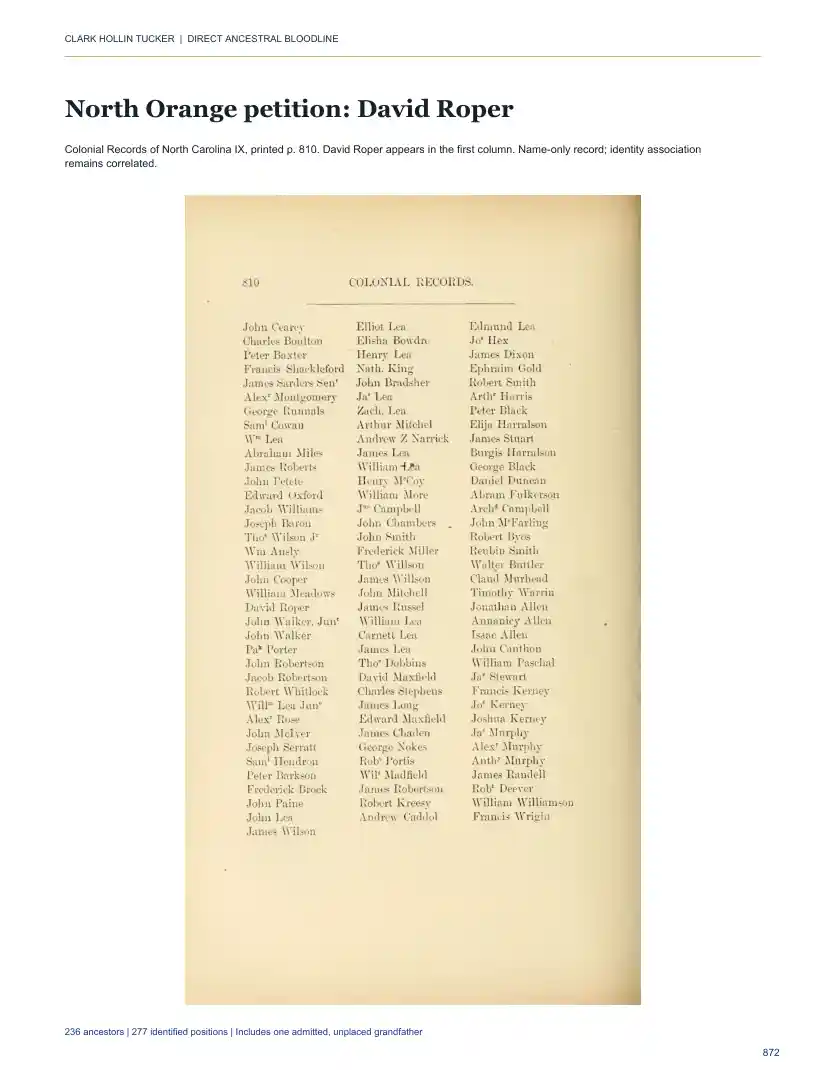
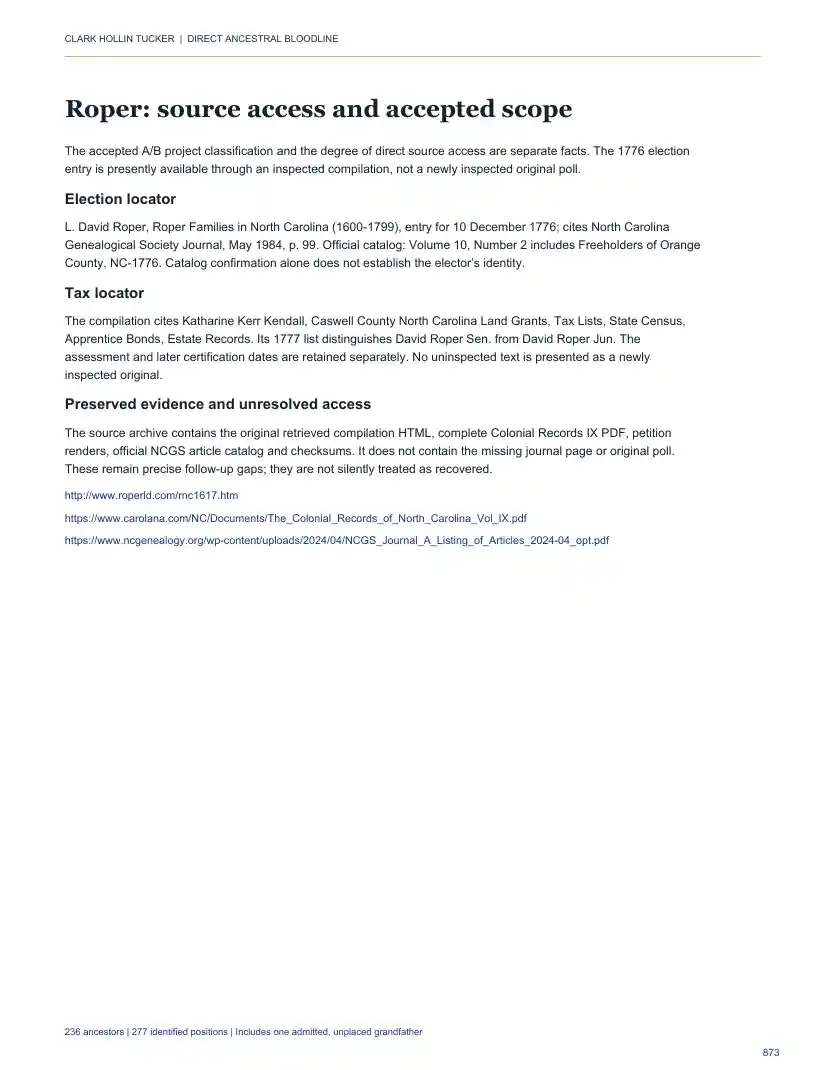
David Roper is the eighth accepted Patriot in this family project, with a qualified A/B civil and political classification. His contribution belongs in the public life of Revolutionary North Carolina. A published petition in the Colonial Records names David Roper among the petitioners; the associated research compilation assigns it to 1773. The same compilation reports Davd Roper as an elector on December 10, 1776, citing a 1984 transcription of the Orange County poll. The original poll and that journal page have not yet been inspected. A later tax compilation distinguishes David Roper Sen. from a junior David and records an assessment, rather than a receipt for payment. These sources support the project’s carefully qualified civil and political treatment; they do not establish a militia unit, personal combat, delegate status, or participation in a particular provincial congress. His identification and descent through Jemima remain separate questions, and the ancestry grade stays B.
The full printed North Orange petition appears below. The compilation supplies its 1773 date. The 1777 tax assessment is not a receipt proving payment. Open the complete ancestor profile and source-access explanation.