England · Helmingham, Suffolk

The Wythe family
of Helmingham.

The wills, manorial leases and Chancery records behind Elizabeth Wythe Bacon’s family. Six people occupy twelve pedigree positions through the two Bacon descent routes. Each person counts once.

Current register: 217 unique ancestors through Generation 20. The Wythe additions belong in Generations 16–18. Their civil property litigation does not establish military service.

Read the complete supplied 18-page research report (PDF) · Published will transcriptions

Six ancestors, connected by evidence

Generation 16 · #122370 / #122626 · A

Richard Wythe of Helmingham

Parent of Elizabeth Wythe Bacon. Spouse: Joan Wythe.

Birth: Birth date not established; a birth after April 1501 is an inference from omission in his grandfather’s will.

Death: Buried 8 November 1564, Helmingham, reported; will 14 April 1563, proved 13 December 1565.

Richard’s will abstract names wife Joane, sons Lionell and John, a grandson John through deceased eldest son Francis, and daughters Alice (wife of William Felgate), Elizabeth, Jone, Barbara and Marget. The daughter Elizabeth is correlated with Michael Bacon’s 1565 bride through parish chronology and the Felgate family association in 1572.

The 1538 will transcript of John Wythe names Richard as his son and Joan as Richard’s wife. Framsden and Helmingham property, the Bocking Hall litigation and the Crowfield/Coddenham decrees help separate this Richard from the Framsden namesake.

Grade A: original PCC will names Elizabeth as Richard’s daughter; original Helmingham marriage names Michael Bacon and Elizabeth Wythe on 18 November 1565. Established Felgate correlation identifies the daughter with the bride. Master proof: pp. 1525-1527.

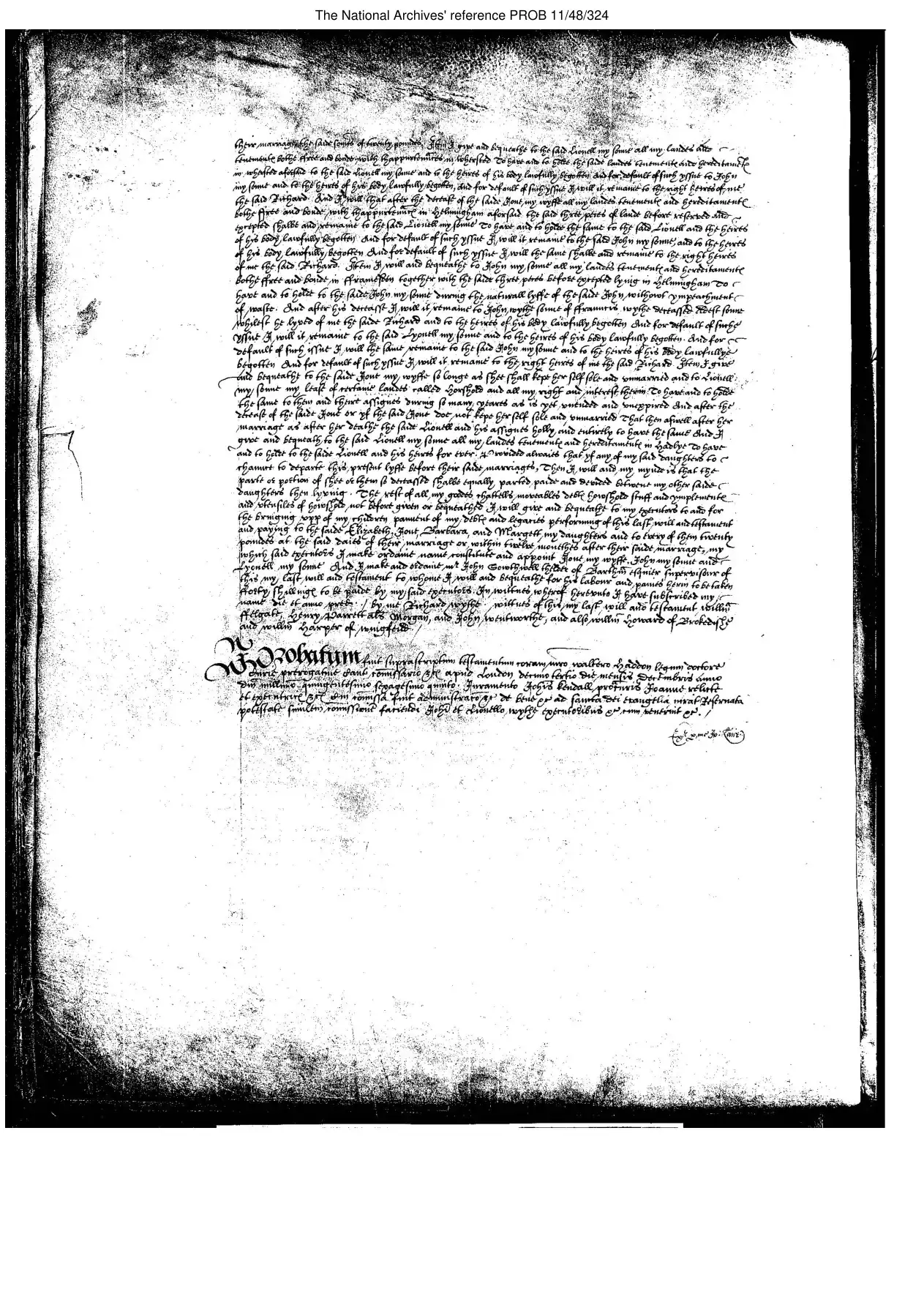
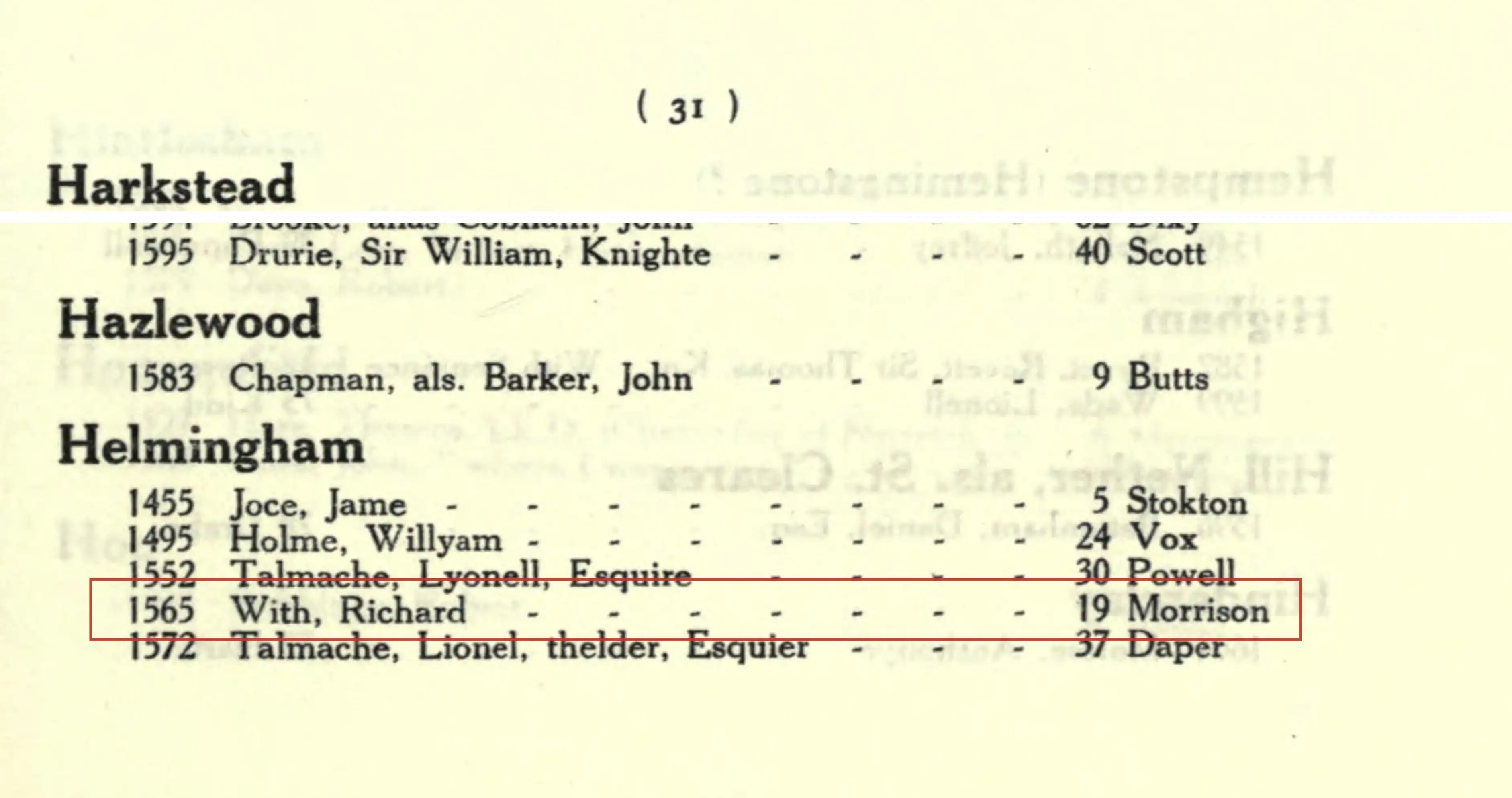
Source: TNA PROB 11/48/324, 19 Morrison, D956540; C 78/17/9 (1560), C 78/46/3 (1570); Suffolk Archives IC/AA1/10/175, IC/AA2/24/1.

Master profile: p. 1505. Open the family register

1570 Chancery decree: Richard’s sons

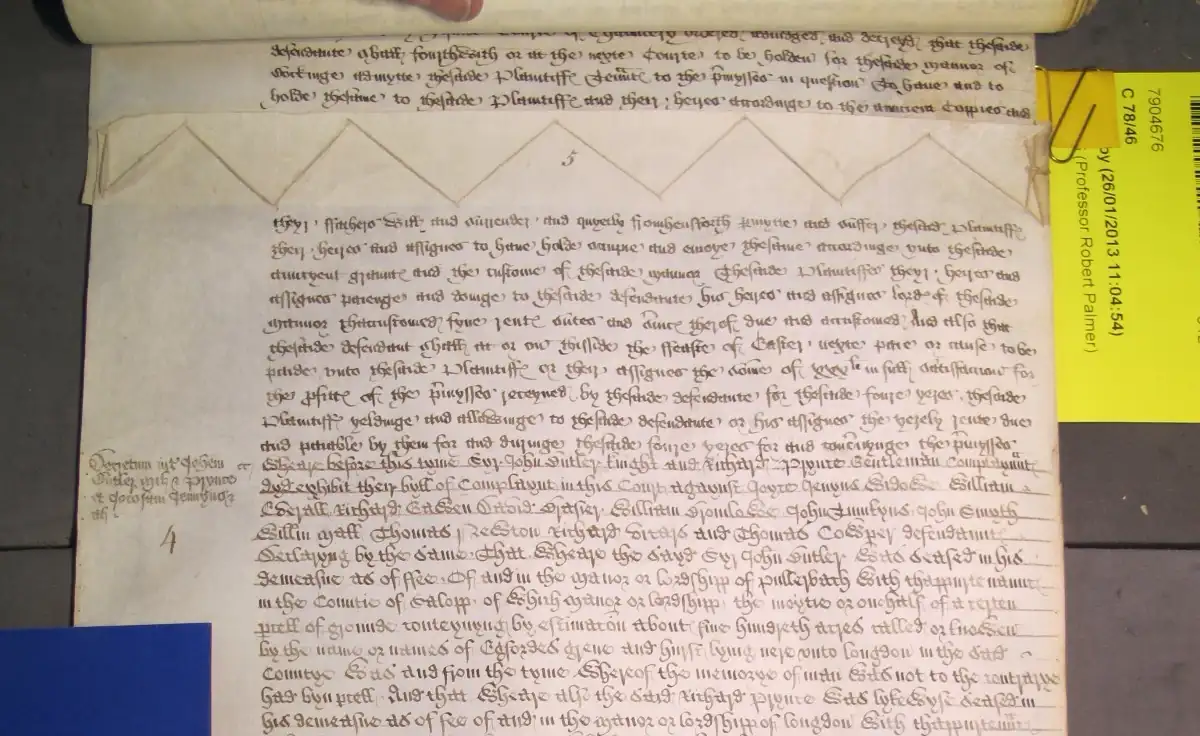
The Chancery decree of 24 November 1570 explicitly names John and Lionel Withe as sons of the late Richard Withe of Helmingham. It independently corroborates Richard’s family and the sons’ succession to his copyhold property. Richard remains Grade A; no new direct ancestor is added.

Read the parentage review, transcription and original photographs

Generation 16 · #122371 / #122627 · A/B

Joan Wythe

Parent of Elizabeth Wythe Bacon. Spouse: Richard Wythe of Helmingham.

Living 13 December 1565, represented as widow and executrix in Richard’s PCC probate.

John Wythe’s 1538 will transcript names Joan as Richard’s wife. Richard’s original 1563 will and 1565 probate confirm the wife and widow/executrix status. New identity review and sources: master pp. 1528–1531.

Maternity of Elizabeth is a Strong B correlation from the documented marriage before Elizabeth’s estimated childbearing generation, the later widow, and the family network. Elizabeth’s proposed 1541–1545 birth range is an estimate, not a recorded birth date.

A/B retained: explicit wife status and correlated maternity. Jane Radcliffe is excluded by incompatible life dates; no maiden surname or new parent is assigned.

Source: Suffolk Archives IC/AA1/10/175 / IC/AA2/13/176; TNA PROB 11/48/324 and C 3/79/20.

Read the probate and identity review

Master profile: p. 1506. Open the family register

Generation 17 · #244740 / #245252 · A/B

John Wythe of Helmingham

Parent of Richard Wythe of Helmingham. Spouse: Margaret Wythe.

Birth: About 1460–1465, report estimate.

Death: After will dated 8 October 1538; probate reported in 1538.

The 1538 will transcript names sons Robert and Richard, wife Margaret, and daughters-in-law Joan (wife of Robert) and Joan (wife of Richard). Richard receives Framsden lands and a Helmingham tenement bought of John Cowper after Margaret’s death.

Identified with the younger John in the 1486 father–son lease and the John with wife Margaret in 1500/1503 through Bocking Hall, the senior/junior transition after the elder John’s 1501 death, Robert Lawe and the continuing local property network.

Grade A father–son statements in the supplied will transcript; Strong B+ identity correlation. Combined display A/B. The registered-copy citation is IC/AA2/13/176, indexed under Hemingstone in Crisp; the transcript identifies Helmingham.

Source: Suffolk Archives IC/AA1/10/175 / IC/AA2/13/176; HD 1538/253/123, /137, /139; TNA C 1/1081/65 and C 1/1085/74–75.

Master profile: p. 1507. Open the family register

13 November: Holme original-record update

Upstream filiation from John Wythe the Elder (#489480 / #490504): Grade A. Downstream paternity of Richard Wythe (#122370 / #122626): Strong B+ retained; combined register display A/B. The original 1538 Suffolk will remains an archival target. Evidence update: pp. 1532–1537.

Read the proof and inspect the original will

Generation 17 · #244741 / #245253 · A/B

Margaret Wythe

Parent of Richard Wythe of Helmingham. Spouse: John Wythe of Helmingham.

Death: Living 8 October 1538 and in subsequent widow’s litigation.

Margaret is named as John’s wife in the 2 December 1500 Bocking Hall lease, the 6 April 1503 grant and the 1538 will transcript. She receives a life interest in property devised subsequently to Richard.

Maternity of Richard is correlated at B/B+ from this marital sequence and the household and property evidence. Richard’s omission among named grandchildren in 1501 supports, but does not conclusively prove, a later birth. The omission is not treated as an exact birth boundary.

Grade A stated marriage; correlated maternity B/B+. Combined display A/B. Margaret belongs to this John, not the elder John who died in 1501.

Source: Suffolk Archives HD 1538/253/137 and /139; IC/AA1/10/175; TNA STAC 2/23/128, /139, /189, /200.

Master profile: p. 1508. Open the family register

Generation 18 · #489480 / #490504 · A/B

John Wythe the Elder of Helmingham

Parent of John Wythe of Helmingham. Spouse: Alice Wythe.

Birth: About 1430–1440, report estimate; documented by 1467.

Death: Between the will dated Wednesday before St George’s Day 1501 and probate 3 May 1501.

The 1486 lease abstract pairs John Wythe senior with John Wythe, his son. The 1501 will transcript names sons John and James, daughter Elizabeth Kene, grandchildren, and wife Alys in a commemorative provision. John is executor and receives Helmingham lands and a close and pasture called Bacon.

The son is correlated with the 1538 testator through Bocking Hall, wife Margaret, the senior/junior sequence and local associates. The elder John’s 1501 death excludes identification with the John and Margaret recorded in 1503.

Grade A stated father–son relationships in the charter abstract and supplied will transcript; Strong B+ identity correlation. Combined display A/B. The transcript heading says 14 April, while its dating clause implies 21 April 1501; preserve the clause and discrepancy pending manuscript inspection.

Source: Suffolk Archives IC/AA2/4/20; HD 1538/253/111, /123, /137, /139; Bodleian MS Tanner 138, folio 87.

Master profile: p. 1509. Open the family register

13 November: Holme original-record update

Grade A paternal relationship to John Wythe the Younger (#244740 / #245252), supported by the original 1495 Holme will and the correlated Helmingham sequence. Combined register display A/B retained because the forward identity correlation still uses the 1501 and 1538 will transcripts. Evidence update: pp. 1532–1537.

Read the proof and inspect the original will

Generation 18 · #489481 / #490505 · A/B

Alice Wythe

Parent of John Wythe of Helmingham. Spouse: John Wythe the Elder of Helmingham.

Death: Deceased by the elder John’s 1501 will, inferred from its commemorative provision.

The elder John’s will transcript calls her Alys, his wife, in the provision for prayers for himself, Alys and his parents, charged to son John. Alice is the normalized display name; Alys is retained as the record spelling.

Maternity of John is admitted at B by the report’s cumulative household and commemorative argument, supported by the recurrence of Alys/Alyce among grandchildren in both sons’ families. This is an indirect conclusion; the will does not call her “their mother.”

Grade A stated wife relationship; Grade B correlated maternity. Combined display A/B. A deceased wife could have been a later spouse, and first-listed daughters are not necessarily eldest; neither assertion is used as conclusive exclusion evidence.

Source: Suffolk Archives IC/AA2/4/20; James Wythe’s 1535/36 will transcript, IC/AA1/9/212.

Master profile: p. 1510. Open the family register

13 November: Holme original-record update

Grade B maternity and A/B combined display retained. William Holme’s 1495 will does not name Alice Wythe. The Holme sibling hypothesis (C) and proposed parentage (C–) remain unadmitted. No natal surname or new parent is assigned. Evidence update: pp. 1534–1537.

Read the proof and inspect the original will

Wills, property and chronology

The profiles distinguish explicit record statements from correlated identity and maternity conclusions. The report is preserved unchanged; the following reconciles its citations, dates and source forms.

Richard Wythe: 14 April 1563; probate 13 December 1565

Researcher abstract of TNA PROB 11/48/324, 19 Morrison. Richard provides for wife Joane and names sons Lionell and John, grandson John (son of deceased eldest son Francis), and daughters Alice, wife of William Felgate, Elizabeth, Jone, Barbara and Marget. Joane, Lionell and John are executors. Listed witnesses are William Felgate, Henry Parrett alias Morgan, John Wentworth, William Howard of Brockdish and William Harper of Wingfield.

Richard’s property provisions

The abstract assigns Lionell lands in Coddenham/Crowfield, Debenham, Winston, the Trimleys, Hadleigh and Wherstead. John receives Framsden and Helmingham property with remainder to grandson John, son of Francis. Poor relief extends to Helmingham, Gosbeck, Framsden, Coddenham and Debenham. The 1570 decree identifies Richard as Lionell’s father and recites succession to the litigated copyhold estate.

William Felgate: 31 March 1572; probate 15 May 1572

Abstract of IC/AA2/24/1. Felgate gives his wife a life interest in Stonham Aspal and Mickfield property; brother and executor Andrew takes the remainder and must enter a performance bond with John Withe and Michael Bacon. Read with Richard’s naming of Alice, wife of William Felgate, this is the central family-network correlation identifying Elizabeth, Michael Bacon’s wife. The bond association is not itself an explicit statement of Elizabeth’s parentage.

John Wythe: 8 October 1538

Transcript of IC/AA1/10/175; reported registered copy IC/AA2/13/176. Wife Margaret, sons Robert and Richard, and each son’s wife Joan are named. Richard receives Framsden lands and the Helmingham tenement purchased from John Cowper after Margaret’s death. Robert receives Wythes, Dreggys and Bocking Hall leasehold interests. Margaret, Robert and Richard are executors. The two wives called Joan are separate women.

John Wythe the Elder: 1501

Transcript of IC/AA2/4/20; probate 3 May 1501. Sons John and James, daughter Elizabeth Kene and grandchildren are named. John is executor and receives Helmingham lands, including a close and pasture called Bacon. The commemorative clause names wife Alys; Master Robert Lawe supervises. The date heading and weekday clause differ in the modern transcription and require comparison with the manuscript. Omission of a grandchild does not establish that child’s birth date.

1467-1503: distinguish the two Johns

HD 1538/253/111 (28 May 1467) places the elder John in the local land network. HD 1538/253/123 (8 November 1486) explicitly pairs John senior and his son John in a manorial lease. HD 1538/253/137 (2 December 1500) names John junior and wife Margaret at Bocking Hall. After the elder John’s 1501 probate, /139 (6 April 1503) names John senior and Margaret. The change in style, wife, supervisor and property sequence supports continuity across these records.

1538-1570: land and litigation

C 1/1081/65 describes Robert as son and heir of John Wythe and Richard as Robert’s brother. C 1/1085/74-75 calls Richard the younger brother and concerns the deceased John’s Bocking Hall lease. The later Crowfield/Coddenham decrees, C 78/17/9 (1 February 1559/60) and C 78/46/3 (24 November 1570), connect Richard with son Lionell’s succession. C 3/79/20 names widow Joan; STAC 2/23 records Margaret’s later litigation. These are civil property proceedings, not military service.

St Mary’s, Helmingham: the family’s church legacy

The report cites Clive Paine, Proceedings of the Suffolk Institute of Archaeology and History 43:4 (2016), pp. 658-660: a 1488/89 tower contract with John Wythe among its guarantors; the elder John’s 1501 battlement gift; and John’s 1538 conditional church-roof and battlement bequests. The study associates the “J Wy” monogram on the tower’s west parapet, completed in 1543, with the later John. This architectural account is secondary corroboration, kept distinct from the will transcripts and charter abstracts.

Keep collateral families separate

James Wythe of Framsden, the elder John’s son, has a separate 1535/36 will and descendants. Richard of Framsden and Thomas of Framsden are not substituted for Richard of Helmingham. Robert’s wife Joan is not Richard’s wife Joan. Alice Felgate is Richard’s daughter, distinct from Generation 18 Alice. Witness William Howard and the Brockdish associations remain research leads; no Howard parent is added.

Dates and source boundaries

Richard’s burial is reported as 8 November 1564; his will was made in 1563 and proved in 1565. These are different events. Elizabeth’s estimated birth interval is not a recorded date or a strict biological limit. First-listed children are not necessarily eldest. Original will images remain useful verification targets; viewing one does not automatically establish every cross-record identity or raise the whole pedigree to A.

Corrected probate citation and date controls

Richard’s will is TNA PROB 11/48/324 (19 Morrison), Discovery D956540. D956926 identifies a different will and is not used. Richard’s will date, reported burial and probate are separate events: 14 April 1563, 8 November 1564 and 13 December 1565.

The elder John’s 1501 transcript has a 14 April heading but a weekday clause corresponding to 21 April; probate is 3 May. John’s 1538 calendar entry says Hemingstone while the supplied transcript says Helmingham. These discrepancies remain disclosed for manuscript comparison.

Richard Wythe: Grade A

Grade A: Richard Wythe (#122370 / #122626) is the father of Elizabeth Wythe Bacon (#61185 / #61313). The original PCC will supplies explicit filiation; the original Helmingham marriage register independently identifies Michael Bacon’s bride as Elizabeth Wythe on 18 November 1565. The existing Felgate family-network evidence completes the cross-record identity correlation.

The original register reads “eighteenthe daye of November” under 1565. The older 16 August date is superseded. Joan’s A/B grade and the existing ancestors remain unchanged.

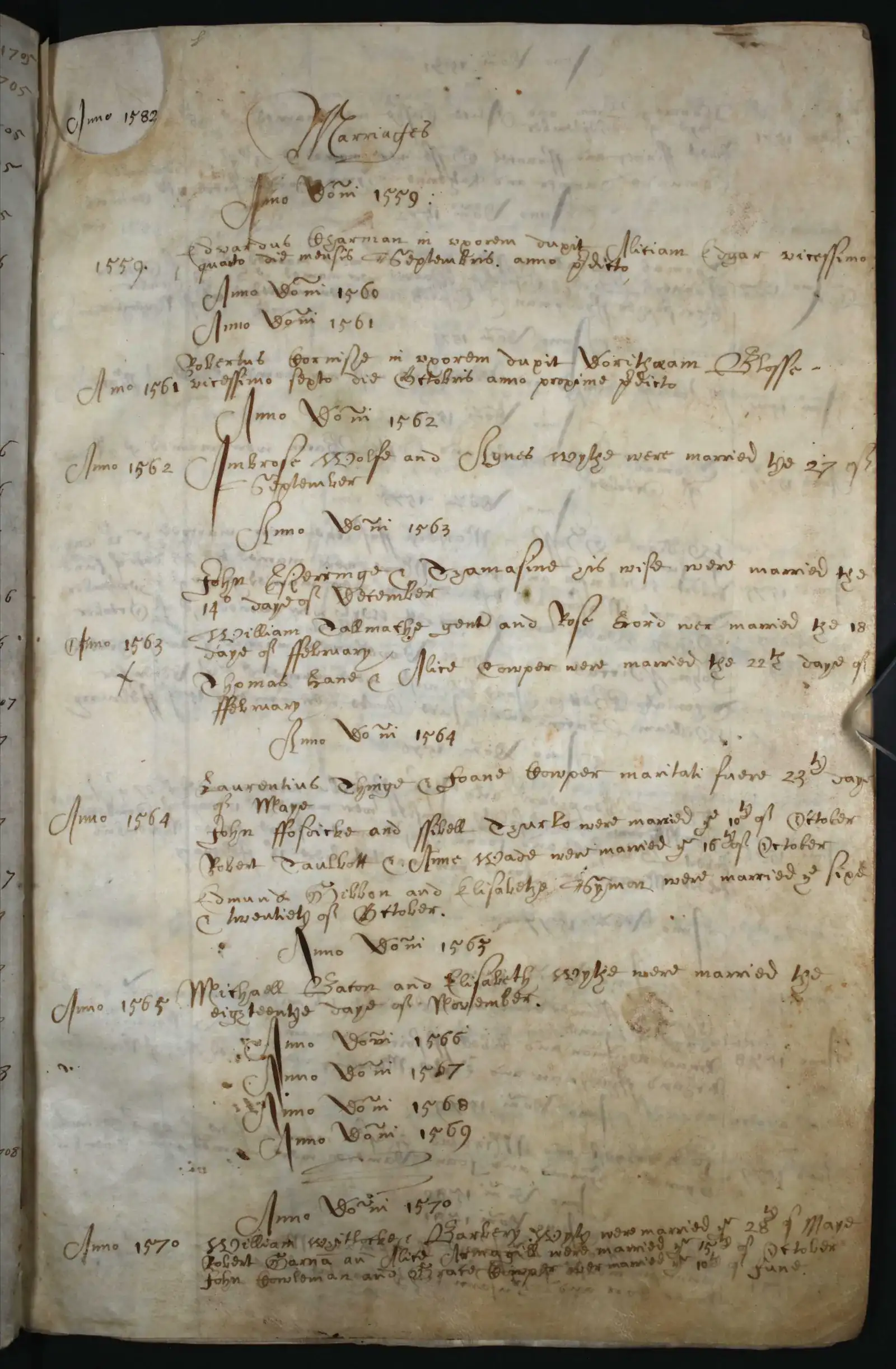
Helmingham original register: Michael Bacon and Elizabeth Wythe, 18 November 1565
Suffolk Archives FB37; Ancestry 62751, image 43 of 82. Select to open the repository image.
Read the proof and material will excerpts

Grade A: Richard Wythe (#122370 / #122626) is the father of Elizabeth Wythe Bacon (#61185 / #61313). The original PCC will supplies explicit filiation; the original Helmingham marriage register independently identifies Michael Bacon’s bride as Elizabeth Wythe on 18 November 1565. The existing Felgate family-network evidence completes the cross-record identity correlation.

Richard Wythe | Grade A determination

Grade A: Richard Wythe (#122370 / #122626) is the father of Elizabeth Wythe Bacon (#61185 / #61313). The original PCC will supplies explicit filiation; the original Helmingham marriage register independently identifies Michael Bacon’s bride as Elizabeth Wythe on 18 November 1565. The existing Felgate family-network evidence completes the cross-record identity correlation.

Independent original marriage evidence

St Mary, Helmingham, register 1559-1715, marriages under 1565; Suffolk Archives, parish collection FB37. Ancestry collection 62751, image 43 of 82, image identifier 62751_48021001947_1217-00044. Full-resolution image recovered and inspected 12 November 2026 (5,273 x 8,059 pixels).

“Michaell Bacon and Elizabeth Wythe were married the / eighteenthe daye of November.” The slash marks the manuscript line break. The year heading is 1565. This is 18 November 1565, not 16 August. The earlier 16 November reading of a reduced preview is also superseded by the full-resolution spelled-out day.

Identity correlation

Richard’s 1563 will names daughter Elizabeth, daughter Alice as wife of William Felgate, and son John. The established 1572 Felgate abstract associates John Withe and Michael Bacon in the bond securing the widow’s interest. Read together with the original local marriage, the shared surname, family relationships, place and chronology identify the bride with Richard’s daughter. The bond supports the conclusion; no rule that every bond surety must be a relative is assumed.

Previous generation and namesakes

John Wythe’s 8 October 1538 will transcript (IC/AA1/10/175; registered-copy citation IC/AA2/13/176) names son Richard and Richard’s wife Joan. The existing Helmingham/Framsden property and Chancery chronology identifies the Helmingham testator. The separate Framsden family and Radcliffe identification are not imported. The 1538 source remains a transcript in this collection; the new PCC scan is not mislabeled as that earlier will.

Conclusion and controls

No material contradiction in the father–daughter identity remains in the correlated evidence examined. The date discrepancy is resolved from the original marriage entry. The conclusion uses direct and indirect evidence together under the project’s Grade A convention. Joan remains at her existing A/B grade: wife language alone does not prove maternity. The count, all other grades, pedigree positions and generations are unchanged.

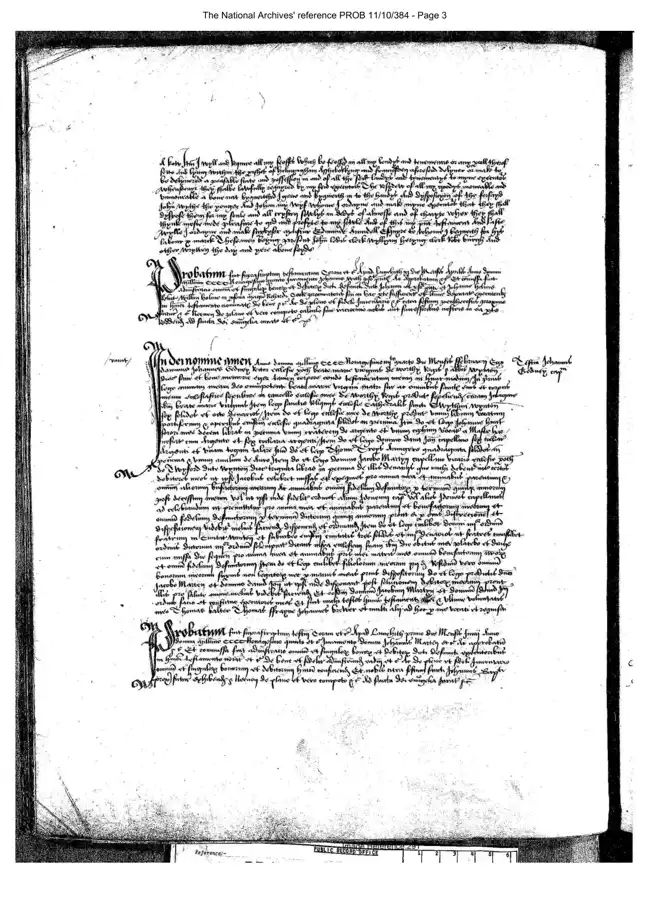
Primary will: TNA PROB 11/48/324, 19 Morrison, Discovery D956540; made 14 April 1563, proved 13 December 1565. Complete scans: pp. 1523-1524. Marriage image: p. 1527.

Richard’s will | material manuscript readings

TNA PROB 11/48/324. Selected diplomatic excerpts from both archive pages; original spellings retained where legible. Ellipses mark omitted wording. These are proof-relevant excerpts, not a full transcription of every property boundary or monetary provision. Image locations refer to the two unchanged archive pages on pp. 1523-1524.

Image 1, will opening below the preceding probate

“In the name of god Amen … the fourtenth daye of the monethe of Aprill … a thousand fyve hundrethe … thre score and thre. I Rychard wythe of Helmyngham …” The omitted opening includes the regnal dating and devotional formula.

Image 1, first property provision

“Jone my wyfe” is explicit. The life interest concerns Helmingham, with three pieces tied to the Framsden house excepted; the fuller property note appears in the Joan review below.

Image 1, bequest following the bed and household goods

“… my daughter wyfe of Willm ffelgate …”. This clause identifies the married daughter by her husband; Alice’s given name comes from the correlated Felgate evidence, not this quoted clause.

Image 1, lower portion; repeated on image 2 near the executors

“… Elizabeth, Jone, Barbara and Margrett my daughters …” The collective possessive and relationship apply to all four women. Elizabeth’s filiation is explicit; her later married surname is supplied by the separate parish record.

Image 2, property remainder and survivorship clauses

“… John my sonne …”; “… John wythe sonne of ffrauncis wythe deceased eldest sonne of me the said Richard …”; “… Lionell my sonne …”. These distinguish the living son John from grandson John, son of the deceased eldest son Francis.

Image 2, executorship near the end of the English will

“… I make and ordeyne … Jone my wyffe, John my sonne and Lionell my sonne …”. The same wife and sons recur in the executorship provision.

Image 2, Latin probate below the witnesses

“… decimo tertio die mensis Decembris …”. Read with the year clause, this is probate on 13 December 1565. It is distinct from the 1563 execution date and the separately reported 1564 burial.
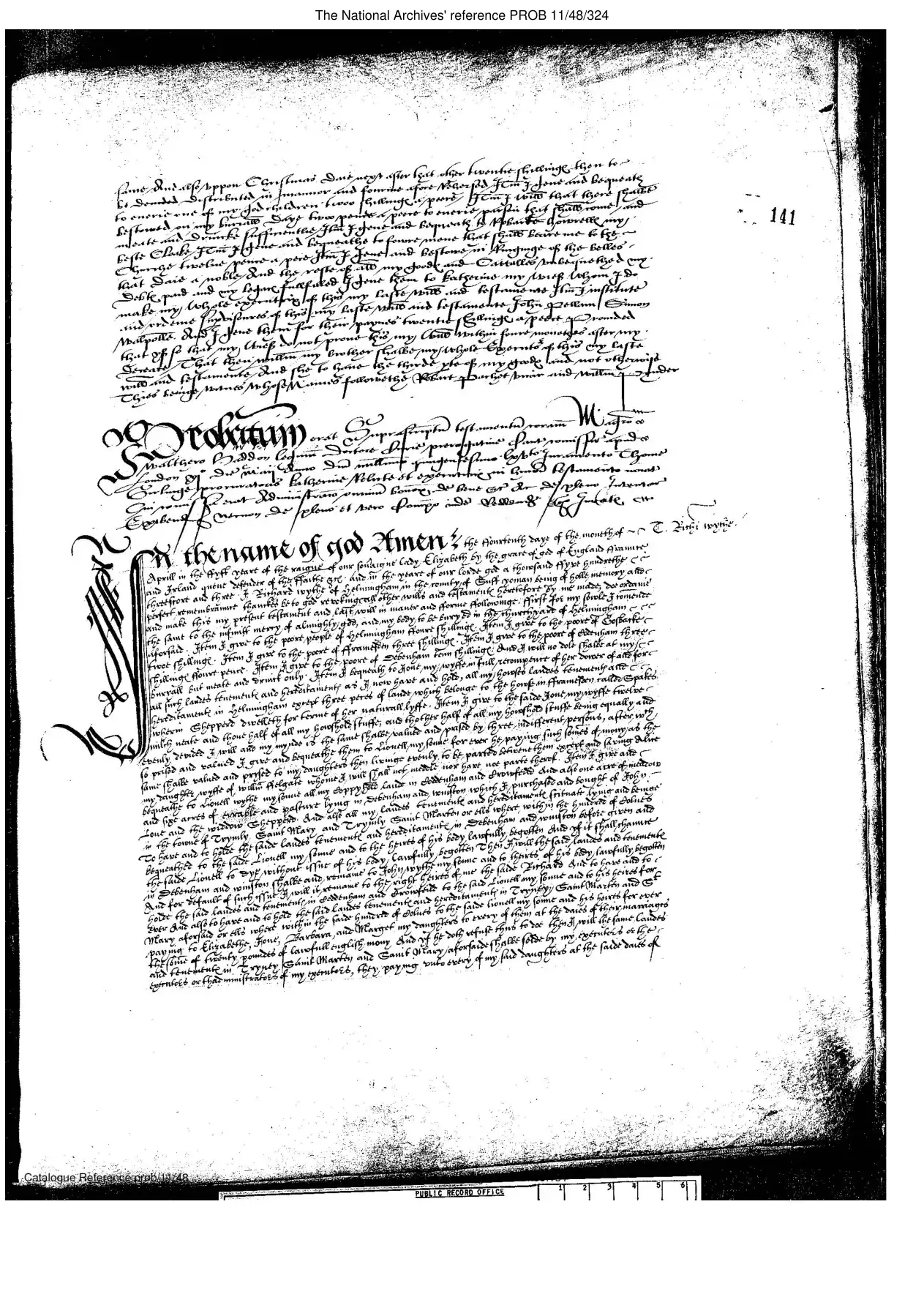
Richard Wythe’s original PCC will

The National Archives, PROB 11/48/324. Will dated 14 April 1563; probate 13 December 1565. The complete two-page archive download is preserved unchanged.

Open the original National Archives PDF

Grade A: original PCC will names Elizabeth as Richard’s daughter; original Helmingham marriage names Michael Bacon and Elizabeth Wythe on 18 November 1565. Established Felgate correlation identifies the daughter with the bride. Master proof: pp. 1525-1527.

Richard Wythe PCC registered will, archive page 1
Archive page 1 of 2. Select to open the original PDF.
Richard Wythe PCC registered will, archive page 2
Archive page 2 of 2. Select to open the original PDF.

New evidence review · 13 November 2026

Joan Wythe: the widow behind the will

The original probate places Joan alive on 13 December 1565. The property clauses open specific research paths in Suffolk, while the dated evidence excludes the proposed Jane Radcliffe identity. Joan remains A/B; Richard remains A. No ancestor is added.

Open the four-page illustrated evidence review

Joan Wythe | identity and widowhood

#122371 / #122627 | Generation 16 | A/B retained

The original PCC probate supplies a firmer life marker for Joan: living on 13 December 1565, when her proctor proved Richard Wythe’s will on her behalf as widow and executrix. Richard remains Grade A; Joan’s established correlated maternity remains A/B. No new person, parent, surname, military service or pedigree position is admitted.

The original probate

TNA PROB 11/48/324, second archive page, Latin act below the witnesses: “procuratoris Joanne relicte et executricis”. This identifies the proctor of Joan, widow and executrix. The act is dated 13 December 1565 and reserves power to the other executors, John and Lionel Wythe. It does not require Joan to have attended the London court personally. Original image: master p. 1524.

Radcliffe identity excluded

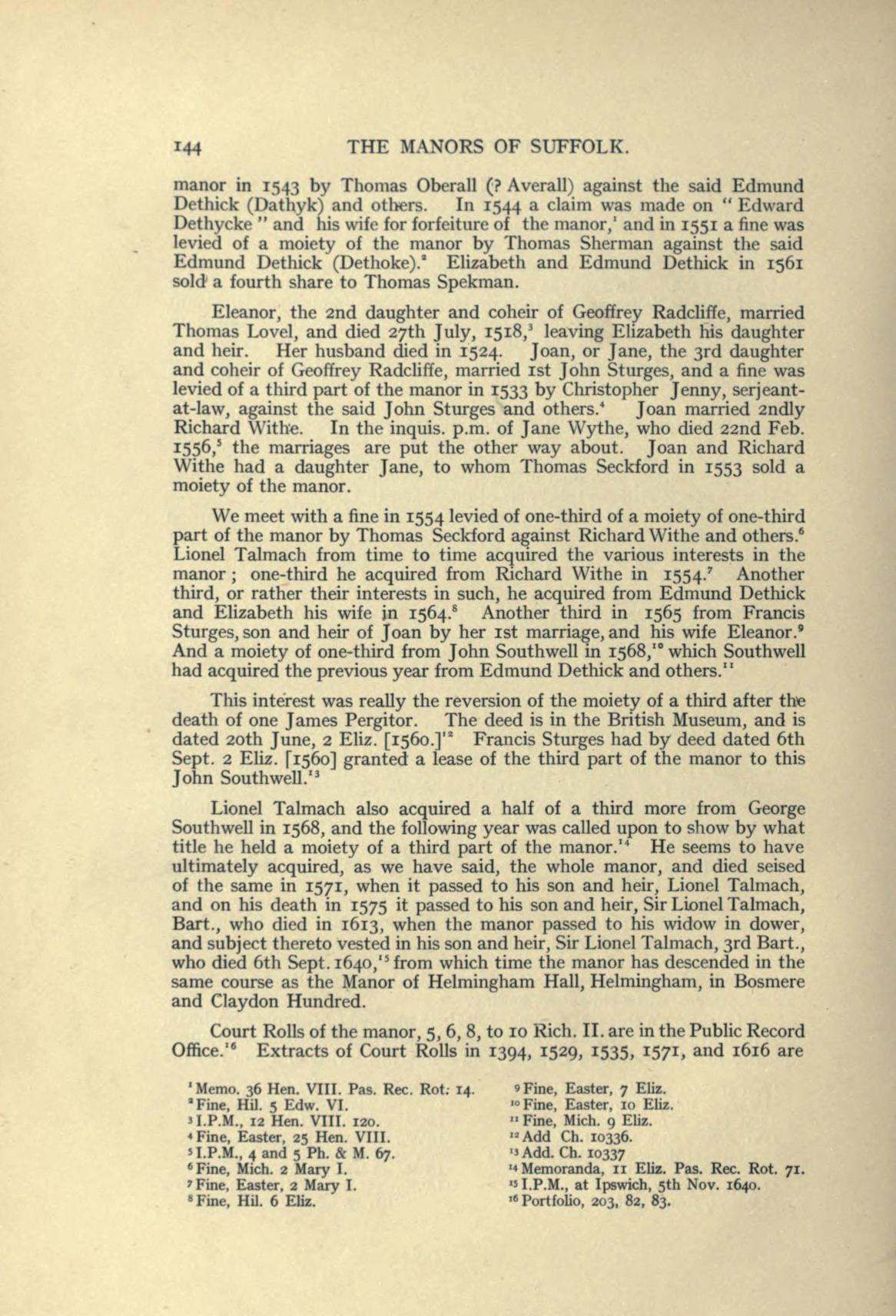
Copinger, The Manors of Suffolk, VII, printed p. 144, describes Joan/Jane Radcliffe’s Sturges and Withe marriages and reports Jane Wythe’s death on 22 February 1556. The National Archives independently catalogues her inquisition post mortem as C 142/114/67, dated 4 & 5 Philip and Mary (1557-1558). That deceased woman cannot be the Joan represented as living widow and executrix in December 1565. The Radcliffe identification is excluded on this chronology; no noble gateway is attached.

Date and source controls

The supplied return expands the printed death year to 1556/57. Retain that as the reported old-style interpretation pending the original IPM text. Copinger himself notes conflicting marriage order; his page names Geoffrey Radcliffe, whereas the supplied return names John. Neither collateral parentage nor marriage order is imported into this pedigree. These discrepancies do not erase the decisive before-1565 death versus living-1565 distinction.

Record access

IPM catalogue: discovery.nationalarchives.gov.uk/details/r/C7823735. Printed source image: p. 1531 below. The original IPM manuscript has not been inspected in this review.

Richard’s will | property and family leads

The two original PCC pages remain unchanged on pp. 1523-1524. The fuller supplied reading identifies useful property and household details. The following records the observed places and operative structure without converting a property association into an additional parent.

Helmingham and the Framsden exception

Joan receives the Helmingham house and lands for life in recompense of dower, except three pieces belonging to the Framsden house called Spekes, occupied by Sheppard. Lionel takes the later Helmingham interest under the stated remainders. The separate Framsden provision benefits son John for life, then grandson John, son of the deceased eldest son Francis.

Trimley St Mary and Trimley St Martin

The will devises lands in both Trimley parishes and elsewhere within Colneis Hundred to Lionel. The provision charges him with portions for Elizabeth, Jone, Barbara and Margaret at marriage, with a sale mechanism if he refuses payment. These parishes are specific leads for earlier title and manorial admission searches.

Wherstead, Hadleigh and Horesfild

The second page describes lands in Wherstead, lands in Hadleigh, and a lease called Horesfild shared by Joan while unmarried and Lionel, with Lionel taking the whole lease after her death or remarriage. These are recorded property interests, not proof of Joan’s birthplace or natal surname.

Debenham, Winston, Coddenham and Crowfield

The first page distinguishes a purchased meadow/arable/pasture holding in Debenham and Winston from copyhold land in Coddenham and Crowfield. The purchase and remainder clauses should be compared with the earlier deeds and manorial rolls before assigning any holding a maternal origin.

Household provisions

Joan receives twelve milch cattle and half the household goods. The remaining household goods are valued for the daughters, excluding the already-married daughter who is the wife of William Felgate. The marriage portions and the executors’ duty concerning the children strengthen the household reconstruction; they do not explicitly say that every child was born to Joan.

Interpretation boundary

A dower-recompense clause by itself does not reconstruct every earlier conveyance or prove that no property ever came through a wife’s family. The supplied maternal-property hypothesis remains a research lead. Likewise, a shared lease or a witness association alone does not establish biological maternity or kinship.

Joan’s Chancery record | exact next targets

C 3/79/20: catalogue verified

The National Archives catalogue identifies two related proceedings. (i) Harebottell v Wythe: plaintiff John Harebottell; defendants Joan Wythe, John Wythe and Lionel Wythe; manor of Crowfield Booking and lands in Crowfield, Coddenham and other specified Suffolk places. (ii) Wythe v Harebottell: plaintiffs John and Lionel Wythe; defendant John Harebottell.

Joan is a named defendant in the first proceeding. The catalogue dates the file broadly to 1558-1579. Its description alone does not establish that she personally spoke as plaintiff, identify her parents, or prove that she was still living in 1570. Inspect the pleadings and compare the 24 November 1570 decree C 78/46/3 for the precise chronology.

Prioritized archive requests

1. TNA C 3/79/20: request every surviving pleading and endorsement in both proceedings; record parties, dates, capacities, kinship wording and title recitals. Catalogue: discovery.nationalarchives.gov.uk/details/r/C3778212.

2. TNA C 142/114/67: obtain the original Jane Wythe inquisition and transcribe the death, marriage and heir clauses to confirm the printed abstract and its year style.

3. Manorial admission and surrender records for the specifically named Trimley, Wherstead and Crowfield Booking properties: establish the manor and surviving series before ordering. The supplied HA119 lead is not treated as a verified match to every parcel.

4. Search Joan’s later will/administration and the identified Howard/Brockdish records. A Howard witness is not evidence of a Howard father; the supplied affinal explanation requires its own source correlation. No Howard or Radcliffe parent is admitted.

Ahnentafel and count controls

Joan’s father would occupy #244742 / #245254; her mother #244743 / #245255. These are vacant positions, not four added people. Arithmetic: father = 2 x child; mother = 2 x child + 1. Current total: 217 unique ancestors, 247 occupied ancestral positions, ten Patriots and Generations 0-20.

Transcript status

The full supplied return is preserved as research history in the master and linked below. Its will text includes ellipses, summarized remainders and interpretive insertions, so it remains a working transcription. The inspected evidence and source distinctions in this review govern the current account.

Copinger, Manors of Suffolk volume VII page 144: Jane Wythe death abstract and IPM citation
Copinger, The Manors of Suffolk, VII, printed p. 144. A published secondary abstract, not the original inquisition. Select the image for its full-size copy.

Jane Wythe inquisition catalogue · Harebottell–Wythe Chancery catalogue · Copinger’s scanned volume

Research return and transcription history

Read the unchanged supplied research return. It includes working interpretations; the reviewed account above distinguishes verified records from remaining hypotheses.

13 November 2026 · Original-record relationship upgrade

John Wythe: a father and son in the 1495 Holme will

John Wythe the Elder (#489480 / #490504) → John Wythe the Younger (#244740 / #245252): Grade A paternal relationship. Combined register badges remain A/B. The younger John’s separate paternity of Richard remains Strong B+; Alice’s maternity remains B. No ancestor is added.

Open the complete original three-page National Archives will · Read the three-page evidence review

John Wythe | original-record proof upgrade

Wythe evidence update · no additional ancestor in this review

John Wythe the Elder #489480 / #490504 → John Wythe the Younger #244740 / #245252: Grade A paternal relationship. The combined register display remains A/B. The younger John’s separate relationship to Richard remains Strong B+ (A/B display); Alice’s maternity remains B (A/B display).

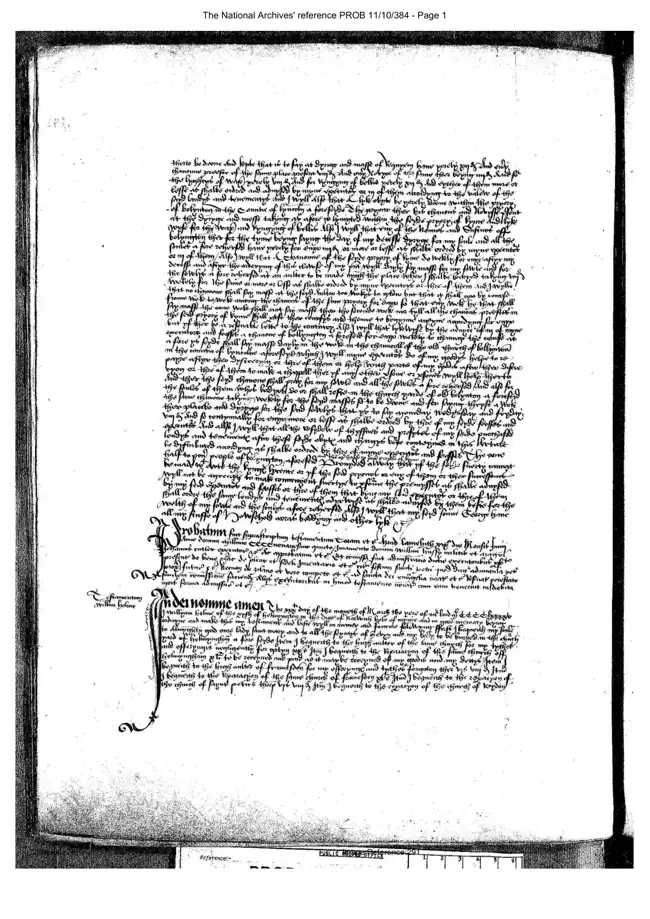
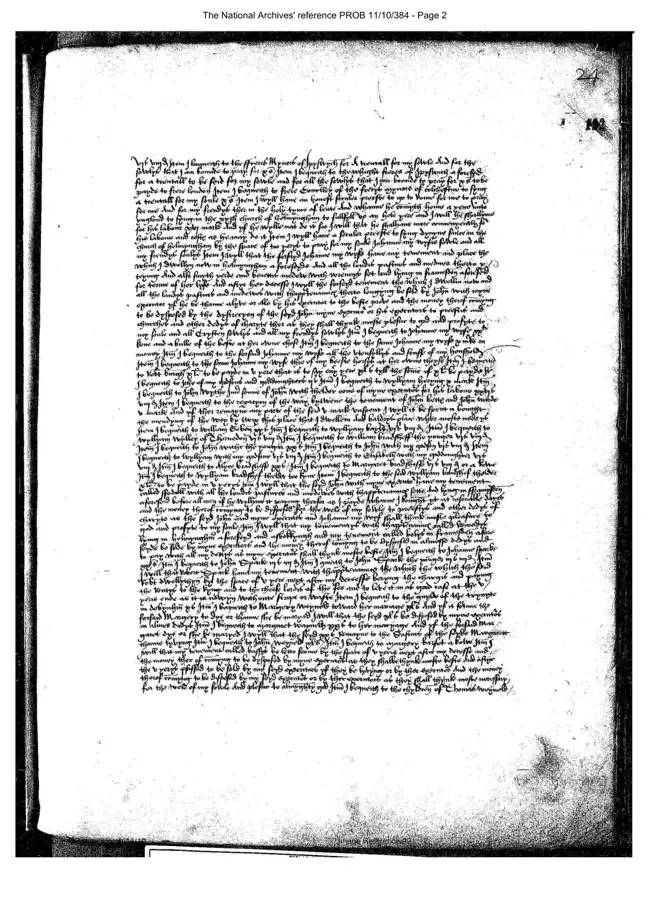
The original source

The National Archives, Kew, PROB 11/10/384, Prerogative Court of Canterbury, Register Vox, quire 24 (24 Vox), reported fols. 191v–192v. William Holme of Helmingham, Suffolk. Will dated 30 March 1495, with 25 March a paleographic alternative; proved at Lambeth 24 June 1495. All three archive PDF pages follow on master pp. 1535–1537 and are embedded unchanged as a downloadable attachment.

Father and son in the will

PDF p. 2, reported fol. 192r, line 25: “John wyth [the/and?] sonne of John wyth thelder oone of myne executoris for his laboure”. The next line completes the legacy, 26s. 8d. The uncertain intervening graph is retained rather than silently normalized. The final appointment identifies “John wythe the yonger” with Johanne, Holme’s wife, as executors (PDF p. 3, reported fol. 192v, lines 5–6).

Executor identity and probate

The repeated singular executor references, the final younger-John appointment and the probate act support the report’s single-person reading. The act names John Wyth personally present and Joan Holme represented through her proctor, Richard Croke. The document provides direct father–son wording; the wider identity chain is correlated with the Helmingham records on the next page.

Scope of the grade

The Grade A conclusion applies to the elder-to-younger paternal relationship. It does not upgrade every downstream identity or establish Alice’s natal family. The A/B combined badge preserves the supplied-transcript limitation in the onward identification with the 1538 testator.

Helmingham | identity and citation sequence

Original manuscript, archival abstracts and transcripts remain distinct.

1486 — HD 1538/253/123

The 8 November lease abstract pairs John Wythe senior with John Wythe, his son. This is an archival abstract; its parchment has not been newly inspected here. The church-tower association with William Holm is reported through Bodleian MS Tanner 138, f. 87 and PSIAH 43:4 (2016), p. 662.

1495 — PROB 11/10/384

Original PCC registered will inspected in the supplied three-page PDF. The father–son passage, younger-John executor appointment and personal appearance in the probate provide contemporary identification. The reported line numbers are locators in the research report, not printed archive line numbers.

1498 — HD 1538/253/134

The cited abstract concerns the Holme estate conveyance. The report correlates it with execution of the will. A transfer made under an executor’s authority is not, by itself, a maternal inheritance.

1500 and 1503 — HD 1538/253/137 and /139

The cited abstracts place John junior and Margaret at Bocking Hall on 2 December 1500, and John senior with Margaret on 6 April 1503. The senior/junior change is correlated with the elder John’s 1501 death; it does not create an extra John.

1501 — IC/AA2/4/20

The supplied will transcript names son John, sons and other descendants, and wife Alys in a commemorative provision. Probate is reported as 3 May 1501. Its heading gives 14 April, while “Wednesday before St George’s Day” is interpreted as 21 April. Both readings remain visible pending the registered manuscript.

1538 — IC/AA1/10/175 / IC/AA2/13/176

The supplied transcript, dated 8 October 1538, names Richard as son and Margaret as wife. Bocking Hall, the Framsden and Helmingham properties, and Chancery references C 1/1081/65 and C 1/1085/74–75 support identity correlation. The 1538 original has not been newly viewed in this update; the younger John’s downstream grade is not promoted.

Alice Wythe | limits and remaining sources

Existing ancestry preserved; no Holme admission.

Alice/Alys Wythe #489481 / #490505

Her maternity remains Grade B with A/B combined display. The 1495 will does not identify her as a daughter or sister of William Holme. The Holme sibling hypothesis remains C; William’s proposed fatherhood and the proposed John Holm of Thorndon parentage remain C–. No natal surname or new parent is added.

What the property clauses establish

John Wyth is empowered to sell the Helmingham home after Johanne’s death if he is then living, otherwise through his executor. He has a preferential purchase option concerning Smyth wode and Wrongis londe in Framsden, described as “before all men yf he wyll within x marke”. The report interprets this as a ten-mark preference. It supplies a possible purchase mechanism, not proof of inherited maternal title or of a completed purchase.

Childlessness and competing explanations

No “without issue” declaration has been identified. Having no surviving children is a probable inference from the testamentary scheme, not an explicit biological fact. Testamentary silence does not affirmatively exclude a predeceased daughter. Executorship, godchildren and shared property dealings also admit non-kin explanations. The two Holm families in the 1457 charter remain distinct.

Exact remaining archival targets

Suffolk Archives IC/AA2/4/20 (1501 will) and IC/AA1/10/175 / IC/AA2/13/176 (1538 will); HD 1538/253/97 (24 June 1457) and /134 (1498); IC/AA2/2/300 (Cretingham Holme will); Norfolk Record Office, NCC Typpes, f. 136 (1497 John Holme will), reported FHL film 94868 / DGS 8422159, item 2. These are research targets, not new ancestor assignments.

Preservation and source controls

The full supplied 13 November proof report is embedded unchanged as research history. This incorporation retains the report’s March date alternative, 24 June probate, unresolved intervening word, source tiers and protected counts. Original archive pages 1–3 follow without cropping or replacement. The A/B summary badges and the separate Grade A paternal relationship are both intentional.

William Holme original PCC will page 1: Opening: William Holme’s testament begins beneath the preceding probate
Archive PDF page 1. Opening: William Holme’s testament begins beneath the preceding probate. Select the page to open the original PDF.
William Holme original PCC will page 2: Father–son clause and property provisions
Archive PDF page 2. Father–son clause and property provisions. Select the page to open the original PDF.
William Holme original PCC will page 3: Younger John’s executor appointment and the 24 June probate
Archive PDF page 3. Younger John’s executor appointment and the 24 June probate. Select the page to open the original PDF.
Full research report and source history

Read the supplied proof report. The review preserves uncertain readings, distinguishes abstracts from inspected manuscripts, and retains the unadmitted Holme hypotheses separately.

13 November 2026 · Independent parentage corroboration

Richard Wythe and his sons in Chancery

Richard Wythe #122370 / #122626 remains Grade A. The 24 November 1570 decree names John and Lionel as his sons. These are Elizabeth’s brothers; the plaintiff John is not Richard’s father. No new direct ancestor is added.

Richard Wythe | his sons in Chancery

24 November 1570 | TNA C 78/46, no. 3 | Richard remains Grade A

Richard Wythe of Helmingham (#122370 / #122626), already admitted at Grade A as the father of Elizabeth Wythe Bacon, is independently identified in this decree as the father of the plaintiffs John and Lionel Withe. The two sons are collateral relatives in the present direct-line register; they receive no new Ahnentafel positions.

The explicit parentage

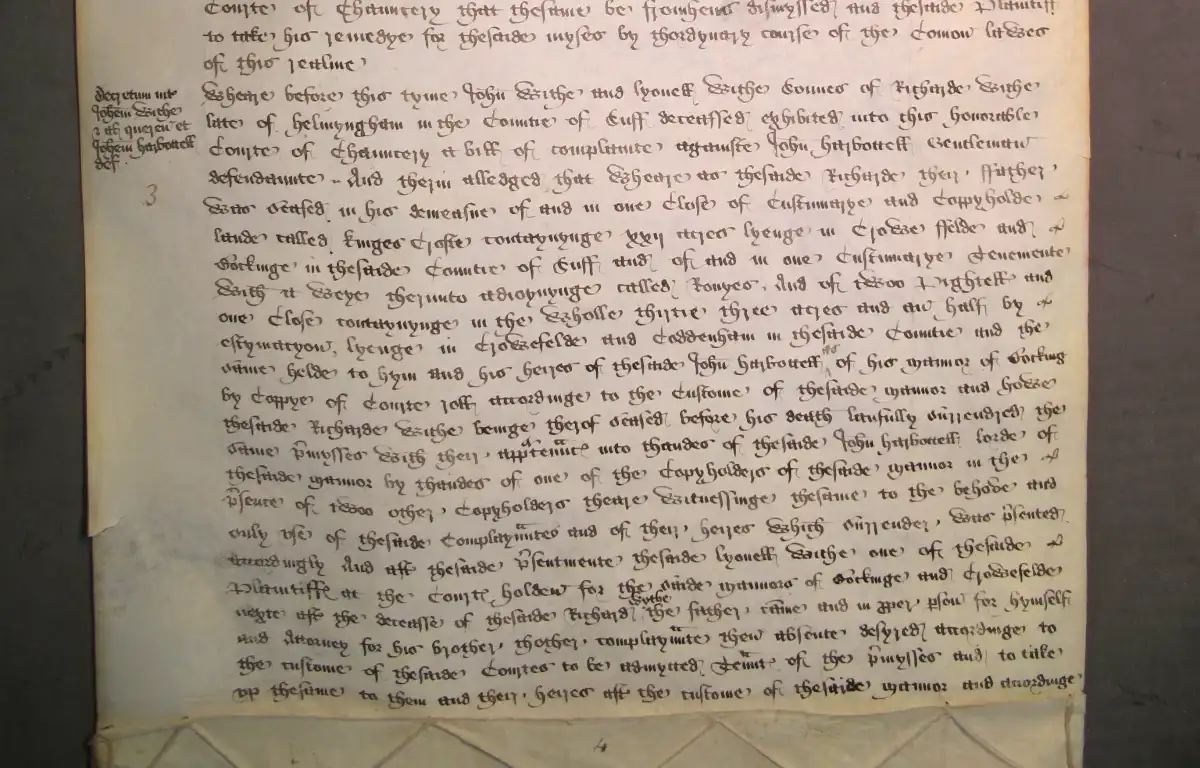
The opening of entry no. 3 reads: “John Withe and Lyonell Withe sonnes of Richarde Withe / late of Helmyngham in the Countie of Suff[olk] deceassed”. It then calls Richard “their ffather”. The account names Lionel acting in person for himself and as attorney for his absent brother. These relationship clauses are visible in AALT frame IMG_0007.

Property passing from father to sons

The decree recites Richard’s surrender of the customary holdings to the use of the two plaintiffs and their heirs. Lionel sought admission after Richard’s death. The final order directs admission according to the ancient copies and “their ffathers will and surrender” (IMG_0009–0010). This reinforces the identification of the deceased Helmingham Richard and the two sons already named in his PCC will.

Which John is this?

The plaintiff John is Richard’s son, a brother of Lionel. He is not John Wythe #244740 / #245252, Richard’s father, and not the elder John #489480 / #490504. The document does not provide Richard’s own father’s name. It therefore cannot by itself upgrade the earlier John-to-Richard relationship.

Result for the register

Richard remains A. His father’s downstream relationship remains Strong B+ with combined A/B display; the separate elder-to-younger John relationship retains its existing A conclusion. No wife, daughter or mother is named in this decree. Joan’s maternity and Elizabeth’s existing identity evidence are not independently upgraded by it. This Wythe review adds no person. The current Green Cove edition holds 217 unique ancestors, 247 ancestral positions, ten Patriots and Generations 0–20.

The decree | source and reading controls

Civil property litigation, not military service

John and Lionel Withe sued John Harbottell, lord of Bocking manor, over customary holdings in the Crowfield, Bocking and Coddenham area. The decree records disputed admission, an allegation of timber waste, four years of profits taken by the defendant and an order to admit the plaintiffs. This is evidence of kinship and tenure, not armed service. Sir Nicholas Bacon appears as Lord Keeper; the office does not establish a family connection to the Bacon ancestors.

Date and record sequence

The final order is dated 24 November, 13 Elizabeth I (1570). It recites an earlier 20 January order and referral of depositions on 15 November. These are procedural dates; none supplies an exact death date for Richard. The four downloaded photographs are full frames, including overlapping lines and adjacent cases. Entry no. 3 begins in the lower portion of IMG_0007 and ends in the upper portion of IMG_0010.

Citation

The National Archives, Chancery decree rolls, C 78/46, no. 3, Withe v Harbottell, 24 November 1570; Anglo-American Legal Tradition (AALT), C78no46, IMG_0007.jpg–IMG_0010.jpg. Retrieved and inspected 13 November 2026. Direct repository images: http://aalt.law.uh.edu/AALT7/C78/C78no46/IMG_0007.jpg (then IMG_0008, IMG_0009 and IMG_0010 in the same directory).

Supplied transcription preserved

The complete supplied Markdown transcription is embedded unchanged in this PDF and linked from Richard’s website profile. Its brackets, doubtful readings and summary are retained as the transcriber’s work. The parentage, brotherhood and concluding will-and-surrender clauses were checked against the photographs. This incorporation does not certify every letter of the full transcription.

Do not silently resolve uncertain readings

The supplied text marks uncertainties in the field names, acreage, witness name and monetary amount. Its account of the “other land” and waste finding requires further diplomatic checking before being used as a precise boundary conclusion. No parentage conclusion here depends on that passage. The secure family clauses stand separately from these property-reading questions.

Evidence placement

Richard’s profile on p. 1505 links to this review on pp. 1538–1539. The four complete AALT photographs follow on pp. 1540–1543. Existing will evidence, earlier source pages and all Ahnentafel numbers remain in place.

Four original photographs

Complete frames hosted by AALT, including overlaps and adjacent entries. Entry 3 begins in the lower part of frame 7 and ends in the upper part of frame 10. All four photographs are preserved in the master on pp. 1540–1543.

Opening of the 1570 decree naming John and Lionel as sons of Richard Withe
Existing detail of the explicit parentage clause. Select for the complete repository photograph.
Read the complete supplied transcription

The transcription is preserved as supplied; doubtful readings remain marked. The review above distinguishes checked parentage clauses from other readings.

Download the supplied transcription

# TNA C 78/46, no. 3: Withe v Harbottell, Chancery final decree, 24 November 1570 (13 Elizabeth I)

**Source images** are AALT photographs of TNA C 78/46, copied to the box at /workspace/c78_46_3/:
- IMG_0007.jpg: the end of entry no. 2, then the start of entry no. 3 (about 55% of the way down), up to the parchment join marked "4"
- IMG_0008.jpg: the top lines repeat the end of IMG_0007; the entry continues to the bottom edge
- IMG_0009.jpg: the top repeats the end of IMG_0008; the entry continues past the join marked "5"
- IMG_0010.jpg: the top two lines repeat the end of IMG_0009; entry no. 3 ends about a quarter of the way down, and entry no. 4 (Sutley[?] & Prynce v Jenyns & others) begins

The AALT frame URLs follow the pattern http://aalt.law.uh.edu/AALT7/C78/C78no46/IMG_000N.jpg.

**Conventions**
- Spelling is kept as written.
- Abbreviations are expanded in [square brackets].
- [?] marks a doubtful reading.
- " / " marks a line break on the roll.
- [...] marks text I couldn't read.
- Line breaks across frames follow the images. Text repeated at the top of a frame is not transcribed twice.

**Language:** the text is Tudor English, apart from the Latin margin heading and the Latin court day "Crastino Animar[um]".

**How this was made:** this is a re-reading of all four frames made in one pass from enhanced crops in /workspace/c78_46_3/tiles/. Where it differs slightly from my earlier reports, this file is the later and more careful reading.

---

## Transcription

**[Margin, IMG_0007]** Decretum int[er] Joh[ann]em Withe & al[ium] quer[entes] et Joh[ann]em Harbottell def[endentem].   3

**[IMG_0007]**
Where before this tyme John Withe and Lyonell Withe sonnes of Richarde Withe / late of Helmyngham in the Countie of Suff[olk] deceassed exhibited into this Honorable / Courte of Chauncerye a bill of complaynte agaynste John Harbottell Gentleman / defendaunte. And therin alleged that where as the saide Richarde their ffather / was seased in his demeane of and in one close of Customarye and Coppyholde / lande called Kinges Crofte[?] conteynynge xxij[?] acres lyenge in Crowe ffelde and / Bockinge in the saide Countie of Suff[olk] and of and in one Customarye tenemente / with a yarde therunto adioynynge called Fonyes[?]. And of two Pyghtells and / one close conteynynge in the whole thirtie three acres and an halfe by / estimacyon lyenge in Crowefelde and Coddenham in the saide Countie and the / same holde[n] to hym and his heires of the saide John Harbottell [...][?] of his manno[r] of Bockinge / by coppye of Courte roll accordinge to the custome of the saide manno[r] and wh[er]e[?] / the saide Richarde Withe beinge therof seased before his deathe lawfully surrendred the / same premysses with their app[ur]ten[a]nc[e]s into thandes of the saide John Harbottell lorde of / the saide manno[r] by thandes of one of the Copyholders of the saide manno[r] in the / p[re]sence of two other Copyholders there witnessinge the same, to the behofe and / onely use of the saide Complaynantes and of their heires, which surrender was p[re]sented / accordingly. And at the saide p[re]sentmente the saide Lyonell Withe one of the saide / Plaintiffes at the Courte holden for the saide manno[r]s[?] of Bockinge and Crowefelde / next after the deceasse of the saide Richarde ^Withe^ the father, came and in p[er]son for hymselfe / and Attorney for his brother, thother Complaynante then absente, desyred accordinge to / the custome of the saide Courtes to be admytted tenante of the premysses and to take / up the same to them and their heires as the custome of the saide manno[r] and accordinge

*[parchment join, pencilled "4"]*

**[IMG_0008]**
to the fourme and effecte of the saide surrender of the saide Richarde their ffather. / Wherunto at that tyme ffrowarde[?] and dilletory answeres were made by the Stewarde of the / saide Courte. Directe[?] answere was made by the saide Stewarde of the saide manno[r]s / that the saide Plaintiffe shoulde not be admytted tenaunte for that the same premysses / were forfeited into the lordes handes for that at the other Courte for the saide manno[r] / next after the deathe of their saide ffather holden both the saide Plaintiffes in their / p[ro]per p[er]sones were not there p[re]sente to take up the same. Wherupon the saide John / Harbottell gat and deteyned the possession of the premysses into his owne handes. ffor / the which cause the saide Plaintiffe p[ro]cured processe agaynste the saide defendaunt, who / afterwarde appeared and made answere affirmynge that the same premysses were no / auncient Customarye or Coppyholde lande and howe that the saide Plaintiffe had also / made a forfeiture therof in fellinge of certayne Tymber growinge uppon the premysses / as in his saide answere more at lardge appereth. Wherunto the saide Plaintiffe replyed / and the defendaunt reioyned and so discended to a p[er]fecte and full yssue, and wytnes examyned / on both p[ar]tes and publicacyon graunted, and a daie appoynted for the hearinge of the same. / At which daie the parties beinge p[re]sente togeather with their lerned councell, before / whom the bookes pleadinge and deposicions were openly redd, thallegacions & chardges / and the circumstaunce therof weyed and considered, the [...][?] / on either syde deliberately harde, and the / xx^th^ daie of January laste past beinge, yt was ordered in this matter and in theis wordes: / In the matter of Copyh[o]ld[?] betwene the saide parties uppon the full hearinge and debatinge / therof, fforasmuche as this Courte cannot procede to the ffynall ende and determynacion of the / cause in question for wante of sufficient p[ro]fe of such allegacions as were this daie / alleged on the behalfe of the saide Defendaunte, that ys to saie, that the saide Plaintiffe / had made waste and spoyle in and uppon the Coppyholde lande in question in fellinge / and carienge awaie Tymber growinge and beinge in and uppon the saide Coppye holde / lande contrarie to the custome of the saide manno[r] sithens a decree heretofore made / in this Courte for the saide Plaintiffe, by reason wherof as yt ys alleged the saide / Plaintiffe have made a forfeyture of the saide Coppye holde lande, It ys therfore ordered / that the saide Defendaunt shall and maie take out a Commission to examyne wytnesses touchinge / the p[ro]fe of the saide allegacions, wherin the Playntiffe maie ioyne yf they will, uppon / Interrogatories to be mynystred unto such p[er]sone or p[er]sons as shalbe examyned by v[er]tue / of the saide Commission, that ys to saie, whether any waste hath ben done by the saide / Playntiffe sithens the saide decree made in this Courte. And whether the tenaunte / maie by the custome of the saide manno[r] fell any tymber growinge in or uppon the / premysses without licence fyrste had and obteyned of the lorde of the same manno[r]. / And also whether one Mathewe[?] Goodinge beinge examyned on the behalfe of the / saide Defendaunte have sithens his saide examynacion saied that he did mystake the saide / lande contrarie to his former deposicion. Which Commission to be retorned and certified into / this Courte by Crastino Animar[um] next cominge. In the meane tyme the Plaintiffe to / have the possession of the premysses agaynste the saide defendaunte. And the defendaunt / to p[er]mytte and suffer the saide Plaintiffe quetly to have holde occupie and enioye the / same without lett or disturbaunce of the saide Defendaunte or of any other p[er]sone or p[er]sons / [...][?] in his name or by his meanes consente or procuremente. And if the saide defendaunt do / not by the saide Crastino Animar[um] by testymony of wytnesses bringe into this Courte sufficient / p[ro]fe in manner and fourme aforesaide, It ys then further ordered that the saide Playntiffe, / their heires and assignes shalbe admytted tenaunte of the saide Coppie holde lande in / question by coppie of Courte roll, yeldinge payenge and doinge unto the chiefe lorde / therof all such ffynes rente sutes and dutie which on their parte are to be p[er]fourmed / fullfilled and done accordinge to the custome of the manno[r] as ys aforesaide. At which

**[IMG_0009]** (the top repeats the end of IMG_0008)
tyme this Courte meaneth to take further order, as well for the meane proffitte and / commodities taken by the saide defendaunte as also for the coste and charges susteyned / by the saide Plaintiffe as in iustice and equytie shalbe thought mete, as by the saide order / made the saide xx^th^ of January laste appereth. After which order so made the Commission / mencioned in the same was executed and retourned accordinglie. And therupon on / Wednesdaie the xv^th^ of November this presente terme yt was by this Courte ordered / in this matter betwene the saide parties and in theis wordes: It ys ordered that the / deposicions taken by vertue of a Commission which heretofore yssued out of this Courte / touchinge the p[ro]fe of waste supposed to have ben commytted by the saide Plaintiffe in and uppon the / Copye holde lande in question and other thinges mencioned in the order made in this Courte / the xx^th^ of Januarye, accordinge to the tenor and effecte of the same, be referred to the / consideracion of maister Doctor Huyck and maister Doctor Hussey, two of the maisters of this / Courte, to be by them perused and considered, and they therof to make reporte to this Courte. / Wherupon such further order shalbe taken as to the same shalbe thought mete. And afterwarde, / that ys to saie the xxiiij^th^ of November beinge ffridaie, the saide maister doctor Huyck and / maister doctor Hussey havinge perused and considered the saide deposicions and examynacions taken / and retorned into this Courte as ys aforesaide, they made in open Courte reporte of the same, / viz. that the saide Defendaunt had not p[ro]ved any waste to be done uppon the saide premysses / by the saide Plaintiffe or by any other by their assente, other then that the saide defendaunte / inferred[?] a waste to be by the saide Plaintiffe suffered to be done in and uppon other lande / which the saide defendaunt p[re]tended to be p[ar]cell of the saide premysses, which is also sufficiently / proved by the saide Plaintiffe that the same was or is accompted to be p[ar]cell of the saide / lande in question. And also the saide maister Huyck and maister Hussey made further reporte / that yt was also sufficiently proved on the Plaintiffes behalfe that the saide defendaunte occupied / the same premysses in question by the space of foure yeres, and that he did receave and / take the p[ro]fitte therof, and that the same was worth by the yere eight or nyne poundes. / It ys therfore this p[re]sente terme of Seinte Michaell, that ys to saie the saide xxiiij^th^ daie / of November in the xiij^th^ yere of the reigne of our moste gracious Soveraigne ladye Elizabeth / by the grace of god queene of Englande ffraunce and Irelande defendor of the faith &c, by / the right honorable Syr Nich[ol]as Bacon knight lorde keper of the greate Seale of / Englande and by the saide Courte of Chauncerye ordered adiudged and decreed that the saide / defendaunte shall forthwith or at the nexte Courte to be holden for the saide manno[r] of / Bockinge admytte the saide Plaintiffe tenaunte to the premysses in question, To have and to / holde the same to the saide Plaintiffe and their heires accordinge to the auncient Coppies and

*[parchment join, pencilled "5"]*

**[IMG_0010]** (the top two lines repeat the end of IMG_0009)
their ffathers will and surrender, and quyetly from hensforth p[er]mytte and suffer the saide Plaintiffes / their heires and assignes to have holde occupie and enioye the same accordinge unto the saide / auncyent graunte and the custome of the saide manner, the saide Plaintiffes their heires and / assignes payenge and doinge to the saide Defendaunte his heires and assignes lordes of the saide / manner th[e] accustomed[?] fyne rente sutes and dutie therof due and accustomed. And also that / the saide Defendaunte shall at or on thisside the feaste of Easter next paye or cause to be / paide unto the saide Plaintiffes or their assignes the some of xxx^li^[?] in full satisfaccion for / the p[ro]fitte of the p[re]mysses receyved by the saide Defendaunte for the saide foure yeres, the saide / Plaintiffes yeldinge and allowinge to the saide Defendaunte or his assignes the yerely rente due / and payable by them for and duringe the saide foure yeres for and concernynge the p[re]mysses.

*[End of entry no. 3. The next line begins entry no. 4, "Where before this tyme Syr John Sutley[?] knight and Richard Prynce Gentleman Complaynantes…", with the margin heading "Decretum int[er] Joh[ann]em Sutley[?] mil[item] [et] [Ricardum] Prynce et [...] Jenynges[?] et al[ios]" and the pencilled number "4".]*

---

## Plain-English summary

**The parties**
- **Plaintiffs:** John Withe and Lionel Withe, sons of the late Richard Withe of Helmingham, Suffolk.
- **Defendant:** John Harbottell, gentleman, lord of the manor of Bocking (Bockinge).

**The land**
- A copyhold close called Kinges Crofte[?], about 22[?] acres, in Crowfield and Bocking.
- A customary tenement with a yard, called Fonyes[?].
- Two pightles (small enclosures) and a close, about 33½ acres in all, in Crowfield and Coddenham, Suffolk.

**Tenure:** customary or copyhold land, held of Harbottell's manor of Bocking by copy of court roll according to the custom of the manor.

**The family background**
- Before he died, Richard Withe surrendered the land into the lord's hands. He did it through one copyholder, with two other copyholders as witnesses, to the use of his sons and their heirs. The surrender was presented at the manor court.
- At the next court after Richard's death (for Bocking and Crowfield), Lionel appeared in person for himself and as attorney for his absent brother John. He asked to be admitted tenant according to the surrender.
- The steward gave evasive answers and then refused. He said the land was forfeit to the lord because both heirs had not come in person to the court after their father's death.
- Harbottell then took the land into his own hands.

**The suit**
- **Harbottell's defence:** the land wasn't ancient copyhold at all, and the Withes had forfeited it anyway by felling timber on it.
- **20 January 1570:** after pleadings, witnesses and a hearing, the court couldn't settle the waste allegation. The claim was that the Withes felled timber against the custom after an earlier Chancery decree in their favour.
- **The commission:** Harbottell was allowed a commission to examine witnesses on three questions:
  - whether any waste had been done since that earlier decree
  - whether the custom let a tenant fell timber without the lord's licence
  - whether Mathewe[?] Goodinge had since admitted that his deposition mistook the land
- **Meanwhile:** the Withes were to have quiet possession. If Harbottell didn't prove his case by the morrow of All Souls (3 November), the Withes were to be admitted by copy of court roll. The court would then settle profits and costs.
- **Wednesday 15 November 1570:** the depositions were referred to two Masters in Chancery, Dr Huyck and Dr Hussey.
- **Friday 24 November 1570:** the Masters reported in open court:
  - No waste was proved on the land, by the Withes or by anyone with their consent.
  - The only waste alleged was on other land Harbottell claimed was part of the holding. The Withes showed that land was, or was counted as, part of the holding.
  - Harbottell had occupied the land for four years and taken its profits. It was worth £8 or £9 a year.

**The decree (24 Nov 1570, Michaelmas term, 13 Elizabeth; Sir Nicholas Bacon, Lord Keeper)**
1. Harbottell must admit the Withes as tenants, either right away or at the next court of Bocking manor. They hold to them and their heirs, following the ancient copies and their father's will and surrender.
2. From then on he must let them, their heirs and assigns hold and enjoy the land quietly, under the ancient grant and the custom of the manor.
3. In return they pay Harbottell, as lord, and his heirs and assigns the usual fines, rents, suits of court and dues.
4. **Profits:** by Easter next (1571), Harbottell must pay the Withes or their assigns **£30[?]** in full settlement for the profits he took over the four years.
5. **Rent offset:** the Withes must allow Harbottell the yearly rent they would have owed for those four years. The court took that off what he owed them, which fits £30 against four years at £8 to £9 a year.
6. **Costs:** the January order said costs would be dealt with later, but the final decree as entered awards **no costs**.

---

## Names

**People**
- John Withe, plaintiff, son of Richard
- Lyonell (Lionel) Withe, plaintiff, son of Richard
- Richard Withe, late of Helmingham, deceased, their father
- John Harbottell (Harbottel), gentleman, defendant, lord of the manor of Bocking
- Mathewe[?] Goodinge, a witness for the defendant
- Doctor Huyck and Doctor Hussey, Masters in Chancery. The record gives no first names. They are probably Dr Thomas Huick and Dr Laurence Hussey, but that identification is mine, not the record's.
- Sir Nicholas Bacon, Lord Keeper of the Great Seal
- Queen Elizabeth (in the regnal date)
- Unnamed: the steward of the manor, and the copyholders who took and witnessed the surrender

**Places**
- Helmingham (Helmyngham), Suffolk
- Manor of Bocking (Bockinge), Suffolk; Crowfield (Crowe ffelde, Crowefelde) is also named as a manor court
- Coddenham, Suffolk
- Kinges Crofte[?], a close
- Fonyes[?], a customary tenement

**Family relationships:** Richard Withe was the father of John and Lionel. His will and his surrender are both mentioned. No wives, daughters or other relatives are named.

**Perkins:** no Perkins appears anywhere in entry no. 3.

The record collection

Seven supplied exhibits. Select an image to open its full-size copy. Printed calendars identify records; they are not represented as original wills.

Richard Wythe | PCC calendar

Richard Wythe | PCC calendar
Cloke (1913), printed p. 31: Helmingham, 1565 With, Richard, 19 Morrison. Printed calendar; original will is TNA PROB 11/48/324.

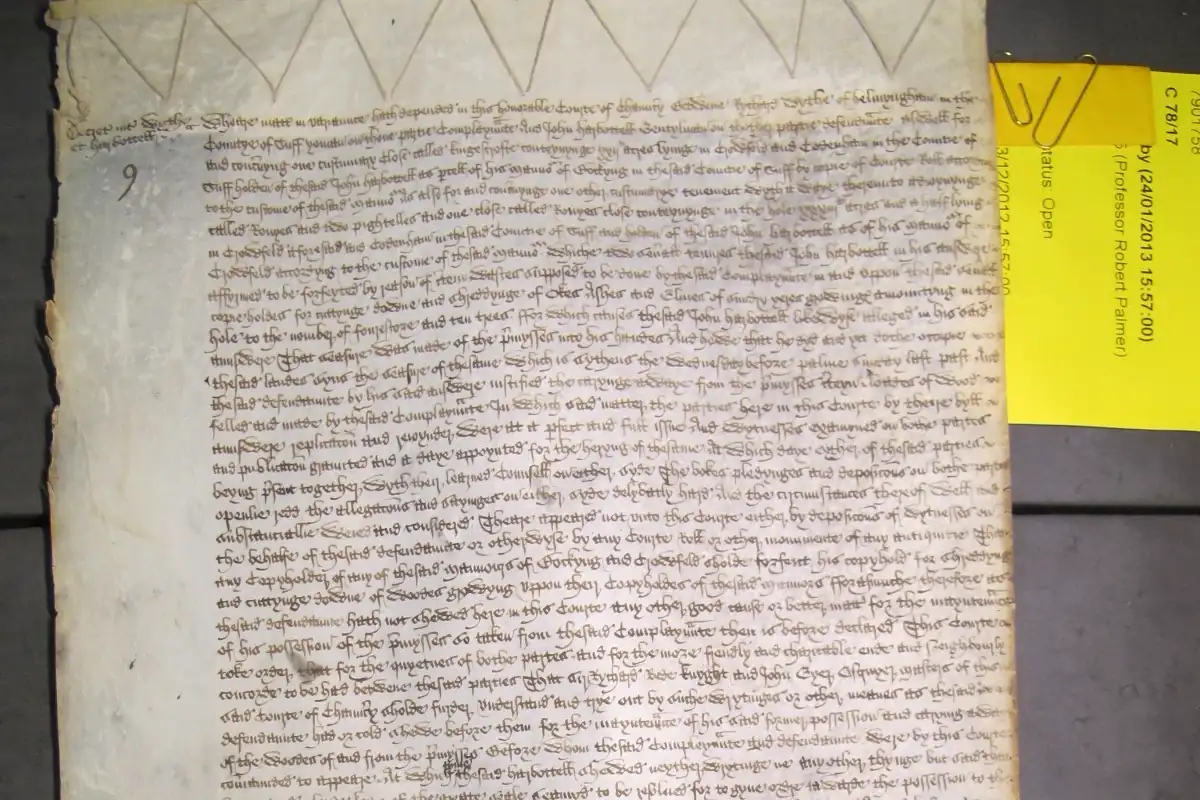
Richard Wythe | Chancery, 1560

Richard Wythe | Chancery, 1560
TNA C 78/17/9, 1 February 1559/60. Supplied manuscript detail from AALT; Richard Wyth of Helmingham and the Crowfield/Coddenham suit.

Lionell Wythe | succession recital, 1570

Lionell Wythe | succession recital, 1570
TNA C 78/46/3, 24 November 1570. Supplied manuscript detail; the recital identifies Richard as the plaintiff’s father.

Lionell Wythe | decree conclusion

Lionell Wythe | decree conclusion
TNA C 78/46/3, concluding membrane detail. Supplied manuscript image; keep its civil property context distinct from military service.

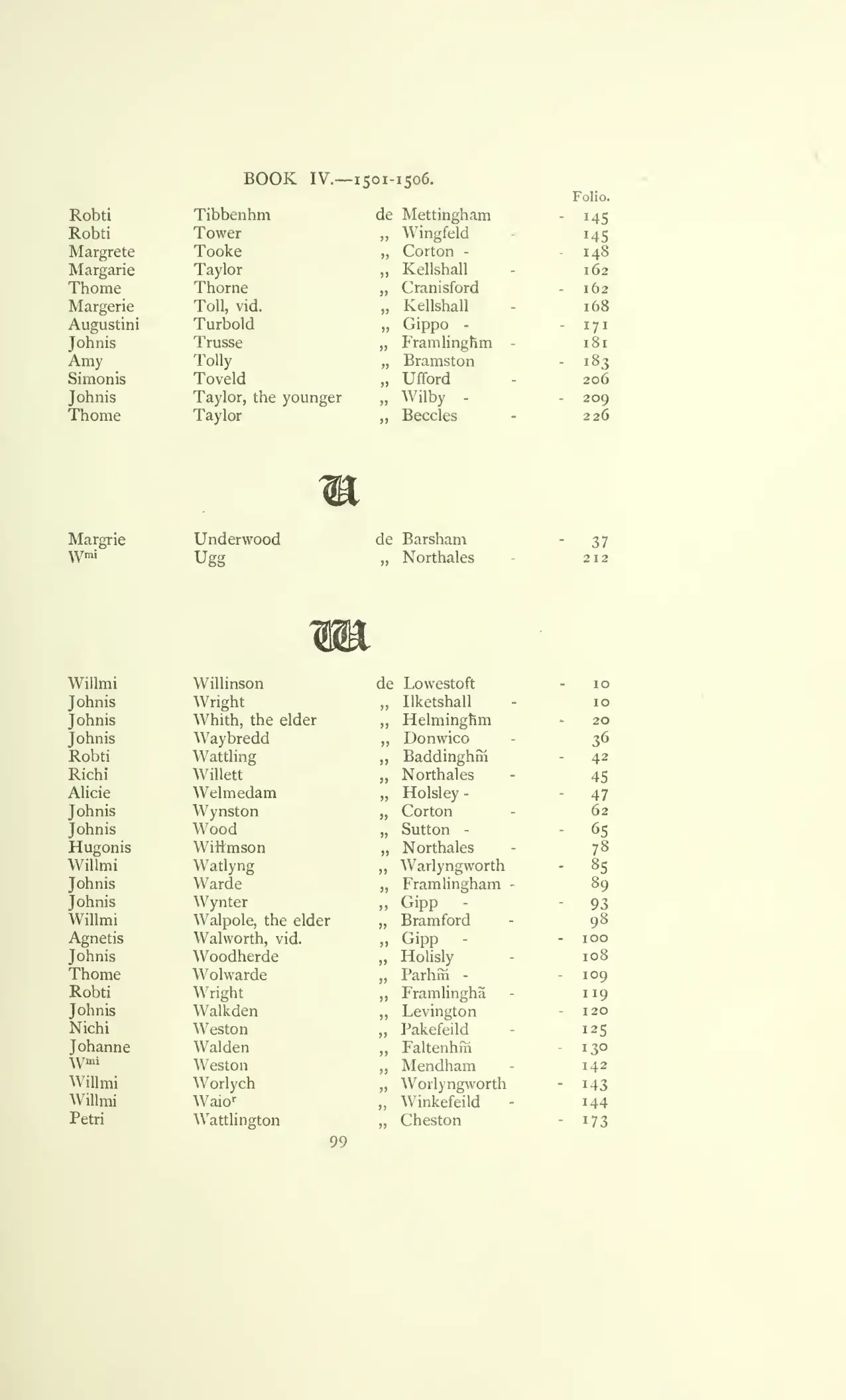
John Wythe the Elder | will calendar

John Wythe the Elder | will calendar
Crisp (1895), printed p. 99, Book IV, folio 20. Printed calendar; the register’s date span does not establish the testator’s death year.

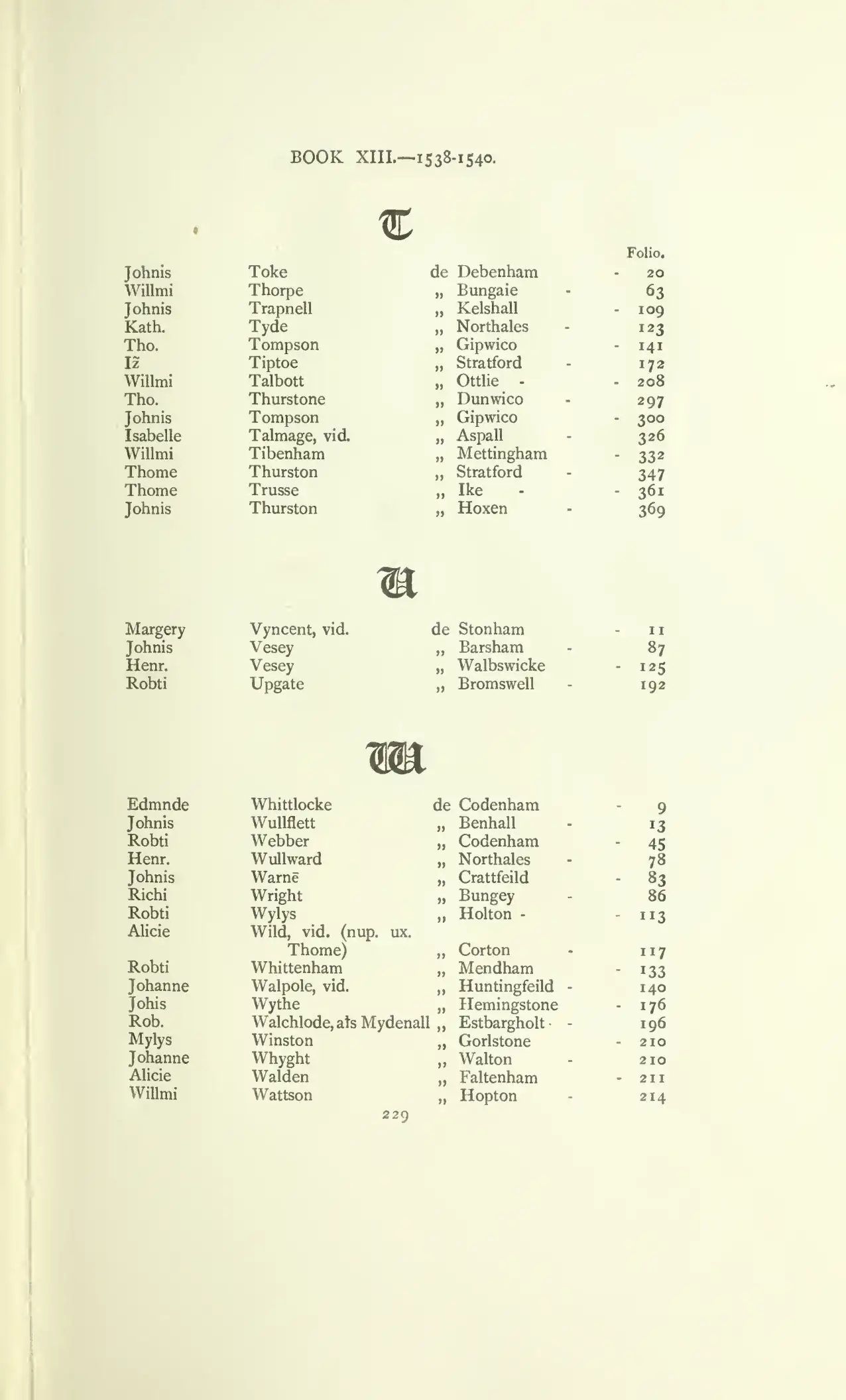
John Wythe, 1538 | will calendar

John Wythe, 1538 | will calendar
Crisp (1895), printed p. 229, Book XIII, folio 176. The index locality reads Hemingstone; the supplied will transcript reads Helmingham.

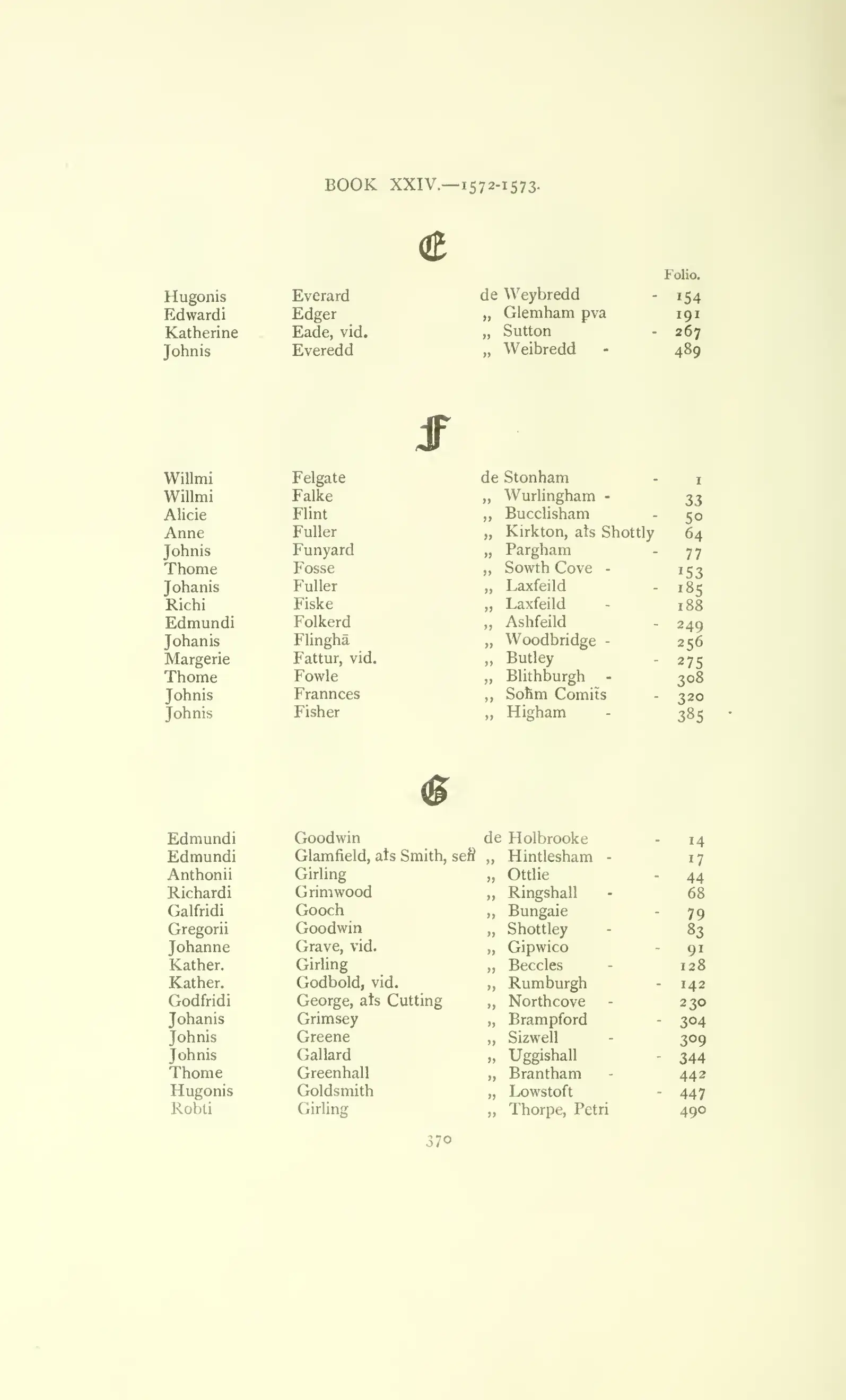
William Felgate | will calendar

William Felgate | will calendar
Crisp (1895), printed p. 370, Book XXIV, folio 1; William Felgate of Stonham Aspal. Suffolk Archives IC/AA2/24/1. Printed calendar, not the original will.